Pentair · ETi
Pentair ETi 400 High-Efficiency Heater
Pentair's condensing 400,000 BTU gas heater: the flow window it needs, the acidic condensate it makes, the display codes, and the chemistry its warranty needs.
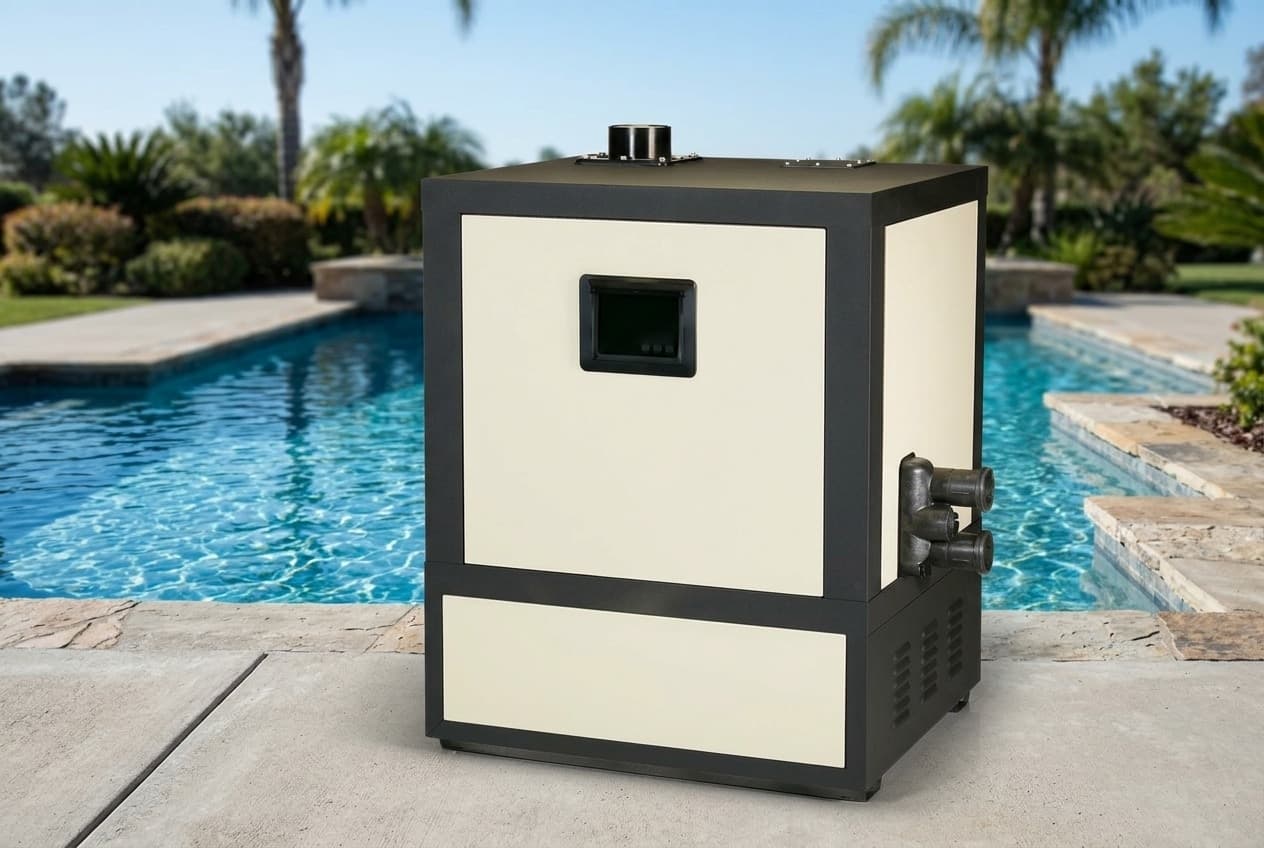
The ETi 400 is Pentair's condensing gas heater: 400,000 BTU in, a titanium heat exchanger, and a thermal efficiency Pentair puts at 96%. Pentair's item table lists one version, 461113, factory set for natural gas. There's a smaller sibling, the ETi 250, with its own manuals and parts.
Pentair's product page says its plumbing aligns to the MasterTemp's, for a drop-in replacement. The MasterTemp page covers that heater's copper and cupronickel exchangers; the ETi 400's exchanger is titanium.
It's a professional install. Pentair's manual says a technician qualified in pool heater installation must install and service it, that some areas require a licensed installer, and that improper installation voids the warranty. What follows is what an owner should know about living with one.
What condensing changes
Pentair's manual calls the ETi 400 a condensing appliance: its flue gases produce water while it runs. Most of what sets it apart from a conventional gas heater follows from that:
- It makes acidic water. Pentair's quick guide says 2 to 4 gallons an hour, at pH 3.1 to 4.2. Pentair strongly recommends its neutralizer cartridge, 475612, and warns that pH 5 or below can harm drains and pipes, particularly metal ones.
- The drain has to be right. The condensate line needs a trap, so flue gas can't leak through it, and a continuous downward slope of a quarter inch per foot.
- The vent can be plastic. It's a Category IV appliance with a 4 inch CPVC exhaust socket, and Pentair's quick guide approves Schedule 40 PVC, Schedule 80 CPVC and stainless steel vent pipe. Horizontal runs slope back toward the heater so condensate drains through the neutralizer.
- It shouldn't run in freezing weather outdoors. Pentair says not to operate it outdoors below 32°F; the condensate line and trap can freeze and shut the heater down.
Pentair's quick guide adds that the cabinet stays close to room temperature, since so little heat leaves in the exhaust.
How fast it heats
Pentair's quick guide gives the formula: hours = gallons x 8.34 x degrees of rise, divided by BTU x 0.96.
For a 20,000 gallon pool raised 10°F, that's 20,000 x 8.34 x 10 = 1,668,000, divided by 400,000 x 0.96 = 384,000, or about 4.3 hours. The formula has no allowance for heat the pool loses while it runs, so an uncovered pool on a cool night takes longer. Pool heating costs covers what that gas costs.
The flow window
Pentair's manual rates the ETi 400 at 40 to 120 GPM, with a temperature rise across the heater of 25 to 35°F.
- Above 120 GPM, install a manual bypass valve before the heater, set it to bring flow into range, then remove the handle or lock it.
- Below the minimum, the water pressure switches stop the burner and the SERVICE SYSTEM light comes on. Pentair says a two-speed pump on low sometimes can't make enough pressure; run it on high, and if that doesn't work, don't run the heater, but correct the installation.
- Don't run it while an automatic cleaner runs. Pentair says a plugged suction line can starve the heater, and not to rely on the pressure switch to catch it.
- The water goes pump, filter, heater, pool. Pentair says a heater plumbed in backward cycles on and off continuously.
- No shut-off valve after the heater, other than winterizing valves where needed. Use a diverter valve between pool and spa.
After start-up, Pentair says the outlet pipe should feel only slightly warmer than the inlet. If it's hot, or you hear boiling, flow is too low: check the filter, and if the temperature stays high, turn the heater off and call a technician. Pool heater not heating covers flow problems across makes.
Where it can go
From Pentair's manual:
- At least 5 feet from the inside of the pool or spa, unless a solid fence, wall or other permanent barrier separates them.
- Outdoors, in an open area on a level surface, away from leaves and debris, sprinklers, roof runoff and prevailing wind.
- Under an overhang, at least 3 feet between the overhang and the top of the vent, open on three sides, and never under a deck.
- At least 36 inches from an air conditioner, heat pump or another gas heater.
- At least 30 inches clear in front for service.
- In a garage or utility room, with its base at least 18 inches off the floor, and in a garage, a rail or wall to protect it from cars.
- Not near propane storage, and a propane heater never in a pit or other low spot where gas could collect.
In hurricane areas, Pentair sells a bolt-down kit, 476004, and its manual says Florida's building code requires the heater to be anchored.
Gas and power
- Gas supply: at least 4 inches of water column while running, and no more than 10.5 inches for natural gas. A manual shut-off valve, sediment trap and union go outside the cabinet; Pentair says a union inside the cabinet voids the warranty.
- Gas valve: Pentair calls it unconventional, factory set to a negative pressure. It says not to adjust the regulator, and to replace the valve only with an identical one.
- Leak testing: soapy water, never a flame. Disconnect the heater during any gas line pressure test above ½ psi, since Pentair doesn't cover over-pressurized gas valves.
- Power: 120 or 240 volts on a 15 amp circuit, drawing about 5 amps at 120 V and 2.5 at 240. It ships with the red 240 V plug fitted. Pentair warns that fitting the blue 120 V plug and connecting 240 V destroys the transformer and control board, and not to run it on 208 V.
- Bonding: a copper conductor no smaller than 8 AWG to the lug on the base. Pentair says poor bonding can also damage the heat exchanger through electrolysis.
Using the control panel
- POOL ON and SPA ON choose which thermostat runs the heater; HEATER OFF turns it off.
- The thermostats set from 65°F to 104°F. The setpoint has to be above the water temperature or the burner won't fire.
- The HEATING light stays on while the burner fires, and blinks when the heater is calling for heat but not firing.
- SERVICE SYSTEM means not enough water flow; start with the filter and skimmers.
- SERVICE HEATER means a fault in the heater; turn off the gas and call a technician.
- To see the last five fault codes, press POOL ON and the up arrow together.
- To switch between °F and °C, turn the heater off and hold an arrow for 5 seconds.
On a call for heat, the blowers start, and after about 15 seconds the burner should light. They keep running about 45 seconds after it shuts off.
What the display codes mean
- PS: a water pressure switch is open, which means not enough flow.
- AFS: an air flow switch, which checks the combustion blowers.
- HLS: the high limit switch opened, above 135°F at the exchanger outlet.
- AG1 or AG2: an automatic gas shut-off switch opened, above 150°F at the outlet. Cycle the power to reset.
- E06: a shorted stack flue sensor, or flue gas above 170°F. Cycle the power to reset.
- E05: an open stack flue sensor.
- E01: an open water temperature sensor. 126 means a shorted sensor or water above 125°F.
- FS: the condensate float switch opened, usually a blocked drain or neutralizer.
- IGN: the flame sensor. Cycle the power to reset.
- tf: a thermal fuse opened, at 187°F. It has to be replaced.
- RNC: a reminder to service the neutralizer cartridge. Clear it by turning the heater off and holding OFF for 5 seconds.
Pentair's manual says only qualified technicians with the right test equipment should troubleshoot the heater, and not to run it with the SERVICE HEATER light on, or if the blower or burner won't start.
Maintenance
Every six months, and at the start of each season, Pentair lists:
- Check the panels and vent for anything blocking air or exhaust, and in an enclosure, that the air openings are clear.
- Keep the area clear of anything combustible, flammable or corrosive.
- Test the 50 psi relief valve by lifting its lever.
- Test the water pressure switches.
Every 12 months, Pentair says to have a qualified technician inspect and clean the upper and lower heat exchangers, check the insulation, and inspect the spark electrode and flame sensor. The quick guide says the technician should vacuum out soot or deposits, with a biodegradable descaler for mineral deposits if needed. The combustion blower is permanently lubricated.
Water chemistry, and the warranty
Pentair's manual lists these ranges for the heater:
- Free chlorine: 1 to 4 ppm, ideally 2 to 3
- pH: 7.2 to 7.8, ideally 7.4 to 7.6
- Total alkalinity: 60 to 180 ppm, ideally 80 to 100
- Calcium hardness: 150 ppm minimum, ideally 200 to 400
- Salt: 2,000 to 5,000 ppm, ideally 3,200
- Cyanuric acid: less than 30 ppm
- Bromine: 2 to 10 ppm, ideally 4 to 6
The manual says failing to keep to these ranges can cause early heat exchanger failure and will void the warranty, and that exchanger damage from chemical imbalance isn't covered. It also says never put chlorine tablets in the skimmer, which floods the heater with concentrated chlorine when the pump stops.
Seasons and winter
In spring and fall, if the pool's only used now and then, Pentair suggests setting the pool thermostat to 68°F and leaving the heater on, so it can bring the pool back up within about a day. For weekend pools, it suggests lowering the thermostat 10 to 15°F during the week.
Where it freezes, Pentair's steps are:
- Turn off power to the heater and pump at the breakers.
- Close the gas valves, inside and outside the heater.
- Open the drain at the bottom of the manifold and drain the exchangers and internal plumbing.
- If the heater sits below the pool's water level, close the isolation valves first.
- Remove both water pressure switches and plug their ports.
- Drain the manifold through the outlet pipe.
- Blow out the remaining water, with a low-pressure blower only.
- Cover the air inlet grate with a plastic bag.
Never use compressed air, which Pentair says can make parts explode; its limit is a high-volume blower below 5 psi. Freeze damage isn't covered by the warranty. In spring, don't turn the heater on until water is circulating. Closing a pool for winter covers the rest of the system.
Parts and prices
Pentair's 2025-2026 catalog lists US list prices for the ETi 400's parts, and the heat exchanger is the one that matters: $7,124.52. The heater's control board is $275.19, the ignition module $366.89, the combustion blower kit $404.68, and the condensate neutralizer kit $400.25. The gas valve kit is listed as call for price.
The catalog, the 2020 manual and the older parts sheet don't number every part the same way; the parts list on this page follows the catalog.
Buying one
Pentair's product page lists no online EC- version, and Amazon had no ETi 400 listing when checked, so this page has no store link. With a professional install required for the warranty, a dealer or installer is the normal route.
Where Pentair's documents disagree
- Propane gas pressure. The manual gives a maximum of 14 inches of water column; the quick guide says 12.
- Propane pipe length. For 1¼ inch pipe, the manual's table allows 150 feet and the quick guide 220 feet. The other sizes match.
- When a flow switch is needed. One page of the manual says a heater more than 1 foot above or below the deck needs a flow switch; another says the pressure switch can be reset up to 3 feet, with a flow switch beyond that.
- The lowest thermostat setting. 65°F in the control panel section, 68°F in the winter section.
- The factory settings. The manual gives 70°F (35°C) for pool and 95°F (21°C) for spa. The Celsius figures are swapped: 70°F is 21°C and 95°F is 35°C.
- Chlorine. The manual's text says never to let chlorine fall below 0.6 ppm, with 1.4 ppm as the effective minimum; its table gives 1.0 ppm.
- Alkalinity. The text says 100 to 140 ppm; the table says 80 to 100 ideal.
- Salt. The table lists salt twice, once as 3,000 to 4,500 ppm and once as 2,000 to 5,000.
- Weight. 379 lb on the product page, a 365 lb crate weight in the catalog.
- Running in freezing weather. The manual says not to operate the heater outdoors below 32°F, and elsewhere explains how to set up the condensate line for an outdoor heater that has to operate below freezing.
- Spark electrodes and parts numbering. 476081Z in the manual and catalog, 475989 on the older parts sheet, which also swaps the thermal fuse and wire harness item numbers and calls the propane orifice kit item 46 rather than 47.
- The quick guide's energy formula divides by the gas price rather than multiplying by it, and its temperature rise of 30°F ± 5°F is printed as -1°C ± 15°C.
Which model do you have?
The model number is on the heater label. Everything else in the range is shared — these are the parts that change with it.
| Model | SKU | Gas as shipped | Propane conversion kit | Input | Thermal efficiency | Water flow | Dimensions | Weight | Note |
|---|---|---|---|---|---|---|---|---|---|
| ETi 400 | 461113 | Natural gas | 476072 | 400,000 BTU/hr | 96% | 40 to 120 GPM | 30 in. L x 34 in. W x 42 in. H | 379 lb on the product page, 365 lb crate weight in the catalog | Pentair sells one version, factory set for natural gas. Propane needs the conversion kit, 476072, fitted by a qualified technician or gas supplier. |
Pentair ETi 400 High-Efficiency Heater parts, and what goes wrong
Read off the manufacturer’s parts list and checked before it ships. Open a row for what a bad one actually does — or start from the symptom and work down, which is the cheaper order.
What is it doing?
The main drain at the bottom of the manifold adapter. For winter, Pentair's steps open it to drain the exchangers, internal plumbing and manifold, and use a blower to clear the rest. It goes back in before the heater returns to service. $8.07 US list, with a Z suffix in the catalog.
Live pricing arrives when the retailer programs are approved.
Opens if the flue gas reaches 187°F. Pentair says it can't be reset and must be replaced. The stack flue sensors, 475601Z, shut the heater down earlier, at 170°F. Pentair's catalog marks the fuse white and the sensors blue. $114.59 US list.
Live pricing arrives when the retailer programs are approved.
There are two, and they keep the burner from firing without enough flow. Pentair says the SERVICE SYSTEM light usually means the filter or skimmers need cleaning; if it stays on after that, call a technician. The switches are factory set at 3 psi for a heater at pool level. A heater more than 1 ft above or below the water needs them reset by a technician, and beyond 3 ft a flow switch has to replace them. Never bypass them. $133.13 US list.
Live pricing arrives when the retailer programs are approved.
The direct spark ignition. On a call for heat the blowers run for about 15 seconds, then the gas valve opens and the electrodes light the burner. On a first start, air in the gas line can stop it firing; Pentair says to turn the heater off, wait five minutes and try again. The manual calls for an annual inspection of the electrodes and flame sensor, 462023Z, by a qualified technician; the IGN code on the display points to the flame sensor. Pentair's older parts sheet lists the electrodes as 475989. $208.90 US list.
Live pricing arrives when the retailer programs are approved.
Factory installed. Pentair says to test it at least once a year by lifting the lever, and to run a drain pipe from it to a safe place, with no reducing couplings or valves in that pipe. Any installation with check valves, isolation valves or other restrictions downstream of the heater must have a relief valve. $224.81 US list.
Live pricing arrives when the retailer programs are approved.
The float switch shuts the heater down when condensate backs up past its permitted level, which Pentair's manual puts down to a blocked drain hose or neutralizer cartridge. The drain has to slope continuously down, a quarter inch per foot, with no spirals, and it must have a trap so flue gas can't escape through it. $367.89 US list.
Live pricing arrives when the retailer programs are approved.
The heater condenses 2 to 4 gallons of water an hour, at pH 3.1 to 4.2. Pentair strongly recommends neutralizing it, and says damage from untreated condensate isn't its responsibility. The RNC code is a reminder to service the cartridge: turn the heater off, then hold OFF for 5 seconds to clear it. Outdoors, the cartridge mounts on the heater base; indoors, on the floor beside it. For an outdoor heater that has to run below freezing, the manual says to remove the cartridge and the hose loop inside the heater, run the hose out on a downward slope, and refit them in spring. $400.25 US list.
Live pricing arrives when the retailer programs are approved.
The most expensive part in the heater, at $7,124.52 US list in Pentair's 2025-2026 catalog. Pentair's troubleshooting table blames boiling or bumping in the exchanger on low water flow, a plugged exchanger or a bypass valve stuck open. The manual says to have the upper and lower exchanger assemblies inspected and cleaned every 12 months, and its warranty section excludes exchanger damage from water chemistry. Keep chlorine tablets out of the skimmer, which Pentair says sends concentrated chlorine into the heater when the pump is off, and put any chlorinator downstream with a check valve, R172288, between it and the heater.
Live pricing arrives when the retailer programs are approved.
Pentair ETi 400 High-Efficiency Heater manuals and documentation
Hosted by the manufacturer. These open on Pentair’s own servers, so they stay current.
- ETi 400 high efficiency pool and spa heater installation and user's guide (P/N 475349 Rev. E, 2020)manual
- ETi 400 quick reference guide, with venting, gas and flow requirements (P/N 476253 Rev. A)guide
- ETi 400 heater replacement parts sheet, with the exploded diagramsdiagram
- Pentair Pool 2025-2026 product catalog, ETi 400 ordering table on page 84, replacement parts and list prices on pages 366 to 370spec
- ETi 400 and ETi 250 family brochure (P1-798)spec
- ETi 400 natural gas to propane conversion kit manualguide
- ETi 400 product page, with the item and accessory tablesspec
- Pentair pool product warranty informationguide
Pentair ETi 400 High-Efficiency Heater warranty
3 years parts, 3 years labor
Three years parts and labor, per Pentair's product page and catalog. Pentair's manual says the heater must be installed and serviced by a professional qualified in pool heater installation, and that improper installation or operation voids the warranty. The manual also excludes freeze damage, heat exchanger damage from water chemistry, damage from combustion air contaminated by chemical fumes, and gas valves damaged by over-pressure testing, and says a gas line union inside the heater cabinet voids the warranty. Pentair's warranty page gives products bought online one year, parts only; the ETi 400 has no online EC- item. O-rings and gaskets are consumables, with one year of parts and labor.
Manufacturer’s termsPentair ETi 400 High-Efficiency Heater complete parts list
Every part on the manufacturer’s exploded diagram, in their numbering. Marked rows are the ones covered above with a symptom and a diagnosis.
58 parts
| No. | Part | Description | Note |
|---|---|---|---|
| 1 | 475978 | Fan control board | |
| 2 | 475984 | Membrane pad | |
| 3 | 475985 | Automatic gas shut-off switch, 150°F | |
| 4 | 475987 | Air pressure switch | |
| 5 | 475996 | Wire harness | |
| 6 | 475998 | Thermal fuse, white what goes wrong | |
| 7 | 475601Z | Stack flue sensor, blue | Two per heater |
| 8 | 476081Z | Spark electrodes what goes wrong | Listed as 475989 on the older parts sheet |
| 9 | 475982 | Spark electrode cables | |
| 10 | 475980Z | Condensate assembly and float switch what goes wrong | |
| 11 | 475615Z | Heat exchanger and chimney gaskets | |
| 12 | 475606 | Heat exchanger screws | |
| 13 | 475979 | Plug assembly, 120/240 V | |
| 14 | 475603 | Water temperature and pressure gauge | |
| 15 | 475604 | Gas and air orifices, natural gas | |
| 16 | 475973 | Heater gasket kit | |
| 17 | 475971 | Air intake kit | |
| 18 | 475608 | Gas side panel | |
| 19 | 475609 | Water manifold panel | |
| 20 | 475610 | Control board panel | |
| 21 | 475611 | Latch assembly | |
| 22 | 475612 | Condensate neutralizer kit what goes wrong | |
| 23 | 475613 | Inlet plumbing assembly | |
| 24 | 475614 | Outlet plumbing assembly | |
| 25 | 475617 | Exhaust assembly | |
| 26 | 42001-0056S | Terminal board | |
| 27 | 32850-0099 | Fireman's switch fuse, 1.25 amps | |
| 28 | 42001-0053S | Thermistor, water sensor | |
| 29 | 42001-0060S | Water pressure switch what goes wrong | |
| 30 | 42001-0107S | Dual voltage transformer | |
| 31 | 475618 | Pressure relief valve what goes wrong | |
| 32 | 475619 | Control cover | |
| 33 | 475620 | Vent cap, exhaust | |
| 34 | 475621 | Water bypass assembly | |
| 35 | 475622 | Vent socket | |
| 36 | 475623 | TitanTough heat exchanger what goes wrong | |
| 37 | 475624Z | Burner | |
| 38 | 476000 | Combustion blower replacement kit | |
| 39 | 476001 | Gas control valve replacement kit | Replace only with an identical control, per Pentair |
| 40 | 38404-4097S | Union, 3/4 in. | |
| 41 | 42001-0063S | High limit switch | |
| 42 | U178-920P | Drain plug what goes wrong | |
| 43 | 476002 | Manifold | |
| 44 | 476003 | Manifold enclosure fasteners | |
| 45 | 476004 | Hold-down bracket kit | |
| 46 | 476072 | Propane conversion kit | The catalog's parts list calls it the propane gas orifice kit; the manual lists that as 476040 |
| 47 | 475975 | Heater control board | |
| 48 | 475976 | Ignition control module | |
| 49 | 462023Z | Flame sensor | |
| 50 | 476059 | Burner assembly | |
| 51 | 476101 | Base door, gas side | |
| 52 | 476102 | Base door, control side | |
| 53 | 476106 | Heat exchanger union adapter kit | |
| 54 | 475777Z | Top panel | |
| - | 476040 | Propane gas orifice kit | From the 2020 manual |
| - | 461103 | Inlet fitting package, heat exchanger | |
| - | 461104 | Outlet fitting package, heat exchanger | |
| - | 462054 | Accessories and documents bundle |