Most of the leaks I got called out to were not leaks.
They were evaporation, and nobody had measured it. That is not carelessness — a pool quietly losing two or three inches a week looks alarming, and there is no intuition that tells you whether that is normal. The bucket test is how you find out, it takes a day, and it costs nothing.
It is also the first thing any leak detection company will ask whether you have done, because their time is expensive and half their call-outs end with them running it for you.
Key takeaways
- Most suspected leaks are evaporation. A quarter to half an inch a day is normal in hot dry weather.
- An automatic filler makes the test useless. Shut it off before you start or you will prove nothing.
- Run it twice — once with the pump on, once with it off. The difference tells you where to look.
- A pool that drops to a certain level and then stops has a leak at exactly that level.
- Half an inch a day past evaporation on a 16 by 32 pool is about 160 gallons a day.
What you are actually measuring
The trick is that a bucket of pool water sitting in the pool is a control.
It has the same air above it, the same sun on it, the same humidity around it and the same water temperature as the pool it is floating in. So it loses water to evaporation at very close to the same rate, in inches, as the pool does.
Both surfaces drop. Only one of them can also be leaking.
That is the whole idea, and every rule below exists to protect it. Anything that makes the bucket behave differently from the pool — a different temperature, a different exposure, a top-up that reaches one and not the other — breaks the comparison rather than just adding noise.
How much loss is normal
Worth knowing before you start, because it tells you whether to bother.
A quarter to half an inch a day is ordinary in hot, dry, windy weather. Over a week that is 1.75 to 3.5 inches — and 3.5 is the top of normal, not the middle of it. Humid or cool weather is less. A heater running with no cover is more.
Those inches are more water than they sound:
| Pool | ¼ inch | ½ inch | 1 inch |
|---|---|---|---|
| 14 × 28 | 61 gal | 122 gal | 244 gal |
| 16 × 32 | 80 gal | 160 gal | 319 gal |
| 18 × 36 | 101 gal | 202 gal | 404 gal |
| 20 × 40 | 125 gal | 249 gal | 499 gal |
So a 16 by 32 pool losing half an inch a day to plain evaporation is shifting 160 gallons a day and nothing is wrong with it. That is why "it's using a lot of water" is not evidence of anything on its own.
Doing it properly
- 1
Turn off the autofill
2 minutesIf you have an automatic leveler, shut it off at the valve before anything else.
An autofill tops the pool up as it drops. The pool level holds steady while the bucket falls, and the test reads as though the pool gained water. I have watched people conclude they had no leak while the filler quietly ran a thousand gallons through the meter that week.
This is the single most common reason a real leak passes the test. Write yourself a note to open it again afterward.
- 2
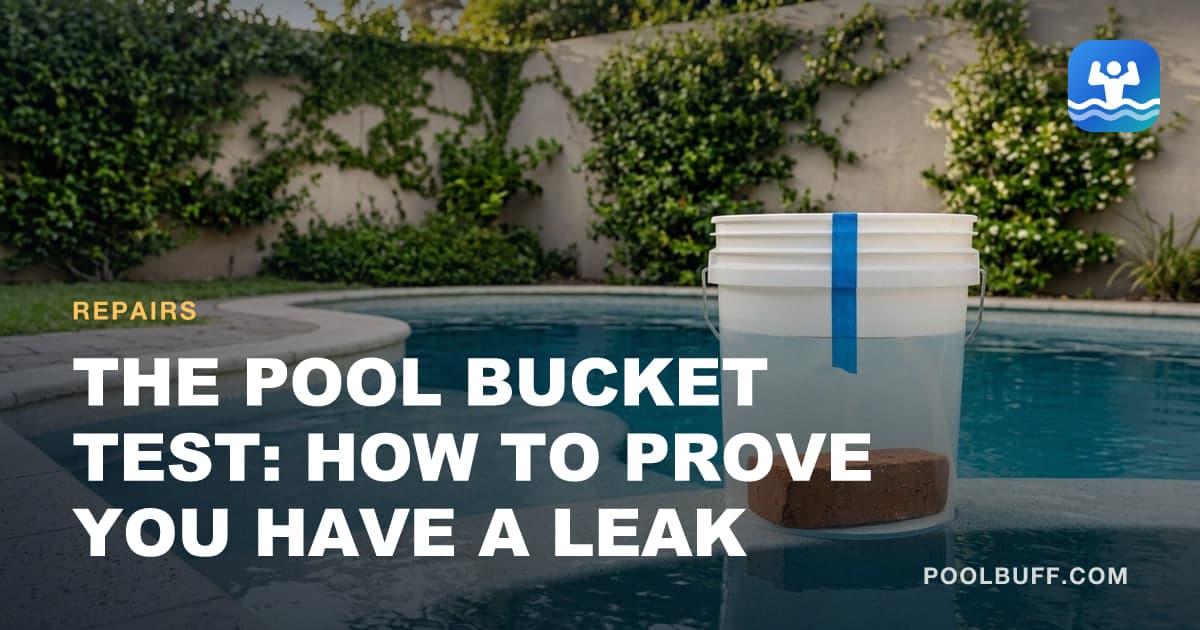
Weight the bucket, put it on a step
5 minutesA five-gallon bucket with a brick or a few stones in it so it neither floats nor tips.
Set it on a pool step, submerged to roughly two-thirds. Not on the deck, not on the coping. A bucket standing in the sun on hot concrete is a warmer, more exposed body of water than the pool, and it will evaporate faster — which makes a leaking pool look fine.
- 3
Match the two levels
2 minutesFill the bucket until the water inside it lines up with the pool water outside it. Sight across the rim; the two surfaces should read as one continuous level.
Starting them level is not strictly necessary for the arithmetic, but it makes the comparison something you can see at a glance rather than something you have to measure twice.
- 4
Mark both, separately
2 minutesWaterproof tape or a grease pencil. One mark for the water inside the bucket, one for the pool outside it.
Two marks, because you are comparing two changes. A single mark tells you the pool dropped, which you already knew.
- 5
Leave it 24 hours, pump on its normal schedule
24 hoursNormal schedule, not off, not running continuously. You want the ordinary case first.
For those 24 hours: nobody swims, nobody backwashes, nobody tops it up, and the cleaner stays out. Every one of those moves water in a way the bucket cannot see.
- 6
Read it
5 minutesMeasure from each mark down to its current level.
Same drop, within about an eighth of an inch: no leak. That is evaporation and you can stop.
Pool dropped further: the difference is your leak rate. Convert it with the table above so you know what you are dealing with.
- 7
Run it again with the pump off
24 hoursRefill, re-mark, repeat — this time with the pump off completely for the full 24 hours.
This is the run people skip, and it is the one that decides where to look.
The five things that quietly ruin it
Every one of these produces a confident wrong answer rather than an obviously broken test, which is what makes them worth listing.
The autofill. Covered above, and it is the big one.
The bucket in the wrong place. On the deck it runs warm and evaporates fast. Floating free it drifts into shade or gets knocked. On a step, two-thirds under, is the position that keeps its water at pool temperature.
Rain. Start over. Rain reaches the pool through runoff from the deck as well as directly, so the two vessels do not gain equally, and it usually arrives with wind and a temperature swing as well.
Anybody using the pool. Splash-out from swimming is real water leaving the pool and none of it leaves the bucket. So is a backwash, a filter clean or a cleaner emptying its line.
Topping up mid-test. Obvious when written down, easy to do on autopilot on day two of a hot week.
Reading the pump-on against the pump-off run
This is where the test stops proving a leak exists and starts telling you where it is.
| What you see | What it points atMy default | |
|---|---|---|
| Worse with the pump ON | Loses faster during run hours | Pressure side — return lines, heater, filter connections, anything downstream of the pump |
| Worse with the pump OFF | Loses faster overnight | Suction side, or a shell leak sitting above the running water line |
| The same either way | Steady loss regardless | Shell, liner, skimmer throat, light niche or a fitting |
| Drops to a level, then holds | Falls a few inches and stops | The leak is at exactly that level |
That last row is the most useful line on this page. A pool that drops six inches and then sits there has a leak six inches down. It has stopped losing water because the water is now below the hole. Nine times out of ten that band contains the skimmer throat, a return fitting or the tile line, and you have just narrowed a whole-pool search down to a stripe you can reach.
What to do with the answer
No leak. Put the autofill back on and stop thinking about it. If the water use still bothers you, a cover is the lever — evaporation is most of where it goes.
A leak, worse with the pump running. Pressure-side plumbing. Start at the equipment pad, because a wet patch under a heater or a weeping union is free to find and cheap to fix, and it is a surprisingly common answer.
A leak that does not care about the pump. The shell or a fitting. Dye testing is the next step, and the level-drop trick above tells you which band to test first.
A leak you cannot localize. This is the point where a leak detection company earns their fee. They have listening gear and pressure-test equipment, and the bucket test result you hand them genuinely shortens the job — which is the other reason to run it before you call.
When the test says no leak and water still disappears
It happens, and there are only a few explanations.
The autofill was on. Check again. It is almost always this.
Splash-out you are not counting. A busy pool with kids genuinely loses meaningful water over a weekend, and none of it is a fault.
Backwashing more than you think. A sand filter backwashed weekly sends a few hundred gallons to waste each time. That is a real line on the water bill that looks like a leak.
A leak above the water line that only runs when the pump does. A pressure-side pipe that weeps only under pressure will not show up in a static overnight test. That is exactly what the pump-on run is for, so if you skipped it, go back and do it.
Go deeperOnce you know there is a leakDye testing the shell, isolating the plumbing, what leak detection costs, and the fittings that fail most often.Frequently asked questions
How do you do a bucket test on a pool?
Weight a five-gallon bucket, set it on a pool step so it is about two-thirds submerged, and fill it until the water inside matches the pool outside. Mark both levels, leave it 24 hours with the pump on its normal schedule, then compare. Both drop from evaporation; only the pool drops from a leak. Turn off any autofill before you start.
How much water loss is normal for a pool?
A quarter to half an inch a day in hot, dry, windy weather, which is roughly 1.75 to 3.5 inches over a week. Less in humid or cool conditions, more with a heater running and no cover. On a 16 by 32 pool a quarter inch is about 80 gallons and half an inch about 160, so normal evaporation genuinely does move a lot of water.
What does it mean if the pool drops more than the bucket?
You have a leak, and the difference between the two marks is its rate. A half inch of extra loss per day on a 16 by 32 pool is about 160 gallons a day, or nearly 4,800 gallons a month, which is the number worth quoting when you decide whether to chase it.
Does the bucket test work with an automatic pool filler?
Not unless you shut the filler off first. An autofill tops the pool up as it drops, so the pool level holds steady while the bucket falls — which reads as the pool gaining water. It is the most common reason a real leak passes the test. Close the valve, and remember to open it again afterward.
Should the pump be on or off during a bucket test?
Both, in two separate 24-hour runs. On the first run leave the pump on its normal schedule. On the second, turn it off completely. Losing more with the pump running points at pressure-side plumbing; losing more with it off points at the suction side or the shell. Losing the same either way points at the shell, a fitting or the skimmer.
What if it rains during the bucket test?
Start again. Rain adds depth to the pool and the bucket unequally once runoff from the deck reaches the pool, and it usually comes with wind and a temperature swing on top. A single dry, still 24 hours is worth more than three days of compromised data.