Most skimmer complaints aren't broken skimmers.
They're a level two inches too high, or a basket packed with wet leaves that don't look like much. Both take thirty seconds to rule out, and doing that first will save you a lot of pointless investigating.
When it really is the skimmer, though, it's usually one of three things. Here's how to tell them apart.
Key takeaways
- Level and basket account for most of these calls. Check both before anything else.
- A suction leak pulls air in and never drips, which is why it hides so well.
- Water that falls to the bottom of the skimmer throat and stops is the classic cracked-skimmer signature.
- On a vinyl pool the faceplate gasket fails long before the skimmer body does.
- Air in the pump basket comes from before the pump, never after it.
Start with the free checks
- 1
Look at the water level
Halfway up the skimmer throat. Too high and the weir floats against the top of the opening and stops making the fast surface layer that does the skimming. This is the single most common cause and it looks like nothing is wrong.
- 2
Pull the basket
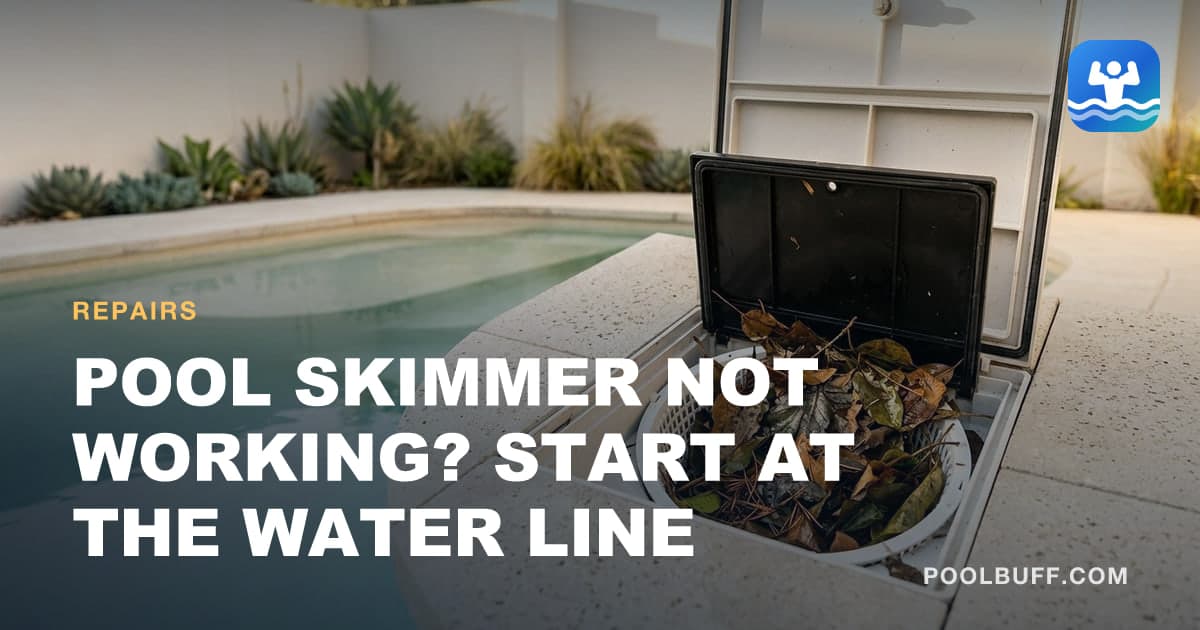
Wet leaves pack flat and restrict flow long before the basket looks full. Empty it and watch whether suction picks up immediately.
- 3
Check the weir moves
It should swing freely and float back up. A jammed weir, or a missing one, is a twenty-dollar fix that people spend weeks working around.
- 4
Check the suction valve
If you have two skimmers and a main drain on a three-way, the handle position decides how much each one gets. Somebody may have moved it.
If suction is back, you're done. If not, keep going.
Finding a suction leak
Here's the thing that makes these hard: a suction leak doesn't drip.
The pipe between your skimmer and pump is under vacuum while the pump runs. A hole there doesn't leak water out, it pulls air in. So there's no wet patch to find, no trickle on the ground, nothing to see.
What you get instead:
- Bubbles in the pump basket while it's running
- Bubbles from the return jets, especially at startup
- Weak or surging suction at the skimmer
- Pump losing prime after it shuts off
Air in the basket can only come from before the pump. That narrows it to the skimmer, the pipe to the pump, the pump lid and its O-ring, and any drain plugs.
Check the pump lid O-ring first regardless. It's the most common suction leak on any pool, it costs about ten dollars, and a dry or flattened one lets air in without any other symptom. Lubricate it with silicone, never petroleum. Jandy's variable-speed pumps are the exception: their manual says soapy water only.
Go deeperPump won't hold prime?The full diagnostic order for a pump that will not prime or will not keep it.Is the skimmer itself cracked?
There's a clean test for this, and it costs nothing.
Turn the pump off and let the pool lose water on its own. Watch where it stops.
Water finds the level of the leak. So:
- Drops to the bottom of the skimmer throat and stops there. The leak is at that height. That's the skimmer, its faceplate, or the pipe right at the back of it.
- Keeps dropping past that. The leak is lower down. Light niche, return fitting, main drain, a plumbing run. Not the skimmer.
- Doesn't drop at all beyond normal evaporation. No leak. You have a flow problem, not a leak problem.
That one observation eliminates most of the pool in an afternoon.
The three ways skimmers fail
The faceplate gasket, on a vinyl pool. The skimmer body is behind the liner, and the liner is clamped to it by a faceplate and a row of screws with a gasket between. That gasket hardens, the screws loosen, and water wicks behind the liner. This is far and away the most common skimmer leak on vinyl pools, and it's also the cheapest to fix — a gasket, a new screw set, and an afternoon.
A cracked throat, on a concrete pool. Freeze damage, ground movement, or something heavy dropped in the opening. A hairline crack in the plastic can often be repaired with a two-part epoxy rated for submerged pool use. It's a real repair, not a bodge, as long as the crack is stable and you prepare the surface properly.
Separation at the pipe or the shell. The skimmer has pulled away from the plumbing behind it, or from the shell it's set into. This is the expensive one. There's no reaching it without breaking out deck or shell, and once you're there you're replacing the skimmer anyway.
What replacement actually costs
The skimmer is cheap — often $40 to $120 for a standard residential unit.
The cost is everything around it. Getting to a skimmer generally means cutting deck or shell, doing the work, then repairing the surface you cut. That's why quotes land anywhere from several hundred dollars to a few thousand, almost entirely depending on what has to come out and what has to be made good afterward.
Which is the argument for catching a faceplate gasket early. It's a cheap job right up until the water sitting behind the liner starts washing out the sand base underneath, and then it isn't.
When it's not the skimmer at all
Worth ruling these out before you commit to anything invasive:
Pump is undersized or on too low a speed. A variable-speed pump run very slow may not pull enough through the skimmer to work the weir properly. Try a higher speed for a few minutes and see if skimming returns.
Filter is overdue. High filter pressure means less flow everywhere, including your skimmer.
Return jets pointed wrong. If the returns push surface water away from the skimmer, debris never arrives to be collected. Aim them so the surface drifts toward it.
Wind. A skimmer on the upwind side spends its life waiting for debris the wind is blowing the other way. Nothing is broken. The pool was just built that way.
Go deeperHow the whole thing is meant to workEvery part explained, and the water level that decides all of it.Cheap parts worth stocking
- Check price
silicone lubricant
Silicone, never petroleum. Petroleum swells the O-ring and ruins the seal.
Frequently asked questions
Why is my pool skimmer not sucking?
In order of likelihood: the water level is too high so the weir cannot work, the basket is full, the suction valve is biased away from that skimmer, or there is an air leak somewhere on the suction side. Work down that list before assuming anything is broken.
Why is there air in my pump basket?
Air can only enter before the pump, so the leak is on the suction side — the skimmer, the pipe between skimmer and pump, the pump lid O-ring, or a drain plug. A pressure-side leak drips water on the ground instead, because that side is pushing rather than pulling.
How do I know if my pool skimmer is cracked?
Let the pool lose water with the pump off. If it drops to the bottom of the skimmer throat and then stops, the leak is at that level, which means the skimmer or its faceplate. If it keeps going past that, the leak is lower down, somewhere else.
Can you repair a cracked pool skimmer?
Sometimes. A hairline crack in the throat can be repaired with a two-part epoxy rated for pools, and a leaking faceplate on a vinyl pool is usually just a gasket and screws. A skimmer split at the pipe connection or separated from the shell needs replacing, which means breaking out deck or shell around it.
How much does it cost to replace a pool skimmer?
The skimmer itself is generally cheap, often $40 to $120. The work around it is the real cost, because reaching one usually means cutting deck or shell and then repairing the surface. Expect several hundred to a few thousand dollars installed depending on what has to come out to get at it.