Jandy · TruClear
Jandy TruClear
Jandy's salt chlorinator — the lowest salt target of the big three, the highest temperature floor, and a replaceable electrode pack.
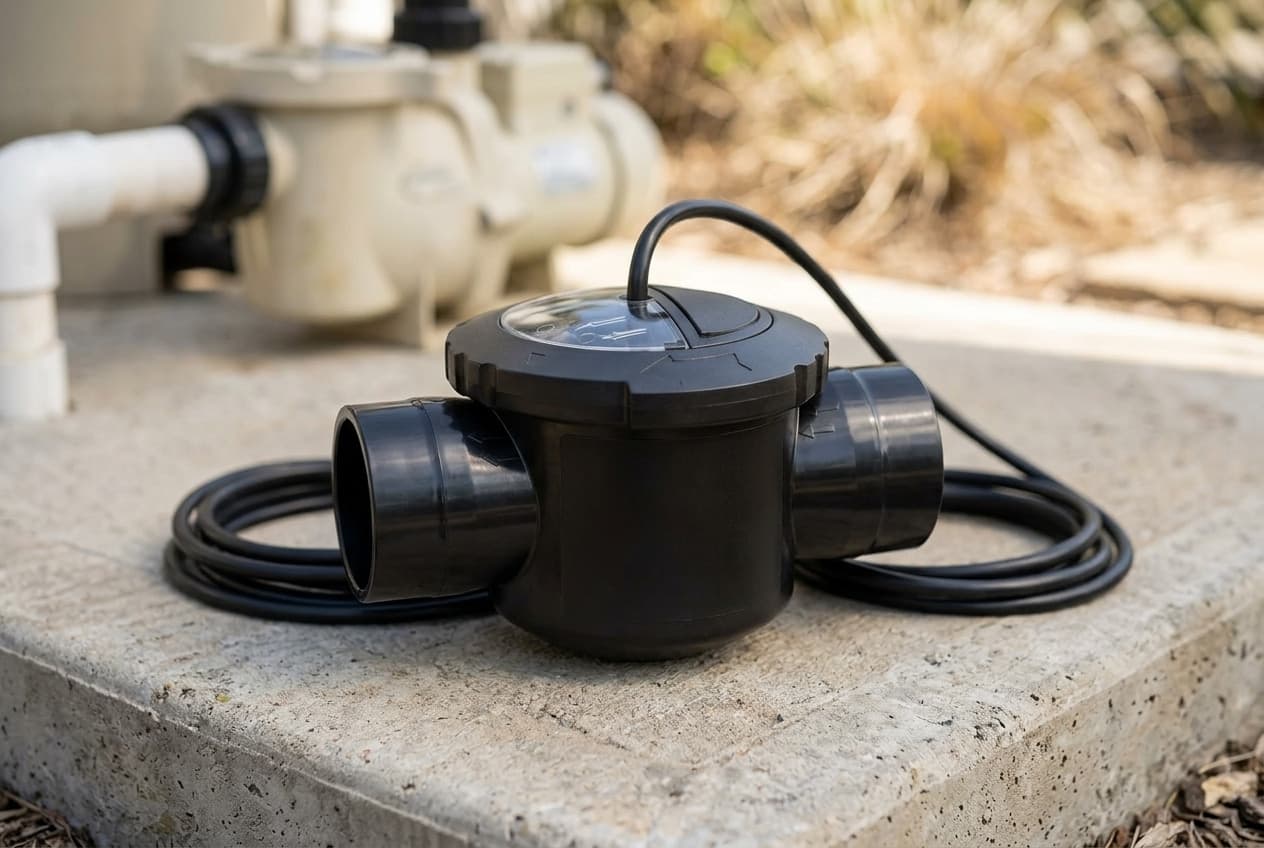
The TruClear is Jandy's compact salt chlorinator, and one unit treats up to 35,000 gallons. Jandy also sells the AquaPure, which is a bigger arrangement — a cell plus a separate power center, in two sizes, with a digital salinity readout the TruClear does not have. It is self-cleaning by polarity reversal, like the others, and it uses dual gas traps to detect flow — so it will not generate when the pump is off.
Two things separate it from the alternatives, and both are numbers.
It wants the least salt and the warmest water
With all three major brands on the site the comparison is finally worth making, and they do not agree with each other about either figure.
Salt:
- Jandy TruClear — 3,000 ppm
- Hayward TurboCell — 3,200 ppm optimal, 2,700 to 3,400 acceptable
- Pentair IntelliChlor — 3,600 ppm ideal in the English section of its manual
That is a 600 ppm spread across the three biggest names. There is no such thing as the right salt level for a salt pool; there is only the right one for your cell, and running Pentair's number in a Jandy is 600 ppm of salt you did not need to buy and cannot easily remove.
Water temperature:
- Jandy TruClear — above 60°F
- Pentair IntelliChlor — stops below 52°F, plus or minus 3
- Hayward AquaRite — stops below 50°F
Jandy's floor is a full ten degrees higher than Hayward's, and it is framed differently. Pentair and Hayward describe a cutoff the cell enforces to protect itself. Jandy lists 60°F among the conditions under which the TruClear is warranted to operate properly — alongside free chlorine, pH, stabilizer, alkalinity and hardness.
Practically, that means a longer stretch of the shoulder season where a salt pool with a TruClear needs liquid chlorine rather than the cell. The salt calculator takes whichever target you enter.
The cell and the housing are separate parts
This is the design decision worth knowing before you compare prices.
On most chlorinators the cell is one plumbed assembly: when the electrodes are worn you buy the whole thing, housing included, and cut it into the pipe. On a TruClear the cell (R0693900) and the housing (R0694000) are separate replacement parts.
So a worn cell is an electrode pack, and the housing stays where it is. A cracked housing on a healthy cell is likewise a cheap fix rather than a new chlorinator. Over the ten or fifteen years a pool owner will replace a cell two or three times, that adds up — and it is invisible on a first-purchase price comparison, which is exactly the kind of thing worth putting on a page like this.
The o-ring between them, R0694100, comes out every time and should not be reused indefinitely.
Jandy states its water chemistry as warranty conditions
Most manufacturers publish recommended ranges. Jandy publishes them as terms:
The Jandy TruClear is warranted to operate properly only if the following conditions are met — Jandy's own words, in the manual.
The list: free chlorine 1.0 to 3.0 ppm, no combined chlorine, pH 7.4 to 7.6, cyanuric acid 30 to 50 ppm for outdoor pools only, total alkalinity 80 to 120 ppm in the US and 100 to 120 in Canada, calcium hardness 200 to 400 ppm, no metals, no nitrates, no phosphates, and water above 60°F.
That pH window is narrower than most — a tenth either side of 7.5 — and salt pools drift upward in pH on their own because the cell aerates the water constantly. If you own one of these, that is the number to watch. The pH and alkalinity calculator works out the acid dose, and it will tell you what the dose does to alkalinity at the same time.
Jandy also notes what to do at startup: shock a new pool with an alternate source rather than asking the cell to do it.
The rest of the numbers
Minimum flow 20 GPM, below the 25 that Pentair's IntelliChlor Plus LT asks for. Hayward sets the bar lower still: its troubleshooting guide says the AquaRite flow switch engages at 11 GPM. So of the three, the TruClear sits in the middle for a variable-speed pump running slowly. Maximum operating pressure 50 psi. Output is 18.4 grams an hour.
Electrically it runs on 120 or 240 VAC, drawing about 4 amps at 120 or 2 at 240. The power pack is 10 by 4.5 by 13 inches and 7 pounds; the cell is 6.5 by 5.5 by 12 inches and 2 pounds.
Buy the controller and the cell together
A detail in Jandy's warranty that costs money if missed: a complete electronic salt system is warranted for three years when the controller and cell are purchased and installed together. Buy them separately and each falls back to the one-year default.
And the rule that applies to everything Jandy sells: the warranty does not apply to products purchased through the Internet or any e-commerce platform. Not a shorter term — none at all. The Jandy brand page has the full policy.
Which model do you have?
The model number is on the salt cell label. Everything else in the range is shared — these are the parts that change with it.
| Model | SKU | Cell | Housing | Power pack | Note |
|---|---|---|---|---|---|
| TruClear | TRUCLEAR11K | R0693900 | R0694000 | R0802200 | One unit treats up to 35,000 gallons. TRUCLEAR11K is Jandy's new-construction kit without unions. The power pack and the cell are separate items and separate part numbers — R0802200 is the power pack alone, not the system — and a version with unions fitted is an option rather than standard. |
Jandy TruClear parts, and what goes wrong
Read off the manufacturer’s parts list and checked before it ships. Open a row for what a bad one actually does — or start from the symptom and work down, which is the cheaper order.
What is it doing?
The electrode pack on its own. This is the unusual and useful thing about a TruClear: on most brands a worn cell means replacing the whole plumbed assembly, and here the housing stays in the pipe. Check the housing is sound before ordering the pair.
Live pricing arrives when the retailer programs are approved.
The other half of the same split. A cracked housing on a healthy cell is a cheap repair here rather than a whole new chlorinator, which is the argument for the two-piece design.
Live pricing arrives when the retailer programs are approved.
Comes out every time the cell is separated from the housing, which on a chlorinator is every clean and every inspection. Cheap, and the thing that weeps if it is reused once too often.
Live pricing arrives when the retailer programs are approved.
One part doing three jobs — it seals the housing for a pressure test, holds the plumbing during installation, and closes it over winter with the cell removed. Worth having rather than improvising, because the alternative is leaving an open housing in the pipe.
Live pricing arrives when the retailer programs are approved.
The controller, sold separately from the cell. A failing power pack looks exactly like a failing cell from the deck and is a separate bill — the board inside it is R0802300 and the transformer R0802400 if only one of those has gone.
Live pricing arrives when the retailer programs are approved.
The board inside the power pack. Worth establishing before replacing the whole pack, because the transformer and the cover are separate items too.
Live pricing arrives when the retailer programs are approved.
The seal at the union tailpiece rather than at the cell itself. Different number from the cell o-ring, and the two get confused.
Live pricing arrives when the retailer programs are approved.
If you are doing the job anyway
These get replaced together. Doing them in one pass costs a few dollars more and saves taking the same thing apart twice.
Cell replacement
The electrode pack and the o-ring that has to come out to fit it. On this chlorinator you are not buying a housing you already have, which is the whole point of the two-piece design.
- Cell, replacement — no housingR0693900
- O-ring, cellR0694100
Winterizing
The cell comes out and the cap goes in, so the housing is sealed rather than open in the pipe over winter. The o-ring is here because it is what you will be short of in spring.
- Pressurizing, installation and winterizing capR0621900
- O-ring, cellR0694100
It shows nothing at all
A dead display is the power pack side, not the cell. The board first, because it is cheaper than the whole pack and it is the part that usually goes.
- PCB, replacement assemblyR0802300
- R0802400R0802400
Jandy TruClear manuals and documentation
Hosted by the manufacturer. These open on Jandy’s own servers, so they stay current.
Jandy TruClear warranty
3 years parts
Jandy warrants a complete electronic salt system for three years when the controller and cell are purchased and installed together — buy them separately and you fall back to the one-year default. Note also that Jandy lists its water chemistry limits as conditions of the warranty rather than as advice: the TruClear is warranted to operate properly only if free chlorine, pH, stabilizer, alkalinity, hardness and water temperature are all inside the stated ranges. And Jandy's warranty does not apply at all to products bought through the Internet or any e-commerce platform.
Manufacturer’s termsJandy TruClear complete parts list
Every part on the manufacturer’s exploded diagram, in their numbering. Marked rows are the ones covered above with a symptom and a diagnosis.
| No. | Part | Description |
|---|---|---|
| A | R0802200 | Power pack what goes wrong |
| B | R0693900 | TruClear cell, replacement — no housing what goes wrong |
| — | R0694000 | TruClear housing, replacement — no cell what goes wrong |
| — | R0694100 | TruClear o-ring, replacement what goes wrong |
| — | R0449200 | O-ring, tail piece what goes wrong |
| D | R0621900 | Pressurizing, installation and winterizing cap what goes wrong |
| — | R0663800 | TruClear11P power pack cover, replacement |
| — | R0802300 | TruClear PCB, replacement assembly what goes wrong |
| — | R0609400 | TruClear cover screw set |
| — | R0802400 | TruClear transformer assembly |