Jandy · AquaPure
Jandy AquaPure
Jandy's bigger salt system: a cell plus a separate power center, and one Tri-Sensor whose failure looks like three unrelated faults.
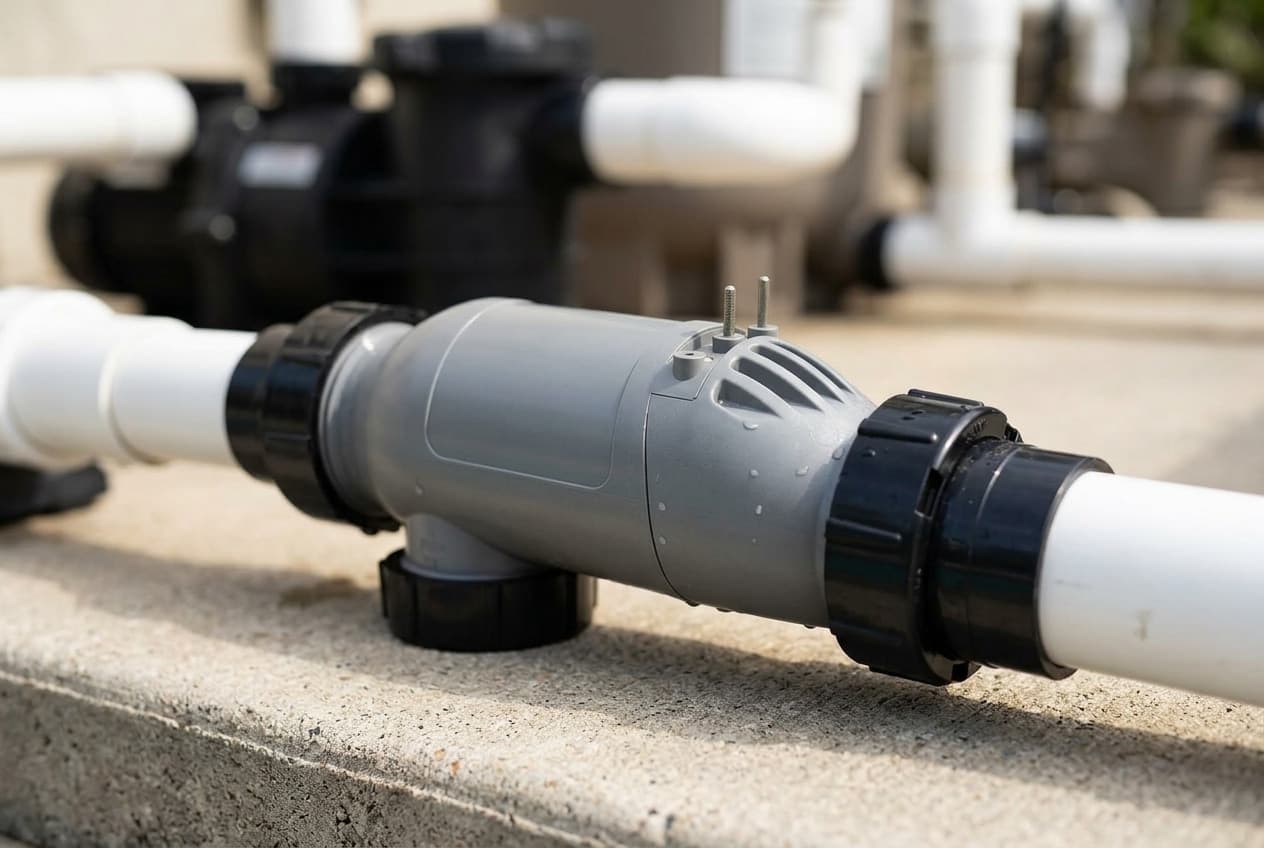
AquaPure is the other Jandy salt system, and it is a different shape of product from the TruClear. Where the TruClear is one compact self-contained unit for pools up to 35,000 gallons, AquaPure is a cell plus a separate power center — either Jandy's own AquaPure power pack or a PureLink center — in two cell sizes.
What you get for the extra hardware is instrumentation. AquaPure has a digital salinity readout in grams per liter, plus flow, temperature and status on the display, and it talks to AquaLink automation for salt readings and output control. The TruClear has none of that. If you want to know what your salt level is without a test strip, this is the Jandy that tells you.
You set the cell size by cutting a jumper
This is the thing to know before touching the board, and it has no equivalent on the other brands.
The Power Interface Board leaves the factory configured as a 1400. To run a PLC700, Jandy's instruction is to cut the JL1 jumper with cutting pliers.
Not a menu, not a dip switch — a physical cut. Two consequences follow:
A replacement board arrives as a 1400. If your cell is a seven-blade 700 and nobody re-cuts the jumper, the system drives it as though it had fourteen blades. Anyone fitting R0467600 to a 700 installation has to do this step and it is easy to miss, because the system will run.
It is not reversible in the field. A cut jumper stays cut. Going the other way means a new board.
Hayward's TurboCell has the same class of problem solved differently — its cell type is a controller setting you scroll to, with Hayward warning that the wrong one causes inaccurate salt readings and possible shutdown. Jandy's version is more permanent and less discoverable.
The blade count is the model number, which at least makes the cell itself easy to identify: seven blades is a 700, fourteen is a 1400.
Salt, and where it sits among the four
Jandy asks for 3.0 to 3.5 gpl — 3,000 to 3,500 ppm — with 3.0 as the target, which is the same floor as the TruClear and a little more headroom above it.
The shutdown behavior is where it differs from everything else on the site. Below 2.0 gpl the system turns the cell off automatically, because Jandy states that operating at low salt damages the electrolytic cell. That is a lower floor than Pentair or Hayward, which both stop at 2,600 ppm.
It cuts out at the top as well: if salinity rises above the measurable range the system shuts the cell down, because operating with high salt damages the power center rather than the cell. Two different failure modes at the two ends, which is unusual to see stated.
So across four chlorinators the targets run 3,000, 3,000, 3,200 and 3,600 ppm. There is no universal number, and the salt calculator takes whichever one your equipment asks for.
The Tri-Sensor is one part doing three jobs
Flow, temperature and salinity are all read by a single port sensor — R0452500 on a 16-foot lead, R0476400 on 25.
That matters for diagnosis. A single failed sensor can present as no flow detected, as no salinity reading, or as a salt level that is simply wrong — three complaints that look unrelated and share one cause. Before concluding the cell is finished, replace the sensor; it costs a fraction of an electrode pack.
On startup the system self-calibrates that sensor, displaying Wait while it does. Jandy says it usually takes under six minutes. A unit that appears stuck on Wait for a couple of minutes is behaving normally.
Four numbers for two cells
Ordering is the fiddly part of this product, because each cell comes two ways:
- PLC700 — R0452300 with universal unions, R0475300 with 2 inch threaded PVC unions
- PLC1400 — R0452400 with universal unions, R0475400 with 2 inch threaded PVC unions
All four are 3-port cells. What differs is the unions that join them to the plumbing, so the question is not only which cell but which unions are already on your pipe. Look at what is there before ordering.
The cable and the sensor also come in two lengths each, 16 and 25 feet, and they have to suit the run between the power center and the cell.
The warranty trap specific to a two-piece system
Jandy warrants a complete electronic salt system for three years when the controller and cell are purchased and installed together. Otherwise the one-year default applies.
On a self-contained chlorinator that is hard to get wrong. On AquaPure it is easy: the cell and the power center are genuinely separate purchases, and a replacement cell fitted to a power center bought six years ago is not a complete system. That is a reasonable position on Jandy's part and an expensive surprise if nobody mentions it.
The other rule applies here as everywhere: Jandy's warranty does not apply to anything bought through the Internet or an e-commerce platform. Not a reduced term. The brand page has the whole policy.
Which model do you have?
The model number is on the salt cell label. Everything else in the range is shared — these are the parts that change with it.
| Model | Cell blades | Cell, universal unions | Cell, 2 in. PVC unions | Note |
|---|---|---|---|---|
| AquaPure PLC700 | Seven blades | R0452300 | R0475300 | The seven-blade cell, rated to about 12,000 gallons. The board does not ship set to this — it leaves the factory as a 1400 and has to be reconfigured, which is not a menu item. See below. |
| AquaPure PLC1400 | Fourteen blades | R0452400 | R0475400 | The fourteen-blade cell, rated to about 40,000 gallons, and the factory default configuration of the power interface board. The blade count is the model number: seven for the 700, fourteen for the 1400. Jandy's manual lists the PLC cell kits with the cell on universal 2 to 2½ in. unions, a sensor with 16 ft of cable, a 16 ft DC cord and a strain relief. |
Jandy AquaPure parts, and what goes wrong
Read off the manufacturer’s parts list and checked before it ships. Open a row for what a bad one actually does — or start from the symptom and work down, which is the cheaper order.
What is it doing?
The PLC1400's 14-blade cell with universal unions, which is the version in the PLC1400 cell kit. The seven-blade PLC700 is R0452300. With 2 in. threaded PVC unions instead, the same two cells are R0475400 and R0475300. All four are 3-port cells, so the difference is the unions: check which ones are in your plumbing before ordering.
Live pricing arrives when the retailer programs are approved.
The Tri-Sensor. One part reads flow, temperature and salinity, which means a single failure can present as any of those three — a system that says no flow, one that will not show a salt level, and one that reads salt wrongly are all candidates for this. R0476400 is the 25-foot version.
Live pricing arrives when the retailer programs are approved.
The board that drives the cell, and the one carrying the JL1 jumper that sets the model. A replacement arrives configured as a 1400 — if your cell is a 700, the jumper has to be cut again or the system will drive a seven-blade cell as though it had fourteen.
Live pricing arrives when the retailer programs are approved.
The display and keypad side, separate from the power interface board behind it. A dead screen on a system that is still generating is this rather than the driver board.
Live pricing arrives when the retailer programs are approved.
The seals and terminal hardware in the cell body. They come out whenever the cell does, which on a chlorinator is every inspection, so they belong in a cell order rather than being reused.
Live pricing arrives when the retailer programs are approved.
The unions on the universal-union cells, R0452300 and R0452400. The 2 in. PVC union cells, R0475300 and R0475400, take their own nut, tailpiece and o-ring, which is the other reason to establish which unions you have before ordering anything.
Live pricing arrives when the retailer programs are approved.
Runs from the power center to the cell. R0476300 is the 25-foot version, and the cable length has to suit the distance between the pad and the plumbing — a cell fitted far from the power center needs the longer one and the longer sensor to match.
Live pricing arrives when the retailer programs are approved.
The internal harness in a PureLink power center. Worth checking before condemning a board, because the symptom is identical and the part is far cheaper.
Live pricing arrives when the retailer programs are approved.
If you are doing the job anyway
These get replaced together. Doing them in one pass costs a few dollars more and saves taking the same thing apart twice.
Cell replacement, PLC1400
The electrode pack and the seals that come out with it. Confirm the board is still configured as a 1400 while you are in there — a power interface board replaced at some point in the past may have been left on the wrong setting.
- Cell, 14-blade, universal unionsR0452400
- O-rings and terminalR0452200
It reports no flow
The Tri-Sensor reads flow, temperature and salinity together, so one failure looks like three different faults. Replace the sensor before assuming the cell is dead — it costs a fraction of one.
- Port sensor, 16 ft, with o-ringR0452500
- O-rings and terminalR0452200
Nothing on the display
The user interface board first, because it is the cheaper of the two and the one that fails while the system is otherwise still working. The harness is here because a power problem presents the same way.
- User interface boardR0467400
- Wiring harness, PureLinkR0447500
Jandy AquaPure manuals and documentation
Hosted by the manufacturer. These open on Jandy’s own servers, so they stay current.
Jandy AquaPure warranty
3 years parts
Jandy warrants a complete electronic salt system for three years when the controller and cell are purchased and installed together. On this product that is easier to get wrong than on a self-contained chlorinator, because the cell kit and the power center are genuinely separate purchases and can be bought years apart — a replacement cell on an old power center is not a complete system and falls back to one year. And the rule that covers everything Jandy sells: no warranty at all on anything bought through the Internet or an e-commerce platform.
Manufacturer’s termsJandy AquaPure complete parts list
Every part on the manufacturer’s exploded diagram, in their numbering. Marked rows are the ones covered above with a symptom and a diagnosis.
25 parts
| No. | Part | Description | Note |
|---|---|---|---|
| 1 | R0467400 | User interface board what goes wrong | |
| 2 | R0467700 | Bezel cover plate, PureLink | |
| 3 | R0447300 | Battery door, PureLink power center | |
| 4 | R0467800 | Screws, user interface, PureLink — 4 off | |
| 5 | R0447500 | Wiring harness, PureLink back what goes wrong | |
| 6 | R0467600 | Power interface board assembly — carries the JL1 model jumper what goes wrong | |
| 7 | R0503400 | Face plate, control center, APURE-F | |
| 8 | R0503300 | Battery door, control center, APURE-F | |
| 1 | R0452100 | Universal union and tailpiece what goes wrong | |
| 2 | R0452200 | O-rings and terminal what goes wrong | |
| 3 | R0452300 | 7-blade 3-port cell, universal unions — PLC700 | |
| 3 | R0452400 | 14-blade 3-port cell, universal unions — PLC1400 what goes wrong | |
| 6 | SP3P | 3-port spool cleaning kit, universal unions | Spool, four o-rings, three universal union nuts, two 2 in. by 2½ in. tailpieces and two port plugs |
| 4 | R0452500 | Port sensor, 16 ft, with o-ring what goes wrong | |
| 5 | R0476400 | Port sensor, 25 ft, with o-ring | |
| 7 | R0402800 | DC cable, 16 ft what goes wrong | |
| 8 | R0476300 | DC cable, 25 ft | |
| 1 | R0475300 | 3-port cell, 2 in. threaded PVC unions — APURE700 | |
| 1 | R0475400 | 3-port cell, 2 in. threaded PVC unions — APURE1400 | |
| 6 | R0412500 | Nut, 2 in. PVC union | 2 in. PVC union cells |
| 7 | R0412600 | Tailpiece, 2 in. PVC | 2 in. PVC union cells |
| 8 | R0412700 | O-ring, 2 in. union | 2 in. PVC union cells |
| 9 | R0403800 | Flow sensor with 16 ft cable | Tee sensor location only |
| 10 | SP3PLX | 3-port spool cleaning kit, 2 in. PVC unions | Spool, three union o-rings, two plug/sensor o-rings, two union nuts, a universal nut, two tailpieces and a port plug |
| — | R0474300 | Connector J15, external ORP controller |
Buy the salt cell
One retailer for now. More get added here as their programs are approved, and this becomes a comparison rather than a link.