Pentair · Boost-Rite
Pentair Boost-Rite
Pentair's other booster pump: five impeller stages against the LA01N's one, and the salt limit no rival publishes.
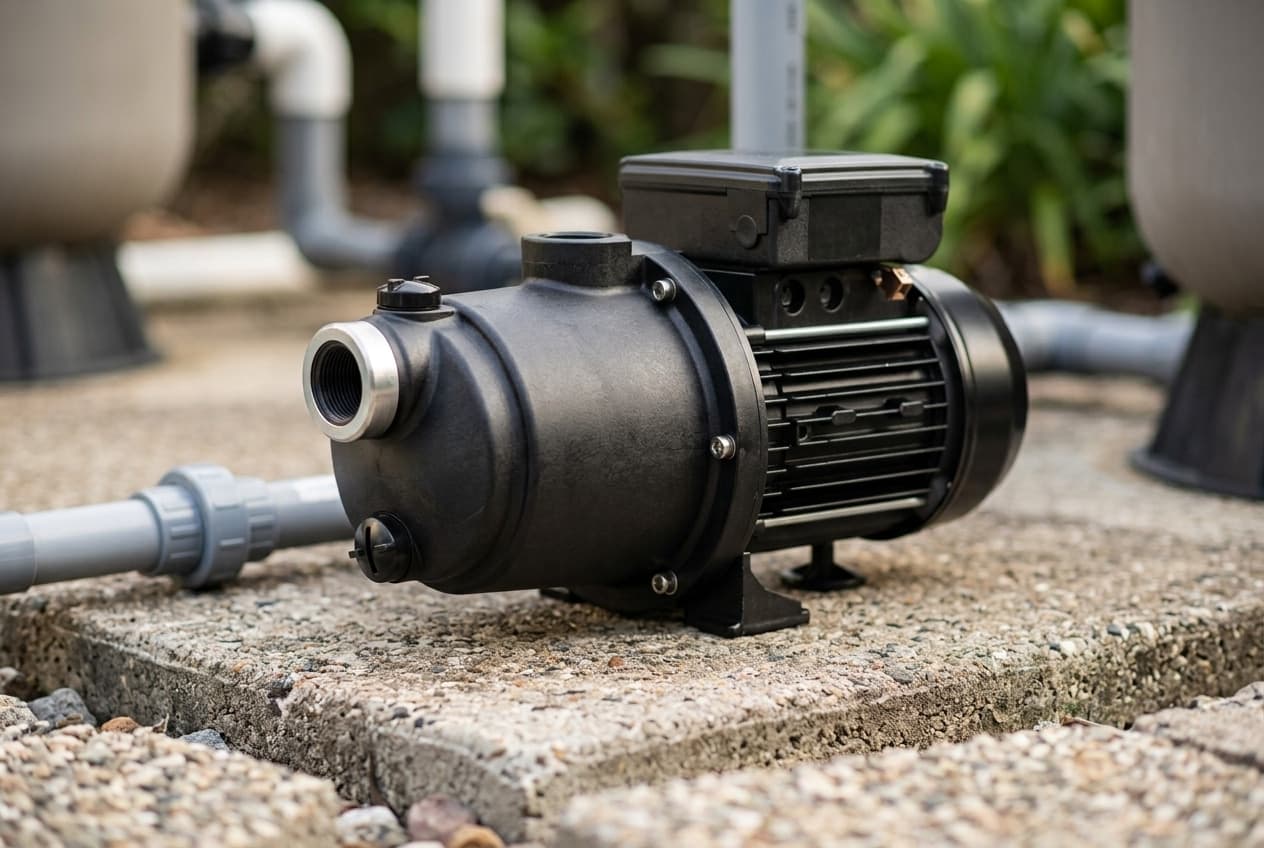
Pentair sells two booster pumps and they are not badge variants of each other. The LA01N is a single-impeller pump with ¾ inch ports. The Boost-Rite is a five-stage pump with 1 inch ports and a totally enclosed motor, and the difference shows up in the numbers.
What five stages buys
Put the two specification sheets side by side and the comparison is unusually clean, because the power is almost identical:
- LA01N — 1.13 total horsepower, 50 psi at 12 GPM
- Boost-Rite — 1.1 horsepower, 50 psi at 13.2 GPM
Same pressure, ten percent more flow, from fractionally less motor. That is what staging does: each stage adds pressure rather than flow, so a multistage pump reaches the pressure a cleaner needs without working the motor as hard to get there.
Pentair's own claim is that the Boost-Rite cuts pressure-side cleaning costs by over 25 percent against other booster pumps. Treat the headline as marketing and the flow figures as the evidence — a pump making more water at the same pressure from the same power is genuinely doing more with less, and the size of the saving depends entirely on how many hours a day your cleaner runs.
The parts list is kits, not parts
This is the trade, and it is worth knowing before you own one.
The LA01N's parts list is components: an impeller is LA05L, a volute is LA39534, a drain plug is LA385. You buy the thing that broke.
The Boost-Rite's parts list is thirteen ZBR kits: a pump body kit, a hydraulic kit, a mechanical seal kit, an o-ring kit, a seal plate kit, a capacitor kit, a complete motor assembly, a base kit, a fan kit.
There is no single impeller to buy. The five stages are the hydraulic kit, ZBR39330, and that is the granularity available. On a pump that ran dry and cooked its impellers, the LA01N owner buys an impeller and the Boost-Rite owner buys the stack.
That is not unreasonable — a five-stage assembly is not something you rebuild one wheel at a time — but it changes the arithmetic on an older pump. The cheapest hydraulic repair here is more expensive than the equivalent on the simpler pump.
The salt limit nobody else publishes
The specification most worth knowing if your pool is salt, and neither the LA01N nor the PB4-60 states an equivalent:
Maximum salt content in water: 0.4 percent.
That is 4,000 ppm. Salt pools run between about 2,700 and 3,600 ppm depending on whose cell you have — Hayward wants 3,200, Pentair 3,600, Jandy 3,000 — so the headroom is somewhere between 400 and 1,300 ppm.
Which is fine, until it is not. Salt only leaves a pool with water, so a pool that gets topped up and dosed without testing can drift upward, and 4,000 ppm is not far above where a Pentair cell owner is aiming. If you run salt and a Boost-Rite, the salt level is now a piece of equipment protection as well as a chlorination setting.
The rest of the water specification: pH 4 to 9, and maximum water temperature 104°F.
Which is why it must not go on the heater
Two rules from the installation guide that follow directly from that 104°F limit, and they are more specific than anything in the LA01N's manual.
Do not connect the booster pump directly to the heater. Pentair's reasoning is plain: heated water can damage the booster pump if the heater malfunctions. The tee goes in after the filter, feeding the booster and the heater in parallel rather than in series.
Install the booster at least 3 feet from the heater, to keep it out of the heater's ambient heat. The pump's own maximum ambient is 122°F, and the air beside a running gas heater gets there.
With solar, the rule matches the one on the LA01N: the in-line tee goes on the return line between the filter and the solar panels, not after them.
Dual voltage, and it ships wired for 230
The Boost-Rite runs on either supply and Pentair ships it wired for the higher one:
- 230 V — 5.1 amps, and no change needed to the factory wiring
- 115 V — 10.2 amps, and the wiring compartment has to be changed over
Twice the current at half the voltage, which is arithmetic rather than a penalty, and at 10.2 amps a 115 V installation sits comfortably inside an ordinary circuit. That is a softer version of the trade the VS FloPro makes, where the larger models need a 30 amp breaker to run on 115.
The manual's warning is worth repeating exactly as it is written: never wire a 230 volt motor to a 115 volt line.
One inch of port, and the bushings that undo it
Pentair makes a point of the port size — 1 inch fittings, 75 percent larger in area than the ¾ inch fittings on a typical booster — and the claim is roughly right on nominal diameters.
Then the hose kit in the box, 353040, contains six feet of hose, four adapters and two ¾ inch to 1 inch reducer bushings.
So the larger ports are real, and most installations will neck straight back down at the pump, because the cleaner's hose and the existing plumbing are ¾ inch. The benefit is in the pump's own passages rather than in the run of pipe leaving it, which is worth understanding before paying for it.
Why a single-speed booster is still legal
The brochure carries a line that confuses people, and the qualifier at the end of it is the whole answer:
Pumps and replacement motors that are single speed and one total horsepower or greater cannot be sold, offered for sale, or installed in a residential pool for filtration use in California, Title 20 CCR sections 1601-1609.
The Boost-Rite is 1.1 horsepower and single speed. It is also not a filtration pump, and the rule is written around filtration use.
That is the same distinction that lets every booster in the pressure-side cleaner range stay single speed while filter pumps went variable. A booster runs two hours a day driving a cleaner, not eight hours a day turning the pool over, and the regulations treat the two differently.
It also means the running cost of a pressure-side cleaner is a fixed kilowatt whenever it runs, and no version of this pump will change that. What a booster costs to run is the number to check before choosing a cleaner type at all.
Which model do you have?
The model number is on the pump label. Everything else in the range is shared — these are the parts that change with it.
| Model | HP | SKU | Hose kit | Hydraulic kit | Motor | Note |
|---|---|---|---|---|---|---|
| Boost-Rite booster pump | 1.1 | LA-MS05 | 353040 | ZBR39330 | ZBR39360 | 1.1 HP, dual voltage, factory wired for 230 V and convertible to 115 V in the wiring compartment. Ships with the 353040 hose adapter kit — six feet of hose, four adapters and two reducer bushings to take the 1 in. ports back down to ¾. |
Pentair Boost-Rite parts, and what goes wrong
Read off the manufacturer’s parts list and checked before it ships. Open a row for what a bad one actually does — or start from the symptom and work down, which is the cheaper order.
What is it doing?
The five-stage impeller stack, sold as one item. This is the structural difference from the LA01N, where a worn impeller is a single part, LA05L. Here there is no single impeller to buy — the stages come as a kit, so the cheapest hydraulic repair on this pump is more expensive than the equivalent on the other one.
Live pricing arrives when the retailer programs are approved.
The part that dies when a booster runs without water, which on a pump that is not self-priming means whenever the filter pump is not running. Sold as a kit rather than a bare seal.
Live pricing arrives when the retailer programs are approved.
Two plugs and two o-rings together, which is the right way to buy them — Pentair names freeze damage as an exclusion, and these are what prevent it. Pull them in the fall and the pump cannot hold water to freeze.
Live pricing arrives when the retailer programs are approved.
The housing, supplied with its drain plugs. A cracked body on a booster is nearly always freeze damage, which is the failure the plugs exist to prevent and the one the warranty explicitly excludes.
Live pricing arrives when the retailer programs are approved.
Carries the mechanical seal between the wet end and the motor. It comes apart with the seal, so the two belong in the same order rather than the same season.
Live pricing arrives when the retailer programs are approved.
Every o-ring in the pump as one item. On a pump whose parts list is kits rather than components, this is the cheapest one, and it is the sensible thing to have on the shelf before opening anything.
Live pricing arrives when the retailer programs are approved.
A motor that hums without turning is a capacitor far more often than it is a motor. The capacitor box itself is a separate item, ZBR39350, if the enclosure is damaged rather than the component inside it.
Live pricing arrives when the retailer programs are approved.
The whole motor. Worth establishing that the capacitor is good before ordering this, because the two present identically from the pad and the price difference is large.
Live pricing arrives when the retailer programs are approved.
This is a totally enclosed fan-cooled motor, so the fan is not optional cooling — it is the cooling. A broken fan on a TEFC motor is a slow route to a new motor.
Live pricing arrives when the retailer programs are approved.
Six feet of hose, four adapters and two ¾ inch to 1 inch reducer bushings. The reducers are the interesting part — the pump has 1 inch ports and the cleaner still wants ¾, so the bushings are how the larger ports meet the plumbing that already exists.
Live pricing arrives when the retailer programs are approved.
The foot the pump bolts to. Worth checking when a booster has become louder, because a cracked or unbolted base turns normal running vibration into a noise complaint.
Live pricing arrives when the retailer programs are approved.
If you are doing the job anyway
Everything on this pump is a kit, so the usual advice to buy the small part first does not apply the way it does on a single-stage booster. The o-ring kit is the exception and the one worth stocking.
It ran dry
The seal and the seal plate come apart together, and on a five-stage pump the hydraulic kit is what took the heat. Check the stack before deciding the seal was the whole failure.
- Mechanical seal kitZBR43920
- Seal plate kitZBR12210
- Hydraulic kitZBR39330
It hums but will not turn
The capacitor first, every time. It is a fraction of the motor and it is the more common failure by a wide margin.
- Capacitor kitZBR39340
- ZBR39350ZBR39350
Winterizing
Two plugs and two o-rings in one item, because freeze damage is a named warranty exclusion and this is the thing that prevents it.
- Drain plugs with o-ring kit, two of eachZBR12160
- O-ring kitZBR12200
Pentair Boost-Rite manuals and documentation
Hosted by the manufacturer. These open on Pentair’s own servers, so they stay current.
Pentair Boost-Rite warranty
1 year parts
One year — Pentair's warranty page puts single-speed pumps and booster pumps at that term, the shortest in its pump range. Pentair's published warranty terms apply, and the exclusions in this manual are the ones that decide whether a claim succeeds on a booster pump. Freeze damage is not covered, and neither is damage from moisture reaching the motor — both are named directly. The operating conditions matter as much: the pump is not self-priming and must not run unless the filter pump is running, the water must stay under 104°F, and salt must stay under 0.4 percent. Those are specifications rather than suggestions, and a booster that failed outside them failed for a reason a warranty assessor can read off the pad.
Manufacturer’s termsPentair Boost-Rite complete parts list
Every part on the manufacturer’s exploded diagram, in their numbering. Marked rows are the ones covered above with a symptom and a diagnosis.
| No. | Part | Description |
|---|---|---|
| A | ZBR39320 | Pump body kit with drain plugs what goes wrong |
| B | ZBR12160 | Drain plugs with o-ring kit — 2 plugs and 2 o-rings what goes wrong |
| C | ZBR12170 | Body pump fasteners kit |
| D | ZBR39330 | Hydraulic kit — the five-stage impeller assembly what goes wrong |
| E | ZBR43920 | Mechanical seal kit what goes wrong |
| F | ZBR12200 | O-ring kit what goes wrong |
| G | ZBR12210 | Seal plate kit what goes wrong |
| H | ZBR39340 | Capacitor kit what goes wrong |
| L | ZBR39360 | Complete motor assembly what goes wrong |
| M | ZBR12270 | End shaft fasteners kit |
| N | ZBR39350 | Capacitor box complete kit |
| O | ZBR26910 | Base kit what goes wrong |
| P | ZBR43810 | Fan kit what goes wrong |
| Q | 353040 | Hose kit — 6 ft hose, 4 adapters, 2 reducer bushings what goes wrong |