Jandy · VS FloPro
Jandy VS FloPro
The variable-speed pump that runs on 115 volts as well as 230: which sizes keep their full performance there, and what Jandy's own wire table says it costs.
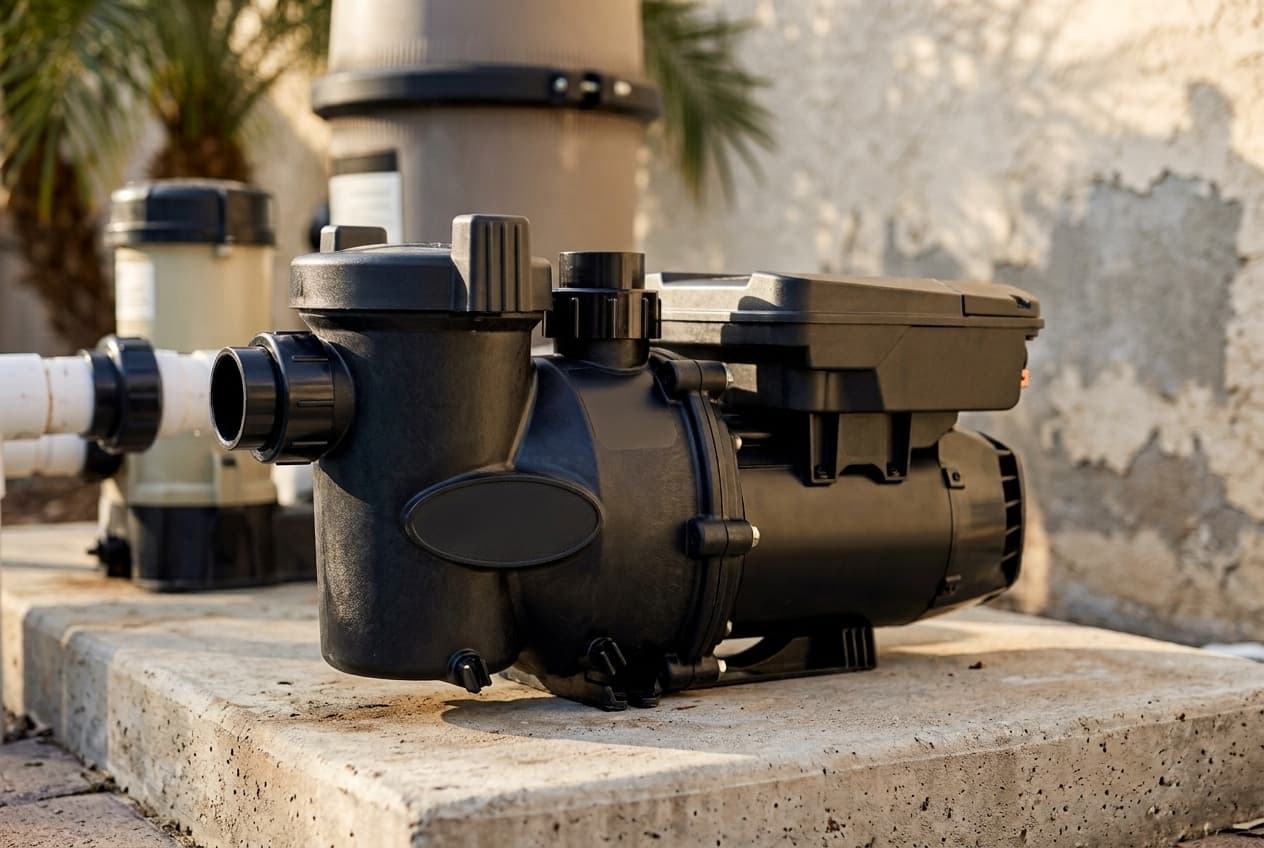
The VS FloPro is Jandy's variable-speed pump, and its selling point is voltage: it runs on 115 volts as well as 230, and the 1.3 and 1.65 HP give up nothing on the lower one.
That matters because the usual obstacle to a variable-speed retrofit is not the pump. It is that the pad has a 115-volt circuit and the new pump wants 230, so the quote arrives with an electrician attached.
Running on 115 volts is common. The TriStar VS and the SuperFlo both do it. Keeping full performance there is rarer. Most of the pumps ENERGY STAR lists separately at each voltage lose hydraulic horsepower on 115, a few of them more than half. The 1.85 HP is one of them, and there is a section on it below.
Jandy says rewiring the pad is "a thing of the past." The manual is more specific, and worth reading before you count on it.
What 115 volts actually costs
Same watts, different amps. Jandy's own specification table:
- 1.3 HP — 1100 W. 8.6 A at 230 V, 15.6 A at 115 V
- 1.65 HP — 1700 W. 10.5 A at 230 V, 17.7 A at 115 V
- 1.85 HP — 1875 W. 13.5 A at 230 V, 17.4 A at 115 V
Halve the voltage and you nearly double the current, which is arithmetic rather than a flaw. But the consequence is in a different table in the same manual, and it is the number that decides whether this is a drop-in:
Minimum breaker size, Jandy's figures:
- 1.3 HP — 15 A at 230 V, 20 A at 115 V
- 1.65 HP — 20 A at 230 V, 30 A at 115 V
- 1.85 HP — 20 A at 230 V, 30 A at 115 V
And the wire, at 0 to 50 feet from the sub-panel: the 1.65 and 1.85 want 12 AWG at 230 V against 10 AWG at 115 V, and the 1.3 wants 14 against 12. Push that to 50–100 feet on 115 volts and the 1.65 and 1.85 want 8 AWG.
So the honest version of the claim: the 1.3 HP is a genuine no-rewiring swap onto an ordinary 20-amp pump circuit. On the 1.65 and 1.85, running at 115 volts needs a 30-amp breaker in 10-gauge wire, which a typical existing pump circuit is not — and if you are pulling new 10-gauge anyway, running 230 to it costs the same trench and gives you a pump drawing half the current.
The feature is real. For a pad where 230 volts is impractical, the 1.3 or the 1.65 on 115 volts is the same pump it would be on 230. That is a reason to choose one over a Hayward TriStar VS, which gives up much of its power on 115: ENERGY STAR lists the larger size at 2.7 total horsepower on 230 volts and 1.5 on 115. Just size the circuit from the manual rather than from the marketing.
The 1.85 is a smaller pump on 115 volts
Jandy's spec sheet promises "identical hydraulic performance" at both voltages for the 1.3 and the 1.65. For the 1.85, the same line says only "Auto-sensing 115V/230V operation."
The manual's charts show why. The 1.3 and 1.65 each get one set of curves, labeled for both voltages. The 1.85's chart adds a dashed line marked 115 VAC. It leaves the full-speed curve at about 55 GPM and runs below it from there, though never as low as the 3,000 RPM curve.
ENERGY STAR lists each voltage separately, and its figures agree. Hydraulic horsepower is the pump's output at full speed on the federal test's standard plumbing curve:
- 1.3 HP: 0.703 on both
- 1.65 HP: 1.072 on 230 V, 1.068 on 115 V
- 1.85 HP: 1.172 on 230 V, 0.969 on 115 V, about 17% less
So the loss is at the top end. Anything you would run at 3,000 RPM or less is untouched, and filtering runs far below that. What comes up short is full speed at high flow, the setting you would use for spa jets or a water feature.
It also turns the range upside down. On 115 volts, ENERGY STAR lists the 1.85 below the 1.65: 0.969 hydraulic horsepower against 1.068, and WEF 8.6 against 9.1, on the same 30-amp breaker. If your pad is 115 volts and staying that way, the 1.65 is the better pump.
Efficiency holds up on the other two. WEF is 10.9 against 11.0 on the 1.3, and 9.1 against 9.0 on the 1.65. The 1.85 scores higher on 115 volts, 8.6 against 8.2, but not because it got more efficient. The federal test sets a variable-speed pump's high test point from its own top flow. ENERGY STAR's listing puts that point at 62 GPM and 2,586 RPM on 115 volts, against 66 GPM and 2,752 RPM on 230. A pump that cannot reach full flow is scored at a slower, cheaper point.
The DV2A, the other pump badged 1.85, is sold on the opposite claim. Jandy's sheet for it says it "offers the same performance at both voltages." ENERGY STAR lists it once rather than at each voltage, so there is no independent figure to check that against.
The base kit names the pump you are replacing
This is the most practical page in the manual and almost nobody sees it before buying.
A pump swap fails on geometry more often than on performance: the new pump's suction port sits at a different height and the existing plumbing does not reach. Jandy ships an adjustable base with spacers to solve it, and then publishes which configuration matches which pump you are pulling out.
No base required:
- Hayward Super Pump
- Pentair SuperFlo
- Sta-Rite SuperMax
Small base:
- Hayward Super II
- Jandy PlusHP and Max HP
Small base with spacers:
- Pentair WhisperFlo
- Sta-Rite Dyna-Glas
Small base plus large base — the large one is optional, order R0546400:
- Sta-Rite Max-E-Pro, Dura-Glas, Dura-Glas II and Max-E-Glas
The four configurations move the suction centerline across a three-inch range: 7¾ inches with no base, 8⅞ with the base, 9⅛ with base and spacers, and 10¾ with both bases. Overall pump height runs 12¾ to 15¾ inches.
Two things follow. If you are replacing a Super Pump or a SuperFlo, this drops straight in. If you are replacing a WhisperFlo, the spacers you need ship in the box. If you are replacing a Sta-Rite Dura-Glas, you need to order a part that is not included, and finding that out with the old pump already cut out is a bad afternoon.
DV or DVS, and why it matters
The suffix is the controller, and it is easy to order the wrong one.
DVS ships with the SpeedSet controller preinstalled — the local interface with the dial on top of the motor that you use to set speeds and schedules.
DV does not. It is the same pump with no local control, intended for a pool that already has Jandy automation or an iQPUMP01 driving it over RS-485.
Buy a DV for a pad with no automation and you have a variable-speed pump you cannot program. The pump is compatible with AquaLink RS, AquaLink PDA, AquaLink Z4 and the JEP-R controller, so there are several right answers — but "nothing" is not one of them.
Two different pumps are called 1.85 HP
Worth checking the SKU rather than the name, because these are not the same machine:
- VSFHP185DV(S) — the manual lists it at 2.25 total horsepower, 1875 W, WEF 8.2, no auxiliary relays, about 40 lb
- VSFHP185DV2AS — its own specification sheet gives 1.85 total horsepower, WEF 8.5, two auxiliary relays, 53 lb
Different total horsepower, different current draw, thirteen pounds apart, same number on the front. The relays are the reason to want the second one — they let the pump switch other equipment — and the extra weight is what they are housed in.
That the badge and the total horsepower disagree at all is the same problem the Stealth makes plainer, where Jandy sells one pump under two different horsepowers. The sizing guide has the general rule: compare total horsepower, and better still compare flow at your head.
Against the single-speed Jandy
Both pumps are on the same price list, so the comparison is worth making directly.
WEF, in thousands of gallons per kilowatt-hour:
- VS FloPro 1.3 HP — 11.0
- VS FloPro 1.65 HP — 9.0
- VS FloPro 1.85 HP — 8.2
- Stealth, the residential model — 3.6
More than twice the water per kilowatt-hour at the top of the range, and three times at the bottom. That is before the real saving, which is that a variable-speed pump spends most of its life well below 3450 RPM and a single-speed one cannot.
And three years of warranty against one. Jandy warrants variable-speed pumps for three years and everything else for one, so the coverage moves with the efficiency.
Jandy's own saving claim is over $750 a year, and the footnote is worth reading: 22,000 gallons, two turnovers per day, at $0.185 per kilowatt-hour, against a comparable single-speed. Two turnovers a day is a generous baseline — most pools do not need it — so treat the number as the top of the range rather than the expectation. The running cost calculator takes your own hours and rate.
Priming, and the numbers that go with it
The pump runs 600 to 3450 RPM, and priming has its own speed setting.
The default priming speed is 2750 RPM, which takes about 15 minutes from 10 feet above the water. Raise it to 3450 and the same prime takes about 8 minutes. If the system plumbing is larger than 2 inches, expect about 20 minutes even at 3450.
The pumps are NSF-certified to prime at up to 10 feet above the water at sea level, which is a real specification rather than a claim — but Jandy still says to install as close to water level as you can.
Two habits that prevent most priming complaints. Check for debris around the lid o-ring seat before closing it, because that is where the air leak comes from. And hand tighten the lid only — the locked indicators line up with the ports, and no tool goes near it.
If it will not prime after that, the priming diagnosis works through the suction side, which is where the fault almost always is.
The zero-clearance motor
Small thing, occasionally decisive. The TEFC motor draws cooling air from the sides rather than the back, so Jandy rates it for installation tight against a wall or a fence.
On a cramped pad, that is sometimes the whole reason a pump fits. It is also why the motor is totally enclosed: the trade for pulling air from the sides is that nothing gets pulled into the motor.
The parts list is in Jandy's catalog, not the manual
The installation manual's exploded view is labeled for general reference only, with no part numbers, and it points to Jandy.com for a complete list. The numbers are in Fluidra's 2023 catalog addendum for the Dual Voltage Series, on page 8: VS FloPro 1.30/1.65/1.85 HP VS Pumps, 115V/230V DV Series, made 2023 to present, covering the VSFHP130DV(S), VSFHP165DV(S) and VSFHP185DV(S).
Most of the wet end is shared across the three: pump body R0479800, lid and locking ring R0480000, basket R0480100, mechanical seal R0479400 and backplate kit R0479500. The impeller kit, and the diffuser kit on the 1.30 HP, change with horsepower, and so does the complete motor/drive.
The 1.85 HP with two auxiliary relays, VSFHP185DV2AS, is not in that table. It has its own manual, H0707400, shared with the 2.7 HP VS PlusHP and the ePump. It also has its own table in Fluidra's 2026 product catalog, on page 27, with the 2.7 and 3.8 HP relay pumps. Most of the wet end carries the numbers above: pump body R0479800, lid R0480000, basket R0480100, mechanical seal R0479400, backplate kit R0479500 and the 1.85 HP impeller kit R0479604. The electrical side doesn't. Its motor and drive is R0856200, the drive alone R0974401, and the fan shroud, wiring compartment lid and port plugs have numbers of their own. Its manual also names the liquid-tight cord grip kit as R0501100, where the DV table gives R0501101.
Which model do you have?
The model number is on the pump label. Everything else in the range is shared — these are the parts that change with it.
| Model | HP | SKU | WEF | Breaker at 230 V | Breaker at 115 V | Max amps | Relays | Weight | Note |
|---|---|---|---|---|---|---|---|---|---|
| VS FloPro 1.3 HP | 1.30 THP | VSFHP130DV(S) | 11.0 at 230 V, 10.9 at 115 V | 15 A | 20 A | 8.6 A at 230 V, 15.6 A at 115 V | — | — | 1.30 total horsepower, 1100 W. WEF 11.0 at 230 V and 10.9 at 115 V — the most efficient of the range, and the only one that does not need a bigger circuit to run on 115 V. |
| VS FloPro 1.65 HP | 1.65 THP | VSFHP165DV(S) | 9.0 at 230 V, 9.1 at 115 V | 20 A | 30 A | 10.5 A at 230 V, 17.7 A at 115 V | — | — | 1.65 total horsepower, 1700 W, WEF 9.0 at 230 V. The middle of the range and the usual choice for a small to medium pool. |
| VS FloPro 1.85 HP | 2.25 THP | VSFHP185DV(S) | 8.2 at 230 V, 8.6 at 115 V | 20 A | 30 A | 13.5 A at 230 V, 17.4 A at 115 V | — | — | Badged 1.85 HP and listed in the manual at 2.25 total horsepower, 1875 W, WEF 8.2. No auxiliary relays. The one size in the range that gives up flow on 115 V, where ENERGY STAR lists it below the 1.65. Not the same pump as the DV2A below, despite the name. |
| VS FloPro 1.85 HP, 2 auxiliary relays | 1.85 THP | VSFHP185DV2AS | 8.5 | — | — | 8.5-8.0 A at 208-230 V, 16.0 A at 115 V | 2 auxiliary | 53 lb | Also badged 1.85 HP, but 1.85 total horsepower on its own specification sheet rather than 2.25, with WEF 8.5, two auxiliary relays and 53 lb of carton weight against 40. Jandy documents it in a different manual from the other three — H0707400, alongside the 2.7 and 3.8 HP pumps — and ships it with the SpeedSet controller. Check the SKU, not the name. |
Jandy VS FloPro parts, and what goes wrong
Read off the manufacturer’s parts list and checked before it ships. Open a row for what a bad one actually does — or start from the symptom and work down, which is the cheaper order.
What is it doing?
Jandy's manual says debris in the basket starts to block the flow, and to inspect it through the clear lid weekly. Clean it with a hose from the outside so every hole is open, and drop it back in with its opening lined up with the suction pipe. A misaligned basket keeps the lid from seating and lets air in. If debris has jammed the impeller, the manual says to check the basket for breaks and replace it.
Live pricing arrives when the retailer programs are approved.
The manual says to take the lid seal off, clear debris from the seal seat, clean the seal and refit it, since debris there lets air into the system. Use only soapy water on the o-ring, never lubricant or sealant, which it says can damage the plastics. Tighten the lid by hand only, never with tools. To open it, turn the locking ring counter-clockwise until START lines up with the ports.
Live pricing arrives when the retailer programs are approved.
Jandy's first suspect is debris between the impeller and the diffuser, which stops the shaft turning and makes the motor fault. With all power off, the manual's quick test is a 5/16 in. hex key through the back of the fan housing into the shaft, to feel whether it spins. Clear what you can through the lid first; if the impeller stays blocked, the pump has to come apart. The 1.30 HP kit is R0479602 and the 1.85 HP kit is R0479604.
Live pricing arrives when the retailer programs are approved.
Work through the manual's checks before a motor/drive. Power cycle at the breaker and wait at least 5 minutes so the capacitors drain. Check the RS-485 wires are intact, free of corrosion and in the order red, black, yellow, green for pins 1 to 4, and that DIP switches 3 and 4 are off for a single pump. The manual's jumper test, pins 1 to 3 and 2 to 4, should spin the motor at 2600 RPM; if it does, the fault is the wiring or the controller. For overheating, give the motor room for air and have the voltage checked, which should be within 10% of the rating plate. The 1.30 and 1.85 HP motor/drives are R0960000 and R0960200.
Live pricing arrives when the retailer programs are approved.
To winterize, the manual says to drain the pump, equipment and piping, take out both drain plugs and keep them and their o-rings somewhere safe until spring. Keep the motor covered and dry, but never under plastic, which traps condensation. Jandy recommends having the wiring disconnected so the pump can come off its unions and be stored indoors, and warns against antifreeze other than propylene glycol.
Live pricing arrives when the retailer programs are approved.
If you are doing the job anyway
These get replaced together. Doing them in one pass costs a few dollars more and saves taking the same thing apart twice.
Backplate kit
The backplate with its six bolts and washers, the backplate o-ring and the mechanical seal, as one kit (key 6).
- R0480500R0480500
- R0480300R0480300
- R0479400R0479400
- R0479500R0479500
Sold as a kit: R0479500
Tailpiece kit
Both union nuts, both 2-inch tailpieces and both tailpiece o-rings (key 14). The o-rings alone are R0337600.
- R0327301R0327301
- R0337600R0337600
Sold as a kit: R0327301
Jandy VS FloPro manuals and documentation
Hosted by the manufacturer. These open on Jandy’s own servers, so they stay current.
- Installation and operation manual, 1.3, 1.65 and 1.85 HP (H0719300)manual
- Installation and operation manual, 1.85, 2.7 and 3.8 HP (H0707400) — the DV2A's own manualmanual
- VS FloPro 1.85 HP sell sheet (11481 SL)spec
- VS FloPro 1.65 HP dual-voltage sell sheet (51781 SL)spec
- Fluidra 2023 catalog addendum, Dual Voltage Series (17232 SA) — the parts table on page 8spec
- Fluidra 2026 product catalog, the 2-relay pumps' parts table on page 27, VSFHP185DV2A(S) includeddiagram
- Jandy limited warranty (H0333803)spec
Jandy VS FloPro warranty
3 years parts
Three years, which is the exception in Jandy's warranty rather than the rule — variable-speed pumps get three where everything else, including the single-speed Stealth, gets one. Purchased replacement parts carry ninety days. Commercial installations drop back to one year regardless. The exclusions that bite on a pump are worth knowing: running it at flow rates outside the published specifications, a dirty or blocked strainer basket or impeller, and collateral damage caused by a failed o-ring or basket. And Jandy's blanket rule applies without exception — no warranty at all on anything bought through the Internet or an e-commerce platform.
Manufacturer’s termsJandy VS FloPro complete parts list
Every part on the manufacturer’s exploded diagram, in their numbering. Marked rows are the ones covered above with a symptom and a diagnosis.
31 parts
| No. | Part | Description | Note |
|---|---|---|---|
| 1 | R0960000 | Complete motor/drive, 1.30 HP DV Series | VSFHP130DV(S) |
| 1 | R0960100 | Complete motor/drive, 1.65 HP DV Series what goes wrong | VSFHP165DV(S) |
| 1 | R0960200 | Complete motor/drive, 1.85 HP DV Series | VSFHP185DV(S) |
| 2 | R0501101 | Liquid-tight cord grip | The DV2A's own manual names R0501100 |
| 3 | R0960400 | Fan shroud cover with mounting screws, DV Series | |
| 4 | R0479900 | Motor mounting foot | |
| 5 | R0480500 | Backplate hardware kit: 6 bolts and washers, backplate o-ring | |
| 6 | R0479500 | Backplate kit: backplate, 6 bolts and washers, backplate o-ring, mechanical seal | |
| 7 | R0480300 | Backplate o-ring | |
| 8 | R0479602 | Impeller kit, 1.30 HP: impeller, screw with o-ring, backplate o-ring | |
| 8 | R0479603 | Impeller kit, 1.65 HP: impeller, screw with o-ring, backplate o-ring what goes wrong | |
| 8 | R0479604 | Impeller kit, 1.85 HP: impeller, screw with o-ring, backplate o-ring | |
| 9 | R0479702 | Diffuser kit, 1.30 HP: diffuser, diffuser o-ring, backplate o-ring, 2 screws | |
| 9 | R0479701 | Diffuser kit, 1.65 and 1.85 HP: diffuser, diffuser o-ring, backplate o-ring, 2 screws | |
| 10 | R0622000 | Diffuser o-ring | |
| 11 | R0479800 | Pump body | |
| 12 | R0480000 | Lid with locking ring and o-ring assembly what goes wrong | |
| 13 | R0480100 | Pump basket what goes wrong | |
| 14 | R0327301 | Tailpiece kit: 2 union nuts, 2 two-inch tailpieces, 2 tailpiece o-rings | |
| 14A | R0337600 | Tailpiece o-ring | 2 required |
| 15 | R0479400 | Mechanical seal, carbon and ceramic | |
| 16 | R0446000 | Drain plugs with o-rings what goes wrong | 2 required |
| 17 | R0486700 | Small base with spacers | Included with every VS FloPro |
| 18 | R0546400 | Large base | Optional, not included with the pump |
| 19 | R0960600 | Wiring compartment lid with gasket and screws, DV Series | |
| 20 | R0974300 | Wiring port plug, 1/2 in. NPT, nylon, black | |
| 21 | SPEEDSET | SpeedSet controller with wall mount | |
| 22 | iQPUMP01 | iQPUMP01 controller | |
| 23 | JEP-R | JEP-R controller | |
| 24 | R0925200 | SpeedSet onboard mount, DV Series | |
| — | R0958100 | SpeedSet wall mount, with mounting hardware and wiring compartment replacement lid | Not shown on Jandy's diagram |