Hayward · Super Pump
Hayward Super Pump
Every Super Pump model and the parts that fit each — which four Hayward still lists, and the two-speed that is the most efficient of the lot.
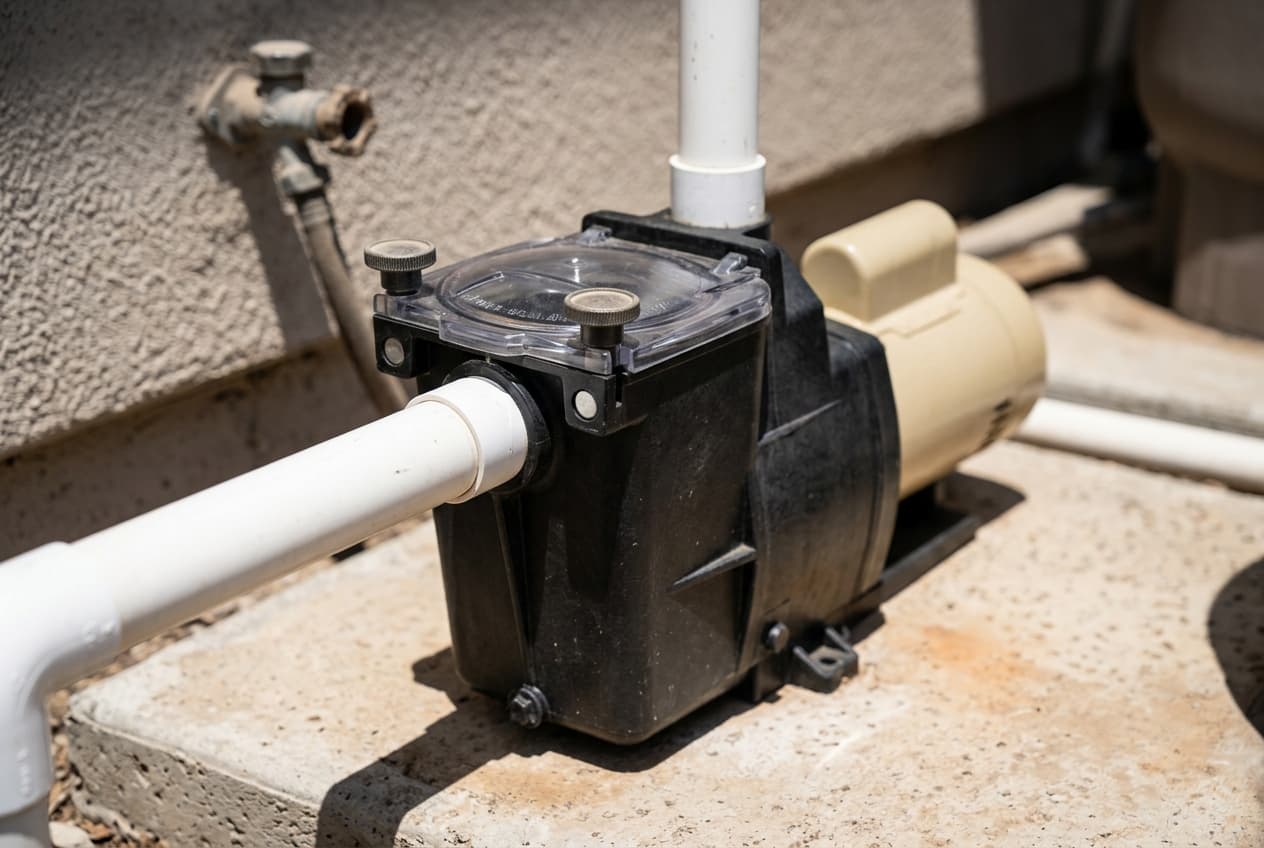
The Super Pump is the pump most people inherit rather than choose. It has been on the back of American pools for decades, it is the one every service tech can rebuild from memory, and parts for it are on the shelf of every pool store in the country. That last point matters more than any spec on this page.
The parts diagram covers six models from 0.60 to 2.5 horsepower, and they are far more alike than the model numbers suggest. All six share the same housing, strainer basket, lid, gasket, shaft seal and drain plugs. What actually changes is the impeller and the motor — which is why ordering parts means knowing your exact model number, and why the table below is the useful part of this page.
The 1.1 HP SP2607X10 is the one most residential pools land on. It moves 66 GPM at 40 feet of head, a comfortable single-speed match for 2-inch plumbing.
The one genuine outlier is the SP2621X25. Despite wearing the Super Pump name it uses a different housing, diffuser and seal plate from the other five, so parts that fit the rest of the range will not fit it.
Six in the parts diagram, four on the spec sheet, one on the shelf
Worth separating, because all three statements are true and they answer different questions.
The parts diagram, ISSPSERIES Rev E, covers six models — SP2600X5, SP2605X7, SP2607X10, SP2610X15, SP2615X20 and SP2621X25. If you own one of those, parts are listed for it, and the table on this page is that diagram.
Hayward's current spec sheet lists four, and they are not the six minus two:
- SP2600X5 — 0.60 total HP, WEF 4.3
- SP2605X7 — 0.85 total HP, WEF 3.9
- SP2607X10 — 1.10 total HP, WEF 3.4
- SP2607X102S — 1.00 total HP, two speed, WEF 4.5
The 1.5, 2.0 and 2.5 HP models are not on it. That is the same pattern the DOE rules produced at Pentair and Jandy, where the top of each single-speed range went and the bottom survived.
Hayward's own pool pump listing currently shows one single-speed Super Pump, the SP2607X10, alongside two Super Pump VS 600 models — a 1.65 HP and a 2.25 HP, both with OmniX built in, and both sharing this pump's housing, basket, lid, gaskets, seal and impeller part numbers. So if you are buying rather than repairing, the modern Super Pump is a variable-speed pump.
One number in that table is worth pausing on. The two-speed SP2607X102S is the most efficient pump in the range at WEF 4.5 — better than the smallest single-speed, at a nominal horsepower above it. Two speeds is not variable speed, but on this range it is the efficient choice, and it is the model people do not know exists.
Read the model number before you buy
Hayward sells this machine under two numbers, and the difference is the warranty rather than the pump.
SP2607X10 is the standard model, sold through pool dealers. W3SP2607X10 is the same pump as Hayward's Open Line, approved for online sale.
Buying the W3 online is sanctioned — this is not a void-warranty situation, whatever you read elsewhere. But the coverage differs by channel, and Hayward's longest parts-and-labor terms attach to the Expert Line, sold through authorized dealers. If a listing shows a W3 prefix, you are buying the online-approved version, and you should know that going in rather than after a failure.
Whether it is the right size
Almost nobody needs more pump than this, and a good number of people bought more.
Oversizing is the most common and most expensive mistake on a pool, because the penalty is not a failure — it is a bill that arrives every month for a decade. A pump that moves water faster than the filter can process it costs more to run, filters worse, and pushes your whole system harder for no benefit. Pump sizing is worth ten minutes before you replace like for like.
If you are replacing rather than repairing, worth knowing that Pentair markets the SuperFlo VST as a drop-in replacement for this exact pump — though it runs 1.5-inch ports against the Super Pump's 2-inch, so check your plumbing before believing the phrase.
The other question worth asking is whether a single-speed pump is the right purchase at all in 2026. Variable-speed models cost more up front and less to run, sometimes dramatically so, and how long you run the pump is where that difference actually shows up.
When it stops priming
The Super Pump's characteristic failure is a loss of prime, and it is usually the cheapest possible cause.
Air is getting in somewhere on the suction side: a strainer lid o-ring that has gone hard, a lid not seated, a low water level, or a drain plug backed out. Those cost about ten dollars apiece and ten minutes. Only after ruling them out is it worth looking at the impeller or the shaft seal.
The full diagnostic order matters here, because people replace the expensive part first and find the problem was a ten-dollar o-ring.
Which model do you have?
The model number is on the pump label. Everything else in the range is shared — these are the parts that change with it.
| Model | HP | WEF | Impeller | Motor | Note |
|---|---|---|---|---|---|
| SP2600X5 | 0.60 | 4.3 | SPX2600C | SPX1600Z1M | |
| SP2605X7 | 0.85 | 3.9 | SPX2605C | SPX1605Z1M | 0.85 total horsepower on the spec sheet, WEF 3.9 — the nameplate ¾ is not the figure to compare with. |
| SP2607X10 | 1.1 | 3.4 | SPX2607C | SPX1607Z1M | The one single-speed Super Pump still on Hayward's own catalog listing. |
| SP2607X102S | 1.0 | 4.5 | — | — | Two speed, 230 V only, and the most efficient of the range at WEF 4.5 — better than the smallest single-speed. On the current spec sheet and easy to miss. |
| SP2610X15 | 1.5 | Not rated; not DOE compliant | SPX2610C | SPX1610Z1M | |
| SP2615X20 | 2.0 | Not rated; not DOE compliant | SPX2615C | SPX1615Z1M | |
| SP2621X25 | 2.5 | Not rated; not DOE compliant | SPX1621C | SPX1620Z1M | Different housing, diffuser and seal plate from the rest of the series. |
Hayward Super Pump parts, and what goes wrong
Read off the manufacturer’s parts list and checked before it ships. Open a row for what a bad one actually does — or start from the symptom and work down, which is the cheaper order.
What is it doing?
Both drain plugs sit below the water line and both are easy to leave finger-tight after winterizing. A backed-out plug or a hardened gasket pulls air on the suction side and the pump will not hold prime, with no visible leak because it is sucking rather than spilling. Hayward's parts diagram dates this 1/4-inch plug to pumps built from 1992 to 2021; later pumps take the SPX4000FG wingnut plug.
Live pricing arrives when the retailer programs are approved.
The gasket between the strainer housing and the seal plate. A leak here shows as water on the pad under the middle of the pump rather than at either end, and it is the seal you replace while the housing is already apart.
Live pricing arrives when the retailer programs are approved.
The lid gasket is the single most common reason a Super Pump loses prime, and the cheapest thing on this list. It goes hard and square-edged with age and heat, stops sealing, and the pump pulls air instead of water. Check it before anything else — it costs about ten dollars and takes five minutes.
Live pricing arrives when the retailer programs are approved.
A cracked basket is not obviously broken until you look at it against the light. The damage it does is downstream: debris that should have stopped here reaches the impeller instead, and you end up diagnosing weak flow when the cause is a $20 basket.
Live pricing arrives when the retailer programs are approved.
The diffuser directs water into the impeller eye. A cracked one lets water take a shortcut, so the pump moves less water while sounding entirely normal. Usually found while you are in there for something else.
Live pricing arrives when the retailer programs are approved.
The mechanical seal separates wet from dry. When it goes you get water weeping from between the pump body and the motor, and that water runs straight into the motor bearings. A seal is an afternoon and under fifty dollars. The motor it destroys is ten times that, so this one is worth catching early.
Live pricing arrives when the retailer programs are approved.
Weak flow at normal filter pressure points at the suction side, and a blocked or worn impeller is a common cause. Debris in the vanes is far more likely than actual wear and costs nothing to clear. Genuine wear takes years and shows as output that fell so gradually nobody noticed.
Live pricing arrives when the retailer programs are approved.
The expensive one, and the last to suspect. A motor that hums without turning, trips the breaker, or will not start is usually a capacitor or a seized shaft rather than a dead motor — worth having checked before replacing, because the price gap is enormous.
Live pricing arrives when the retailer programs are approved.
If you are doing the job anyway
Nobody opens a pump for one o-ring. Once it is apart the rest of the seals are a few dollars and the work is already done.
The no-prime kit
The three cheap suction-side seals that cause most lost-prime calls. Roughly $25 to $40 together, depending on whether you buy Hayward's own parts or copies, and you will use all of them eventually.
- Strainer cover gasketSPX1600S
- Drain plug with gasketSPX1700FG
- Strainer basketSPX1600M
Shaft seal job
Replacing the seal means splitting the housing, so the housing gasket comes out anyway. Doing it twice means draining and dismantling the pump twice.
- Shaft seal assemblySPX1600Z2
- Housing gasketSPX1600T
Hayward Super Pump manuals and documentation
Hosted by the manufacturer. These open on Hayward’s own servers, so they stay current.
- Owner's manual (IS26002 Rev A)manual
- Installation instructions — Super Pump / Super II / MaxFlomanual
- Super Pump series parts diagram (ISSPSERIES Rev E)diagram
- Performance curvescurves
- Specification sheet (LITSPHE23)spec
- Your guide to DOE-compliant Hayward pumps (Pump Listing Version 2.0, May 2021) — the SP2610X15, SP2615X20 and SP2621X25 under non-compliantspec
Hayward Super Pump warranty
3 years parts, 1 year labor
Three years parts and one year field labor, which is Hayward's standard Expert Line term for any in-ground product. The W3-prefixed model is the Open Line version approved for online sale, and Open Line is a different animal: one year parts and no field labor at all. So the online saving costs two years of parts and the whole of the labor. One more term specific to this pump — a single-speed Super Pump TEFC motor bought as a replacement part carries two years, where most electrical replacement parts carry one and plastic ones six months. Two conditions apply to everything Hayward sells: the warranty covers only products bought from Hayward or an authorized seller, and coverage cannot start before the delivery date. It transfers with the house — coverage continues from the original installation date, provided the product is still in its original location.
Manufacturer’s termsHayward Super Pump complete parts list
Every part on the manufacturer’s exploded diagram, in their numbering. Marked rows are the ones covered above with a symptom and a diagnosis.
36 parts
| No. | Part | Description | Note |
|---|---|---|---|
| 1 | SPX1600P | Hand knob | 2 required |
| 2 | SPX1600N | Swivel nut | 2 required |
| 3 | SPX1600D | Strainer cover | |
| 4 | SPX1600S | Strainer cover gasket what goes wrong | |
| 5 | SPX1600M | Basket what goes wrong | |
| 6A | SPX1700FG | Drain plug with gasket, 1/4 in. what goes wrong | 2 required; pumps built 1992 to 2021 |
| 6B | SPX4000FG | Wingnut drain plug with gasket | 2 required; pumps built 2021 and later |
| 7 | SPX1600AA | Pump / strainer housing | SPX1620AA on the SP2621X25 |
| 8 | SPX1600R | Diffuser gasket | |
| 9 | SPX2600B | Diffuser what goes wrong | SPX1616B on the SP2621X25 |
| 10 | SPX2600C | Impeller | SP2600X5 |
| 10 | SPX2605C | Impeller | SP2605X7 |
| 10 | SPX2607C | Impeller what goes wrong | SP2607X10 |
| 10 | SPX2610C | Impeller | SP2610X15 |
| 10 | SPX2615C | Impeller | SP2615X20 |
| 10 | SPX1621C | Impeller | SP2621X25 |
| 11 | SPX1600Z2 | Seal assembly what goes wrong | |
| 12 | SPX1600T | Housing gasket what goes wrong | |
| 13 | SPX2600E5 | Seal plate | SPX1611E5 on the SP2621X25 |
| 14 | SPX1600F5 | Motor mounting plate | |
| 15 | SPX1600Z4 | Housing cap screw | 4 required |
| 16 | SPX125Z4 | Motor cap screw | 4 required |
| 17 | SPX2600G1 | Mounting foot | Includes the adapter and screws |
| 18 | SPX1600J | Mounting foot cap screw | 2 required; SPX1600Z5 on the SP2600X5 |
| 19 | SPX2600Q | Mounting foot adapter | |
| 20 | SPX0125F | Slinger | |
| 21 | SPX1600Z1M | Motor, 60 Hz single phase | SP2600X5 |
| 21 | SPX1605Z1M | Motor, 60 Hz single phase | SP2605X7 |
| 21 | SPX1607Z1M | Motor, 60 Hz single phase what goes wrong | SP2607X10 |
| 21 | SPX1610Z1M | Motor, 60 Hz single phase | SP2610X15 |
| 21 | SPX1615Z1M | Motor, 60 Hz single phase | SP2615X20 |
| 21 | SPX1620Z1M | Motor, 60 Hz single phase | SP2621X25 |
| 7 | SPX1620AA | Pump / strainer housing | SP2621X25 only |
| 9 | SPX1616B | Diffuser | SP2621X25 only |
| 13 | SPX1611E5 | Seal plate | SP2621X25 only |
| 18 | SPX1600Z5 | Mounting foot cap screw | SP2600X5 only |
Buy the pump
One retailer for now. More get added here as their programs are approved, and this becomes a comparison rather than a link.