Jandy · VS PlusHP
Jandy VS PlusHP
Jandy's 2.7 HP pump in the PlusHP body: what it gives up on 115 volts, relays that wait for 1,725 RPM, and the controller letters to check.
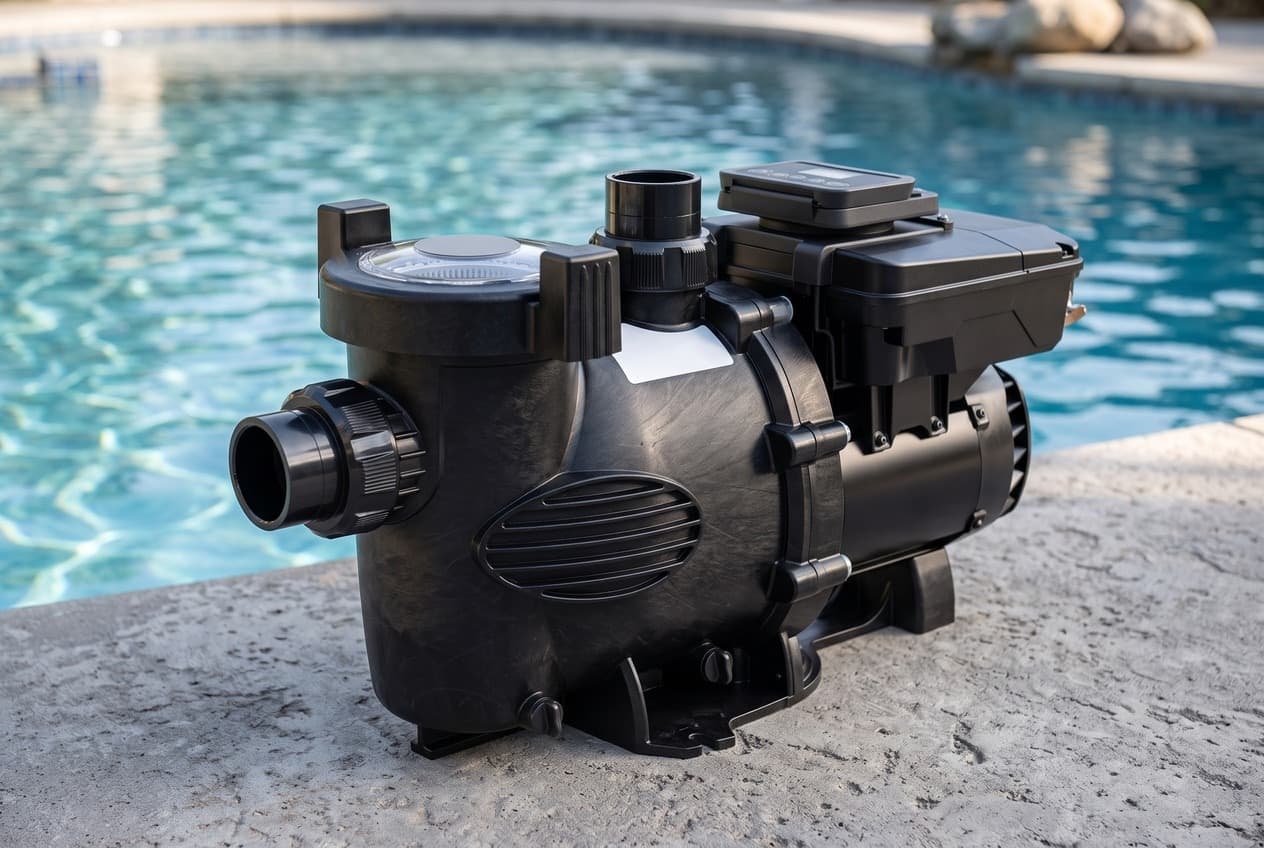
The VS PlusHP is Jandy's 2.7 horsepower variable-speed pump, built on the PlusHP body. That's the same body, lid, basket and unions as Jandy's single-speed PlusHP, with a variable-speed motor behind it. It runs on 115 or 230 volts, and it has two relays that can switch a salt cell or a booster pump along with it.
Both features come with a condition that's easy to miss. On 115 volts it gives up part of its top end. And the relays don't close until the pump reaches a set speed, which a quiet overnight schedule may never do.
Check the letters at the end of the model number
Jandy sells one pump under three model numbers. The difference is the controller.
- VSPHP270DV2A comes with no controller. Jandy's manual is plain about what that means: with power alone, the pump will not run. It needs a SpeedSet, an iQPUMP01 or a JEP-R, a Jandy automation system, or a switch or relay on its dry contacts.
- VSPHP270DV2AS has the SpeedSet controller mounted on the pump. This is the number on Jandy's product page, its 2025 sell sheet and Fluidra's 2026 catalog.
- VSPHP270DV2ASP has the newer SpeedSet Plus instead. It's on Jandy's July 2026 sell sheet, and ENERGY STAR has listed it since January 2026 with the same test results as the other two.
The Plus matters on a Pentair pad. Its guide says it lets a Jandy pump take commands from an IntelliCenter, IntelliCenter Lite, EasyTouch PL4 or PSL4, or IntelliTouch. The pump is set up there as an IntelliFlo VS and takes speed commands only; flow control isn't supported. The original SpeedSet's guide doesn't mention Pentair at all.
On a Jandy pad, any of the three will do. The manual lists the pump as compatible with every Jandy automation system, AquaLink RS included.
What 115 volts costs at the top end
Jandy's sell sheets put the dual voltage under "No Rewiring Necessary" and leave it there. They don't claim the same performance on both voltages, and the curves show why.
In the manual and in Fluidra's catalog, a dashed line marked 115 VAC leaves the full-speed curve at around 40 gpm and falls below it. By the high-flow end of the chart, it has dropped onto the 3,000 RPM curve.
ENERGY STAR tested the pump at each voltage, and its figures agree. Hydraulic horsepower, the pump's output at full speed on the federal test's standard plumbing curve, is 1.697 on 230 volts and 1.341 on 115, about 21% less.
Filtering speeds are untouched. ENERGY STAR's low-speed test point is 31.6 gpm at 123 watts on 230 volts, and 31.1 gpm at 119 watts on 115. What comes up short is full speed at high flow, the setting for spa jets or a water feature. If the pad needs those, run it on 230.
That also explains a rating that looks backward. WEF is 7.3 on 230 volts and 8.4 on 115. The pump isn't more efficient on 115. The federal test sets a variable-speed pump's high test point from its own top flow, and ENERGY STAR's listing puts that point at 75 gpm and about 2,760 RPM on 230 volts, against 69 gpm and about 2,550 RPM on 115. A pump that can't reach full flow gets scored at a slower, cheaper point. The VS FloPro page shows the same pattern on its 1.85 HP.
One figure disagrees. Jandy's manual, both sell sheets and ENERGY STAR, at 8.433, all put the 115-volt WEF at 8.4. Fluidra's 2026 catalog prints 8.5. This page uses 8.4.
What the circuit needs
The 115-volt option is still worth having, because the circuit it asks for is an ordinary one. Jandy's minimums, from the manual's table:
- Breaker: 15 A at 208-230 volts, 20 A at 115
- Wire, up to 50 feet from the sub-panel: 14 AWG at 230 volts, 12 AWG at 115
- 50 to 100 feet: 12 AWG at 230 volts, 10 AWG at 115
- 100 to 200 feet: 10 AWG at either voltage
The table assumes three copper conductors in buried conduit and no more than 3% voltage drop.
That's a lighter circuit than a smaller Jandy pump needs. The VS FloPro 1.65 HP draws up to 17.7 amps on 115 volts, and Jandy puts it on a 30-amp breaker. This pump tops out at 16.0 amps there, and Jandy puts it on 20. So by Jandy's own tables, a pad with a 20-amp breaker and 12-gauge wire inside 50 feet already meets the 115-volt minimum for the bigger pump.
Two more notes from the manual. The pump needs a dedicated circuit, with nothing else on it. And the electrical code requires GFCI protection, which Jandy says variable-speed pumps of every brand tend to trip. It recommends Siemens QFP or QF GFCI breakers to cut down nuisance trips. Jandy's warranty excludes damage from the wrong breaker or wire size.
The relays wait for a speed
The VS PlusHP has two built-in relays, meant for equipment that needs water moving to work. Jandy names a salt chlorinator and a booster pump. The contacts are rated 11 amps at 115 or 230 volts.
They switch on speed, not on time:
- Relay 1 closes at 1,725 RPM
- Relay 2 closes at 2,250 RPM
- From a stop, neither closes for three minutes, even at speed
- After that, a relay closes five seconds after the pump passes its speed, and opens the moment the pump drops below it
That's a trap for a salt cell. If the filtering schedule runs below 1,725 RPM, anything on relay 1 never switches on. A cell wired there makes no chlorine however long the pump runs. Jandy's troubleshooting chart puts it first under relays not working: check that the motor is actually reaching the speed.
The fix is a setting. The SpeedSet and SpeedSet Plus can both change the speed each relay closes at, and the change is written to the pump's drive, so it holds even if the controller is later removed. When a salt cell stops producing has the rest of the checks.
Four speeds without a controller
With no Jandy controller on its RS-485 line, the pump can run from its dry contacts. Close the circuit between one of the four inputs and common, with a time clock or a relay. The pump primes at 2,750 RPM for three minutes, then runs at that input's speed until the circuit opens. Connect any Jandy controller and the dry contacts are ignored.
The four speeds depend on the first letter of the motor's serial number, on the rating plate:
- Serial beginning with A: 3,000, 1,400, 2,200 and 1,725 RPM on inputs 1 to 4
- Serial beginning with B or later: 3,450, 1,375, 2,600 and 1,750 RPM
The same body as the single-speed PlusHP
Jandy's parts lists put the VS PlusHP and the single-speed PlusHP in one body. Both use pump body R0448700, lid R0448800, basket R0448900, lid seal R0449100, tailpiece kit R0449000, mounting foot R0445700, backplate kit R0445200 and mechanical seal R0479400. The motor, the drive and the impeller are what change.
So an old PlusHP comes out and this one goes in on the same unions. Jandy's drawing puts the suction centerline 8⅞ inches above the base. That matches the VS FloPro manual, which raises its own pump to 8⅞ inches on a base when it replaces a PlusHP.
The 2 × 2½ inch unions are larger than most, and Jandy recommends 2 to 3 inch pipe. Its own pipe chart gives 2-inch pipe 62 gpm on the suction side and 85 on the return, and the full-speed curve runs past both. On 2-inch plumbing, set a maximum speed. The SpeedSet Plus guide has a MIN/MAX setting for exactly that, and says the flow through each suction outlet must stay within its cover's rating.
Three Jandy pumps at 2.7 HP
The VS PlusHP shares its manual with two other 2.7 THP pumps. The choice between them is mostly the body:
- VS FloPro 2.7 HP, VSFHP270DV2A: 2-inch unions, 44 lb, suction centerline 7¾ inches. WEF 7.3 on 230 volts and 8.7 on 115
- VS PlusHP, VSPHP270DV2A: 2 × 2½ inch unions, 64 lb, 8⅞ inches. WEF 7.3 and 8.4
- ePump 2.7 HP, VSSHP270DV2A: 2 × 2½ inch unions, 66 lb, 10⅜ inches. WEF 7.5 and 9.3
All three have the same breaker and wire table, the same relays and the same dry contacts. Fluidra's catalog even gives the VS FloPro 2.7 the same motor and drive as the VS PlusHP, R0816800, and the same drive alone, R0974400. What differs is the pump end: body, impeller, basket and unions. The practical question is what you're replacing, because the suction height decides whether the plumbing lines up. Replacing a pool pump walks through measuring it.
Priming
The default priming speed is 2,750 RPM. Jandy's manual gives about 15 minutes to prime from 10 feet above the water at that speed, and within 6 minutes at 3,450. Both controllers default to 3 minutes of priming at 2,750 RPM. If the pump needs longer, raise the speed or the time.
The pump is NSF-certified to prime from 10 feet above the water at sea level. Jandy's own advice is tighter: install it within a foot above the water, and no more than 5 feet.
Before closing the lid, check the seal seat for debris, which is where an air leak starts. Tighten it by hand only, until the locked marks line up with the ports. And if the lid seal ever comes out, it goes back one way on this pump: two ribs up into the lid groove, one rib down toward the pump. The priming guide works through the suction side if it still won't catch.
Freeze protection is in the controller
ENERGY STAR lists all three versions with freeze protection. On this pump it's a controller setting. The SpeedSet and SpeedSet Plus guides both preset it to 38°F, 1,725 RPM for one hour, all three adjustable, and the pump runs its priming cycle before dropping to that speed. A DV2A has whatever freeze protection the controller or automation driving it provides.
Two limits from the same guides. The STOP button turns off everything, freeze protection included, so a pump left stopped for service is unprotected. And Jandy says it covers short freezes only, not long ones or a power cut. For those, it says to drain and winterize.
The manual's winterizing steps are under the drain plugs in the parts list below. Freezing and poor winterizing are both excluded from the warranty. Closing the pool covers the rest of the pad.
Jandy's savings claims
The product page makes two claims a paragraph apart. One is over $1,100 a year against a single-speed pump, for a 28,000-gallon pool at two turnovers a day and $0.185 per kilowatt-hour. The other, which names the ePump alongside it, is up to $950 a year, for the same pool at 1.5 turnovers and $0.15.
Two turnovers a day is more than most pools need, so treat both as the top of the range. The running cost calculator takes your own hours and rate.
Ordering parts
The manual's exploded view has no part numbers and points to Jandy.com. Jandy's replacement parts page points in turn to Fluidra's 2026 product catalog. Pages 28 and 29 have the full table, headed VS PlusHP 2.7 HP VS Pump, 115V/230V, 2-Aux Relays, Mfg. 2019 to present, for the VSPHP270DV2A and DV2AS. That edition carries no prices. ENERGY STAR gives June 2021 as the date the pump reached the market, two years after the catalog's heading.
For a failed drive, Jandy sells the drive alone as R0974400, as well as the complete motor/drive, R0816800.
The SpeedSet Plus version, DV2ASP, isn't in that table. Its sell sheet and ENERGY STAR's test results match the DV2AS figure for figure, but no Jandy parts table names it yet, so give a dealer the full model number.
The earlier VS PlusHP, the VSPHP270JEP and VSPHP270AUT, is in Jandy's product archive with its own 2017 manual. Its wet end has the same numbers: body, lid, basket, impeller R0807200, diffuser, seal and tailpieces. Its motor/drive, R0562201, and its covers don't. Check the model on the rating plate before ordering anything electrical.
Which model do you have?
The model number is on the pump label. Everything else in the range is shared — these are the parts that change with it.
| Model | SKU | Controller | Note |
|---|---|---|---|
| VS PlusHP 2.7 HP, no controller | VSPHP270DV2A | Sold separately | Ships without a controller, and Jandy's manual says it will not run on power alone. It needs a SpeedSet, iQPUMP01 or JEP-R, a Jandy automation system, or a switch or relay on its dry contacts. |
| VS PlusHP 2.7 HP with SpeedSet | VSPHP270DV2AS | SpeedSet | The SpeedSet mounted on the pump. The number on Jandy's product page, its 2025 sell sheet and Fluidra's 2026 catalog. |
| VS PlusHP 2.7 HP with SpeedSet Plus | VSPHP270DV2ASP | SpeedSet Plus | The newer SpeedSet Plus instead, which adds control from Pentair automation. On Jandy's July 2026 sell sheet, and in ENERGY STAR's list since January 2026 with the same test results as the other two. |
Jandy VS PlusHP parts, and what goes wrong
Read off the manufacturer’s parts list and checked before it ships. Open a row for what a bad one actually does — or start from the symptom and work down, which is the cheaper order.
What is it doing?
Jandy's FAQ for the earlier VS PlusHP, which has the same lid and seal, traces bubbles in the pump basket to air getting in. After the water level, it goes to the lid: debris around the seal seat, or a seal put in wrong. This pump's manual gives the seal a direction, two ribs up into the lid groove and one rib down toward the pump. Clean the groove before refitting, use only soapy water on the seal, never lubricant or sealant, and tighten the lid by hand. The whole lid with locking ring and seal is R0448800.
Live pricing arrives when the retailer programs are approved.
The manual says to check it weekly through the clear lid, since debris in it starts to block the flow. Hose it from the outside so every hole is clear, and drop it back in with its opening lined up with the suction pipe. A misaligned basket keeps the lid from seating and lets air in. If debris has jammed the impeller, the manual says to check the basket for breaks and replace it.
Live pricing arrives when the retailer programs are approved.
Jandy's first suspect when the motor quits soon after starting is debris between the impeller and the diffuser, which stops the shaft turning. With all power off, a 5/16 in. hex key through the back of the fan housing into the shaft shows whether it spins. Clear what you can through the lid; if it stays blocked, the pump has to come apart. Jandy's FAQ for the earlier VS PlusHP, which takes the same impeller kit, adds a second cause of low pressure: normal wear on the impeller and the diffuser, R0445400.
Live pricing arrives when the retailer programs are approved.
Jandy's FAQ for the earlier VS PlusHP, which uses the same seal, puts water leaking between the motor and the pump body down to a damaged or failed seal, and says to replace it. It lists a seal leaking air as a job for a service technician. The seal also comes in the backplate kit, R0445200, with the backplate, its o-ring and the eight bolts.
Live pricing arrives when the retailer programs are approved.
For an air leak that won't go away, Jandy's FAQ for the earlier VS PlusHP goes to the suction union. Try tightening it with the pump running. If that fails, turn the pump off, loosen both unions, slide the pump aside, and clean and refit both union o-rings. Hand-tight should seal; if not, snug it gently with large tongue-and-groove pliers, and don't overtighten. Two per pump. The pair of tailpieces with nuts and o-rings is R0449000.
Live pricing arrives when the retailer programs are approved.
Work through the manual's checks first. Cycle the power at the breaker and wait at least 5 minutes so the capacitors drain. Check the RS-485 wires are whole, free of corrosion and in the order red, black, yellow, green for pins 1 to 4. Jumping pins 1 to 3 and 2 to 4 should spin the motor at 2600 RPM; if it does, the fault is the wiring or the controller. On a local controller, DIP switches 3 and 4 are both off. For overheating, give the motor room for air and have the voltage checked, which must be within 10% of the rating plate. The drive alone is R0974400.
Live pricing arrives when the retailer programs are approved.
To winterize, the manual says to drain the pump, equipment and pipes, remove both drain plugs, and keep them and their o-rings somewhere safe until spring. Keep the motor covered and dry, but never under plastic, which traps condensation. Jandy recommends having the wiring disconnected so the pump can come off its unions and be stored indoors.
Live pricing arrives when the retailer programs are approved.
If you are doing the job anyway
Numbers from Fluidra's 2026 catalog table for the VSPHP270DV2A and DV2AS. The earlier VSPHP270JEP and AUT share the wet end, but not the motor/drive or its covers.
Shaft seal job
The seal is in Jandy's backplate kit, so the job can be one part number: the backplate, its o-ring, the eight bolts and washers, and the carbon and ceramic seal together.
- Mechanical seal, carbon and ceramicR0479400
- R0446300R0446300
Sold as a kit: R0445200
Union o-rings
Jandy's fix for an air leak at a union is to clean and refit both union o-rings. If they're flattened or cut, R0449200 is the o-ring alone. R0449000 is both tailpieces with their nuts and o-rings.
- Tailpiece o-ringR0449200
Sold as a kit: R0449000
Jandy VS PlusHP manuals and documentation
Hosted by the manufacturer. These open on Jandy’s own servers, so they stay current.
- Installation and operation manual, 1.85, 2.7 and 3.8 HP variable-speed pumps (H0707400 Rev F, 2024)manual
- VS PlusHP 2.7 HP product pagespec
- VS PlusHP sell sheet, DV2A and DV2AS (13006 SL, 2025)spec
- VS PlusHP sell sheet, DV2A and DV2ASP with the SpeedSet Plus (73610 SL, 2026)spec
- Fluidra 2026 product catalog, VS PlusHP specifications, curves and parts table on pages 28 and 29diagram
- SpeedSet controller quick start guide (H0749400 Rev D)manual
- SpeedSet Plus controller quick start guide, with the Pentair automation setup (H0914600 Rev E)manual
- Single-speed PlusHP manual, for its parts list (H0279500 Rev L)manual
- Earlier VS PlusHP, VSPHP270JEP and VSPHP270AUT: manual (H0490000)manual
- Earlier VS PlusHP in Jandy's product archive, with its troubleshooting FAQspec
- ENERGY STAR certified pool pumps — search model VSPHP270spec
- Jandy limited warranty (H0333803)spec
Jandy VS PlusHP warranty
3 years parts
Three years, where most Jandy equipment gets one. Purchased replacement parts get ninety days, and any commercial installation drops to one year. The exclusions a pump owner is likeliest to meet: running outside the published flow range, a dirty or blocked strainer basket or impeller, damage caused by a failed o-ring or basket, freezing or poor winterizing, and wiring faults, the wrong breaker or wire size among them. And no warranty at all on a Jandy pump bought through the Internet or an e-commerce platform.
Manufacturer’s termsJandy VS PlusHP complete parts list
Every part on the manufacturer’s exploded diagram, in their numbering. Marked rows are the ones covered above with a symptom and a diagnosis.
30 parts
| No. | Part | Description | Note |
|---|---|---|---|
| 1 | R0816800 | Motor/drive, 2.7 HP DV2A models what goes wrong | |
| 1A | R0974400 | Drive only, 2.7 HP DV2A models | |
| 2 | R0807200 | Impeller with screw, backplate o-ring what goes wrong | |
| 3 | R0445400 | Diffuser with o-ring, 2 mounting screws, backplate o-ring | |
| 4 | R0622000 | Diffuser o-ring | |
| 5 | R0479400 | Mechanical seal, carbon and ceramic what goes wrong | |
| 6 | R0448700 | Pump body | |
| 7 | R0445700 | Motor mounting foot assembly with 2 screws | |
| 8 | R0448800 | Lid assembly: lid, locking ring, seal | |
| 9 | R0448900 | Filter basket what goes wrong | |
| 10 | R0446000 | Drain plug with o-ring what goes wrong | Set of 2 |
| 11 | R0449000 | Tailpiece kit: 2 tailpieces (2 × 2½ in.), 2 union nuts, 2 o-rings | |
| 12 | R0522900 | Tailpiece kit: 1 tailpiece (2 × 2½ in.), 1 union nut, 1 o-ring | |
| 13 | R0449100 | Lid seal and o-ring what goes wrong | |
| 14 | R0445200 | Backplate kit: backplate, backplate o-ring, 8 mounting bolts and washers, mechanical seal | |
| 15 | R0446300 | Backplate o-ring | |
| 16 | R0449200 | Tailpiece o-ring what goes wrong | 2 required |
| 17 | R0446500 | Impeller/diffuser hardware kit: impeller mounting screw, 2 diffuser mounting screws, backplate o-ring, diffuser o-ring | |
| 18 | R0446600 | Backplate mounting bolts and washers | 8 required |
| 19 | R0446700 | Motor mounting bolts and washers | 4 required |
| 20 | R0851400 | Wiring compartment lid, gasket, 2 mounting screws | |
| 21 | R0851500 | RS-485 access cover, retaining screw | |
| 22 | R0851600 | Fan shroud, 4 mounting screws | |
| 23 | R0917100 | Wiring port plugs | 4 required |
| 24 | SPEEDSET | SpeedSet variable-speed pump controller, with wall mount | |
| 25 | iQPUMP01 | iQPUMP01 controller, controllable from the iAquaLink app | |
| 26 | JEP-R | JEP-R variable-speed pump controller | |
| 27 | R0925100 | SpeedSet mounting kit, DV2A(S) pumps | |
| — | SPEEDSETPLUS | SpeedSet Plus controller | Not in the 2026 catalog's table; the SKU is from Jandy's SpeedSet Plus page |
| — | R0501100 | Liquid-tight cord grip, 3/8 in. | Not on the diagram. The manual names it for wiring that doesn't use the RS-485 quick connect port |