Hayward · TriStar
Hayward TriStar VS
Hayward's variable-speed pump in both sizes: what it gives up on 115 volts, the left-hand thread that snaps impeller screws, and dating one by serial number.
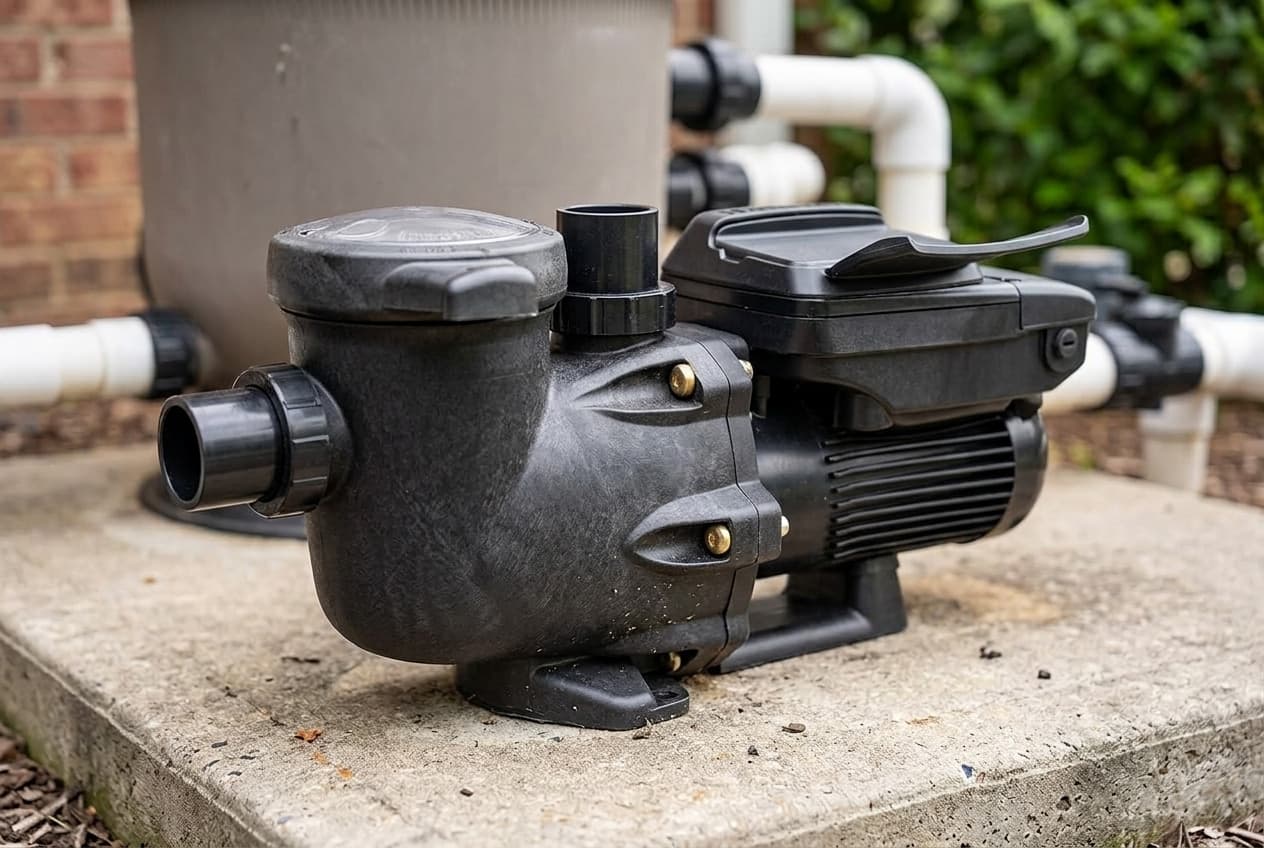
The TriStar VS comes in two sizes and Hayward documents them as two families: 1.85 THP and 2.70 THP, the latter sold as the TriStar VS 950.
What is worth knowing before you order a part: the two are the same pump except for two components. Housing, basket, lid, diffuser, seal plate, shaft seal, every o-ring and every bolt carry the same number across both. The only things that differ are the impeller — SPX3210C against SPX3220C — and the drive and motor assembly.
That makes most TriStar VS parts easy to get right and exactly two of them easy to get wrong, and the two that differ are the two that matter.
One model, several numbers
The same pump is sold under different part numbers depending on where it goes and what is built into it. For the 2.70:
- SP32950VSP — TriStar VS 950, the standard dealer number
- W3SP3206VSP — Open Line, approved for online sale on shorter warranty terms
- SP3206VSPBH — the bare pump
- HL32950VSP — the Omni version, with automation built in
- HCP2500VSP — the commercial variant
The 1.85 follows the same pattern: SP32900VSP, W3SP3202VSP, SP3202VSPBH, HL32900VSP.
They are all in one manual, and they all take the same parts. The Hayward brand page explains what the W3 prefix costs you in coverage.
Hayward's newer TriStar VS 800 Series is a separate line with OmniX built in, in 1.25, 1.85 and 2.25 THP. It shares this pump's housing, lid, basket, diffuser, seal plate and shaft seal, and its 1.85 THP model takes the same SPX3210C impeller, but it has its own power ends and manual.
On 115 volts it is a smaller pump
Both sizes run on 115 volts as well as 230. Hayward's product pages say so, but not how much of the pump you give up. Hayward's curve sheet does. It draws each size twice, once for each voltage:
- 2.70 THP: on 115 V it matches 230 V only up to about 30 GPM, then falls away, reaching about 102 GPM at 30 feet of head instead of 172.
- 1.85 THP: it leaves the 230-volt curve at about 10 GPM and reaches about 58 GPM at 30 feet instead of 122.
ENERGY STAR lists each voltage separately. It rates the 2.70 at 1.5 total horsepower on 115 V, and the 1.85 at 0.85. Hydraulic horsepower, the pump's output at full speed on the federal test's standard plumbing curve, falls by more than half on both: 1.817 to 0.881 on the 2.70, and 1.240 to 0.448 on the 1.85.
Filtering at low speed is not affected. At ENERGY STAR's low test point, around 31 GPM, the 2.70 draws 121 watts on 115 V and 117 on 230. The loss is at the top end, in the jobs you bought a big pump for: backwashing, spa jets, a suction cleaner.
Hayward's spec tables make 115 volts look better, not worse: WEF 12.9 against 8.3 on the 1.85, and 10.1 against 7.3 on the 2.70. That is the test, not the pump. The federal test sets a variable-speed pump's high test point from its own top flow, and its low one from its rated output. ENERGY STAR's listing puts the 1.85's test points at 25 and 48 GPM on 115 V, against 31 and 68 on 230. Slower points cost less per gallon, so the shrunken pump scores better.
If your pad is 115 volts and staying that way, size from the 115-volt curve rather than the name on the box, or pick a pump that keeps its output there. The TriStar VS 800's 1.85 THP takes this pump's 1.85 impeller, and ENERGY STAR lists it at the same output on both voltages. So does the Jandy VS FloPro in its 1.3 and 1.65 HP sizes.
The impeller screw is a left-hand thread
This is the single most useful sentence in the manual, and it is easy to miss.
Hayward's instruction: "Rotate the impeller screw clockwise (note that screw has left-hand thread) and remove." Going the way you would expect tightens it, and people snap them.
Reassembly is the mirror image — the impeller screws onto the shaft clockwise, the impeller screw goes in counter-clockwise. Hold the motor shaft with a 5/16 inch hex wrench in the socket at the back while you do either.
The rest of the seal job is documented with item numbers in the manual, and two figures are worth having in advance. The six housing bolts are 5/16 by 2 inch, taking a ½ inch wrench, and they go back to 185 inch-pounds, tightened alternately and evenly to the torque pattern in the book. The four motor bolts are 3/8 by 1 inch on a 9/16 wrench.
Date the pump before you order
The serial number is 17 digits, and the fifth to eighth are the year and month of manufacture. On Hayward's own example — 21122305456789001 — that reads as the fifth month of 2023.
Worth doing before ordering anything, because part numbers on pool equipment move with manufacturing dates far more often than people expect, and it takes ten seconds off the nameplate.
Pipe size sets the ceiling, not the pump
Hayward publishes maximum system flow by pipe size, and it is the number that should shape the schedule rather than the pump's rating:
- 1½ inch — 45 GPM
- 2 inch — 80 GPM
- 2½ inch — 110 GPM
- 3 inch — 160 GPM
Those work out at roughly 6.9 to 7.6 feet per second, which is below the 8 fps figure usually quoted as the code ceiling. Hayward is being conservative on purpose, and the conservative number is the one to design to. The pump sizing guide works through why velocity rather than horsepower is the real constraint.
Hayward also asks for five pipe diameters of straight pipe between the suction inlet and the nearest elbow or valve — 10 inches on 2 inch pipe. An elbow tight against the inlet makes the pump noisier and the flow worse, and it is the most common plumbing shortcut on a retrofit.
What variable speed is actually for
A TriStar VS is not a faster pump. It is a pump that can run slowly, and the whole saving lives in that.
Flow scales with speed while power falls much faster. The textbook says half the speed takes an eighth of the power, so twice the run time moves the same water for a quarter of the energy. Real pumps fall short of that at low speed. The running cost calculator uses a pump drawing 320 watts at 1,750 RPM, which moves the same water for about a third of a single-speed pump's energy, and does the arithmetic against your own electricity rate. On its example, $0.17 a kWh over a five-month season, a $1,600 pump takes about six seasons to pay back before any rebate.
Two things spoil it. A pump left on a high default captures almost none of the saving — this is the most common way a variable-speed pump disappoints, and it is a programming problem rather than a hardware one. And other equipment has minimum flow requirements: a MasterTemp heater will not fire below 40 GPM on the 400, and a salt cell may sit partly full of air at low speed and quietly underproduce. Set a low speed for filtering and a higher one for whatever else has to run.
Two ways to void the warranty
Hayward states both in the manual rather than burying them.
Non-Hayward replacement parts void it. That is standard language, but it is worth knowing before fitting a generic seal.
Letting the pump freeze with water in it voids it too. The winterizing instruction is to drop the water below all inlets, pull both drain plugs and the strainer cover, disconnect the pump, then refit the cover and plugs once it has drained and store it dry. If antifreeze is used anywhere in the system it must be propylene glycol — the manual is explicit that other antifreezes are toxic and attack plastic components.
Do not wrap a stored pump in plastic, either. It traps condensation against the motor, which is the thing you were trying to protect.
Which model do you have?
The model number is on the pump label. Everything else in the range is shared — these are the parts that change with it.
| Model | HP | SKU | Flow at 30 ft of head | WEF | Impeller | Drive and motor | Note |
|---|---|---|---|---|---|---|---|
| TriStar VS, 1.85 THP | 1.85 THP | SP32900VSP | About 122 GPM on 230 V; about 58 on 115 V | 8.3 on 230 V, 12.9 on 115 V | SPX3210C | SPX3202Z1VSPE | The smaller drive. Sold as W3SP3202VSP in Hayward's Open Line trim and SP3202VSPBH as a bare pump; HL32900VSP is the Omni version with automation built in. Designed as a straight replacement for most 1.5 HP full-rate and 2.0 HP up-rate pumps. On 115 V it is a much smaller pump: ENERGY STAR rates it at 0.85 THP there. |
| TriStar VS 950, 2.70 THP | 2.70 THP | SP32950VSP | About 172 GPM on 230 V; about 102 on 115 V | 7.3 on 230 V, 10.1 on 115 V | SPX3220C | SPX3206Z1VSPE | The larger drive, and the one this site shortlists for big pools. Open Line is W3SP3206VSP, bare pump SP3206VSPBH, Omni HL32950VSP, commercial HCP2500VSP. ENERGY STAR rates it at 1.5 THP on 115 V. |
Hayward TriStar VS parts, and what goes wrong
Read off the manufacturer’s parts list and checked before it ships. Open a row for what a bad one actually does — or start from the symptom and work down, which is the cheaper order.
What is it doing?
The part that fails on every pump eventually, and the one whose failure destroys the motor if it is ignored — water tracks along the shaft into the bearings. Hayward's own change procedure is in the manual with item numbers. SPX4000SAV is the Viton version for aggressive water.
Live pricing arrives when the retailer programs are approved.
Same basket across both drives. A cracked one lets debris through to the impeller, which is how a basket you never replaced becomes an impeller you have to. Check it whenever the lid is off.
Live pricing arrives when the retailer programs are approved.
The first suspect for a pump sucking air, and the cheapest. It wants silicone lubricant, never petroleum. If the lid will not hold vacuum after a new o-ring, the lid itself is next.
Live pricing arrives when the retailer programs are approved.
One of only two parts that differ between the 1.85 and the 2.70 — the 1.85 takes SPX3210C. Note the impeller screw has a left-hand thread and comes out clockwise; people snap them going the usual way.
Live pricing arrives when the retailer programs are approved.
The seal between the strainer housing and the seal plate. It comes out whenever the motor assembly does, so replace it on a seal job rather than reusing it — and lubricate it before the six housing bolts go back to 185 inch-pounds.
Live pricing arrives when the retailer programs are approved.
Nut, connector and gaskets for the 2 by 2½ inch unions. Shared with other Hayward equipment, which is worth knowing because the same kit fits the SwimClear filter's connections.
Live pricing arrives when the retailer programs are approved.
The expensive one, and the other part that differs by size — the 1.85 takes SPX3202Z1VSPE. Before condemning it, check the display cover and the interface assembly are not the actual fault, because those are separate and far cheaper.
Live pricing arrives when the retailer programs are approved.
The keypad and screen, separate from the drive behind it. A pump that runs but shows nothing, or shows something but will not take input, is usually this rather than the drive.
Live pricing arrives when the retailer programs are approved.
Both plugs come out every fall, because a pump allowed to freeze with water in it is not covered. The o-ring is what goes missing over the winter.
Live pricing arrives when the retailer programs are approved.
If you are doing the job anyway
These get replaced together. Doing them in one pass costs a few dollars more and saves taking the same thing apart twice.
Shaft seal service
The seal does not go back in alone. The housing o-ring comes out with the motor assembly and the diffuser o-ring is right there — replacing both while it is apart costs a few dollars against doing the job twice.
- Shaft seal assemblySPX3200SA
- Housing o-ringSPX3200T
- SPX4000Z1SPX4000Z1
It will not prime
Hayward's order for a pump losing prime, cheapest first: the lid o-ring, then the basket, then the drain plug seals. Air is getting in on the suction side and these are the three places it does.
- Strainer cover o-ringSPX3200S
- Strainer basketSPX3200M
- Drain plug with o-ringSPX4000FG
Winterizing
Both plugs out, and the o-rings replaced in spring rather than hunted for. Freezing with water in it voids the warranty, which makes this the cheapest insurance on the pad.
- Drain plug with o-ringSPX4000FG
- Strainer cover o-ringSPX3200S
Hayward TriStar VS manuals and documentation
Hosted by the manufacturer. These open on Hayward’s own servers, so they stay current.
- TriStar VS 900 product page — voltage, warranty and channelspec
- TriStar VS 950 product page — voltage, warranty and channelspec
- TriStar VS 900 and 950 performance curves, 230 V and 115 Vcurves
- Owner's manual, 2.70 THP VS pump family (1011786 Rev B)manual
- Owner's manual, 1.85 THP VS pump family (1011785 Rev B)manual
Hayward TriStar VS warranty
3 years parts, 1 year labor
Three years parts and one year field labor under Hayward's 2026 Expert Line terms, and one year parts with no labor at all on the W3 Open Line version — so the prefix decides two years of parts and the whole of the labor. Note what the pump section excludes: basket-strainers, o-rings and pump seals are normal wear items covered for manufacturing defects only, which Hayward says normally appear within thirty days of installation. Two conditions apply to everything Hayward sells: the warranty covers only products bought from Hayward or an authorized seller, and coverage cannot start before the delivery date. It transfers with the house — coverage continues from the original installation date, provided the product is still in its original location. Hayward's channel split applies: a W3 prefix is the Open Line, approved for online sale, and the same pump without it is Expert Line through authorized dealers on longer coverage. Hayward advertises 3-plus year parts and labor when sold and installed by a Totally Hayward Partner; the warranty sheet puts the Expert Line standard at three years parts and one year field labor. Two exclusions the manual states outright: non-Hayward replacement parts void the warranty, and so does allowing the pump to freeze with water in it.
Manufacturer’s termsHayward TriStar VS complete parts list
Every part on the manufacturer’s exploded diagram, in their numbering. Marked rows are the ones covered above with a symptom and a diagnosis.
32 parts
| No. | Part | Description |
|---|---|---|
| 1 | SPX3200UNKIT | Union connection kit, with nut, connector and gaskets what goes wrong |
| 2 | SPX3200UG | Union gasket |
| 3 | SPX3200A | Pump strainer housing, 2 x 2½ in., with drain plugs |
| 4A | SPX3200DLS | Strainer cover with lock ring and o-ring |
| 4B | SPX3200DLSB | Strainer cover, lock ring and o-ring — not pressure testable |
| 5 | SPX3200S | Strainer cover o-ring what goes wrong |
| 6 | SPX3200M | Strainer basket what goes wrong |
| 7 | SPX3200Z8 | Diffuser screw |
| 8 | SPX4000Z1 | Diffuser o-ring |
| 9 | SPX3200B3 | Diffuser |
| 10 | SPX3200Z1 | Impeller screw — left-hand thread |
| 11 | SPX3021R | Impeller ring |
| 12 | SPX3210C | Impeller with screw, 1.85 THP |
| 12 | SPX3220C | Impeller with screw, 2.70 THP what goes wrong |
| 13A | SPX3200SA | Shaft seal assembly what goes wrong |
| 13B | SPX4000SAV | Shaft seal assembly, Viton |
| 14 | SPX3200T | Housing o-ring what goes wrong |
| 15 | SPX3200E | Seal plate |
| 16 | SPX3200Z211 | Housing insert and seal plate spacer kit |
| 17 | SPX3200Z3 | Housing bolt — six off, 185 in-lbs |
| 18 | SPX3200Z5 | Motor bolt |
| 19 | SPX4000FG | Drain plug with o-ring what goes wrong |
| 20 | SPX3200GA | Motor support |
| 21 | SPX3200WF | Wet end assembly |
| 22 | SPX3200Q | Motor support adapter |
| 23 | SPX3400DR4 | Motor drive display cover, cover only |
| 24 | SPX3200LCD | Digital control interface assembly what goes wrong |
| 25A | SPX3202Z1VSPE | Drive and motor assembly, 1.85 THP |
| 25A | SPX3206Z1VSPE | Drive and motor assembly, 2.70 THP what goes wrong |
| 25B | SPX3206Z1VSPEVR | Drive and motor assembly, 2.70 THP, alternate |
| — | SPX3400DRKIT | Wall mount kit for the control |
| — | SPX3200DRCC | Communication cable kit |