Polaris · PB4
Polaris PB4-60
The booster pump a pressure-side cleaner cannot run without — the three ways to void its warranty in the first week, and the thirteen parts it is made of.
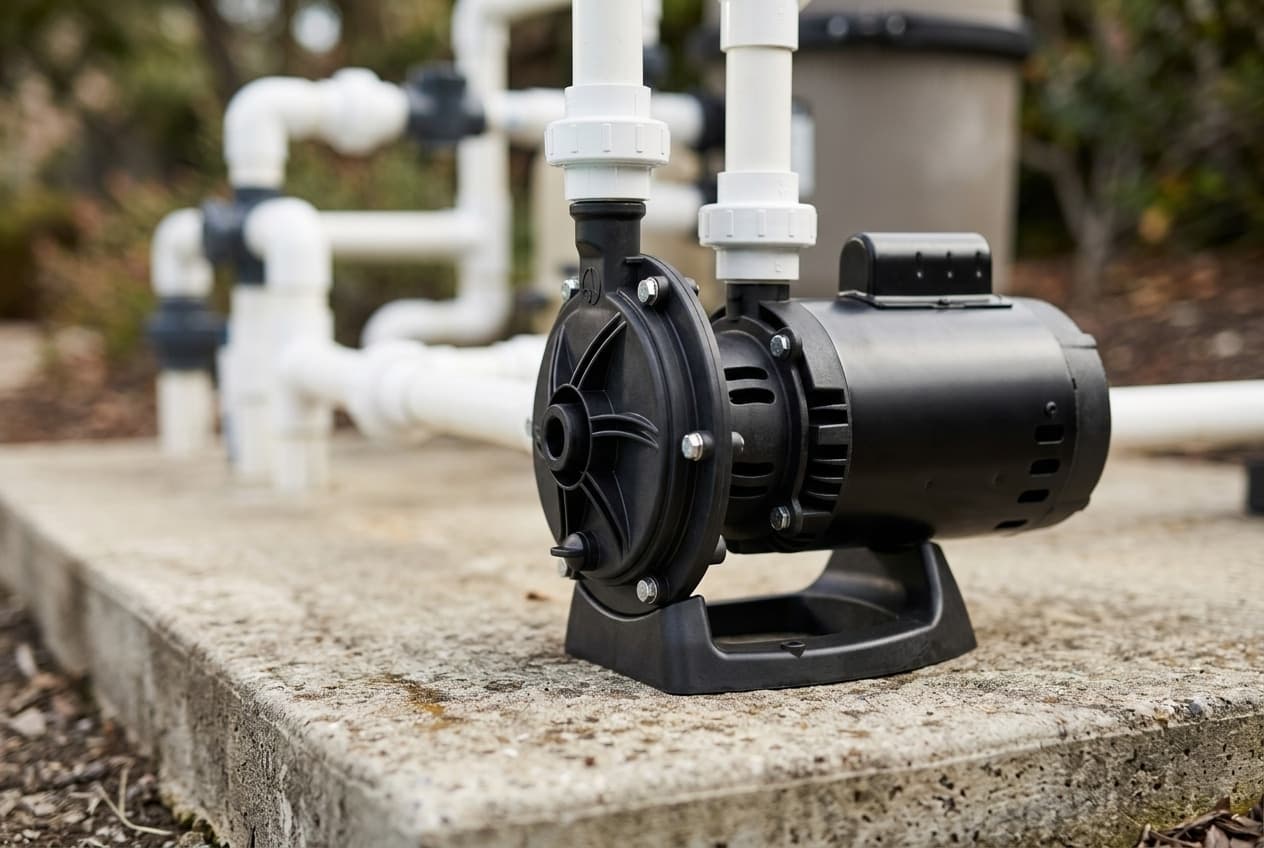
A pressure-side cleaner does not run on your filter pump. It runs on this, a second ¾ HP pump that does nothing except feed the cleaner, and it is the reason a Vac-Sweep 280 or 3900 Sport costs more to own than its price suggests.
At 12.8 amps on 115 volts it is close to a kilowatt whenever it runs. The booster pump article works through what that does to a bill.
Three ways to void the warranty, all of them easy
Polaris puts three separate cautions in this manual, and none of them describe a defect. They describe ways of running the pump that destroy it.
Never run it without the filtration pump. The PB4-60 is not self-priming — it relies on the filter pump to push water to it. Polaris: "Running the booster pump without a filtration pump will damage the booster pump. Improper operation of the booster pump will void the warranty."
Never run it dry. "Running the pump 'dry' for any length of time can cause severe damage to both the pump and motor and will void the warranty." For any length of time. The mechanical seal can go in minutes, and the leak that follows runs into the motor bearings.
Never run it without the cleaner connected. "Running the pump without the cleaner connected will cause damage to the pump impeller and will void the warranty." With nothing restricting the discharge the pump runs well past its design point. The usual way this happens is the cleaner coming out for winter while the timer keeps running.
All three come down to when the booster gets power. Polaris's own answer is a separate time clock, set to turn the booster on at least half an hour after the filtration pump starts and off at least half an hour before it stops, and it says to check periodically that the two clocks are still synchronized. That works while both clocks are right. Wiring that makes the mistake impossible is safer: the booster fed from the load side of the filter pump timer, or run by an automation system that sequences the two. Getting this wrong is the single most expensive mistake available on a pool pad, and it is invisible until the pump is dead.
The electrical numbers
¾ HP, 3,450 RPM, service factor 1.5, 60 Hz single phase. It draws 6.4 amps at 230 volts or 12.8 at 115.
Two things follow. It arrives factory wired for 230 volts, so a 115 V installation needs the motor changed over rather than just the supply connected. And on 115 volts Polaris notes that the motor's starting current can exceed 15 amps, and recommends a 20 amp breaker. The running current is 12.8 amps, comfortably under 15, which is exactly why this catches people out: the pump runs fine on a 15 amp circuit once it is going, and the breaker trips at the moment it starts — often when the timer kicks it on and nobody is watching.
Ports are ¾ inch in and out, and it ships with six feet of reinforced hose and four quick-connect fittings, which is what makes it straightforward to drop into an existing pad.
Getting flow established
A booster that will not build pressure is often not faulty. Polaris's own start-up advice is to fit smaller eyeball fittings in the return lines, or plug one return, so more of the filter pump's output goes to the booster instead of back to the pool.
That is worth trying before assuming a problem. A cleaner that has always been sluggish on a pad with four wide-open returns is competing with them for water.
If the system is being pressure tested, the manual caps it at 35 psi — and warns at length about trapped air, because air compresses and a filter lid coming off under pressure is the one genuinely dangerous failure on a pad.
Winterizing, which is not optional
Polaris excludes freeze damage, so this is the difference between a pump that lasts a decade and one that lasts a season.
Drain all water from the pump and piping. Remove the drain plug — R0537000 — and store it somewhere you will find it, o-ring included. Polaris says so twice, which tells you how often that o-ring goes missing.
Better still, take the pump indoors. Once a qualified person has disconnected the wiring at the switch or junction box, the two quick-connect fittings loosen and the whole pump comes off the pad. Refit the conduit and terminal box covers so nothing gets into them over winter.
If antifreeze goes anywhere in the system it must be propylene glycol. The manual is explicit that other antifreezes are highly toxic and damage the circulation system.
And in spring, remember it still is not self-priming: the filter pump goes on and primes first, every time.
What actually fails
Short list, and the order tells you something.
The mechanical seal, R0445500, almost always first — and usually because the pump ran without water rather than because the seal wore out. A booster that has ever run dry should have this replaced before it runs again.
The motor, P61, second, and usually as a consequence of the seal rather than on its own. Water tracking along the shaft into the bearings is what kills it. Replacing a motor without replacing the seal that killed it is a repair you will do twice.
The impeller, R0536400, when the pump has run with no cleaner attached.
The volute, R0536300, from freezing.
Every one of those is an operating failure rather than a wear failure, which is unusual on a pool pad and is the whole argument for getting the wiring right on day one.
Which model do you have?
The model number is on the pump label. Everything else in the range is shared — these are the parts that change with it.
| Model | HP | SKU | Amps at 230 V | Amps at 115 V | Ports | Note |
|---|---|---|---|---|---|---|
| PB4-60 | ¾, service factor 1.5 | PB4-60 | 6.4 | 12.8 | ¾ in. | ¾ HP, 3,450 RPM, service factor 1.5. Factory wired for 230 V and switchable to 115 V. Ships with six feet of reinforced hose and four quick-connect fittings. |
Polaris PB4-60 parts, and what goes wrong
Read off the manufacturer’s parts list and checked before it ships. Open a row for what a bad one actually does — or start from the symptom and work down, which is the cheaper order.
What is it doing?
The mechanical seal, and the part that dies when a booster runs without water. It can fail in minutes rather than seasons, and once it does the leak runs straight into the motor bearings — which is how a wiring mistake becomes a whole new pump. If this pump has ever run dry, replace this before running it again.
Live pricing arrives when the retailer programs are approved.
Polaris states plainly that running the pump with no cleaner attached damages the impeller and voids the warranty — with nothing restricting the discharge the pump runs far past its design point. A cleaner disconnected for the winter is the usual way this happens.
Live pricing arrives when the retailer programs are approved.
Includes the seal and the backplate o-ring, which makes it the sensible buy when the seal has already gone and the backplate face is scored. The o-ring alone is R0536600.
Live pricing arrives when the retailer programs are approved.
Comes out every fall and is the part people cannot find in spring. Polaris says to store it somewhere safe and not to lose the o-ring, which is a fair indication of how often that happens.
Live pricing arrives when the retailer programs are approved.
The pump housing, and it includes the drain plug and its o-ring. Cracks here are usually freeze damage, which Polaris excludes from the warranty.
Live pricing arrives when the retailer programs are approved.
The ¾ HP motor. Before buying one, work out why the old one died — a motor that failed after a seal leak will do it again if the seal is not replaced too, and a motor that failed after running dry says the wiring lets the booster run without the filter pump.
Live pricing arrives when the retailer programs are approved.
Six feet of reinforced hose and four quick-connect fittings, which is what the pump ships with. The fittings alone are R0621000 and the hose alone is P19.
Live pricing arrives when the retailer programs are approved.
Four stainless bolts holding the motor to the backplate. Worth replacing rather than reusing on a pump that has spent a decade outdoors, because the ones that come out are rarely the ones that should go back.
Live pricing arrives when the retailer programs are approved.
If you are doing the job anyway
These get replaced together. Doing them in one pass costs a few dollars more and saves taking the same thing apart twice.
It ran dry
The seal goes first and the backplate face is usually scored by the time you look. Buying the backplate gets you both, and the drain plug o-ring is here because the pump has to come apart anyway.
- BackplateR0536700
- Drain plug with o-ringR0537000
Seal replacement
The seal, the backplate o-ring it sits behind, and fresh motor bolts. This is the whole wet-end service on a booster pump and it is a fraction of a new one.
- Ceramic and spring sealR0445500
- R0536600R0536600
- Motor bolts and washersR0536800
Winterizing
The plug comes out every fall and Polaris warns twice about losing the o-ring. Freeze damage is excluded from the warranty, which makes this the cheapest insurance on the pad.
- Drain plug with o-ringR0537000
Polaris PB4-60 manuals and documentation
Hosted by the manufacturer. These open on Polaris’s own servers, so they stay current.
Polaris PB4-60 warranty
1 year parts
One year from the date of retail purchase under Polaris's current warranty statement, and a booster pump is its own product on its own clock — the 380's printed warranty says outright that the booster pump is excluded from the cleaner's cover and carries its own. So a pressure-side setup is two warranties, not one. Polaris also names three operating conditions in this manual that void the warranty, and all three are things an owner can do in the first week: running the booster without the filtration pump, running it dry for any length of time, and running it without the cleaner connected. A fourth is freezing. None of them are defects — they are ways of using the pump that destroy it, which is why the wiring and the schedule matter more here than on any other piece of equipment on the pad.
Manufacturer’s termsPolaris PB4-60 complete parts list
Every part on the manufacturer’s exploded diagram, in their numbering. Marked rows are the ones covered above with a symptom and a diagnosis.
| No. | Part | Description |
|---|---|---|
| 1 | P61 | Replacement motor, ¾ HP what goes wrong |
| 2 | R0536600 | O-ring, backplate |
| 3 | R0445500 | Seal, ceramic and spring what goes wrong |
| 4 | R0536400 | Impeller what goes wrong |
| 5 | R0536300 | Volute — includes drain plug with o-ring what goes wrong |
| 6 | R0536900 | Bolts with washers and nuts — 6 off |
| 7 | R0537000 | Drain plug with o-ring what goes wrong |
| 8 | R0537100 | Base |
| 9 | R0536800 | Bolts and washers, stainless, motor — 4 off what goes wrong |
| 10 | R0617100 | Quick connect install kit — 6 ft hose and 4 fittings what goes wrong |
| 11 | R0621000 | Quick connect fittings — 4 off |
| 12 | P19 | Pump hose, 6 ft reinforced |
| 13 | R0536700 | Backplate — includes seal and backplate o-ring what goes wrong |