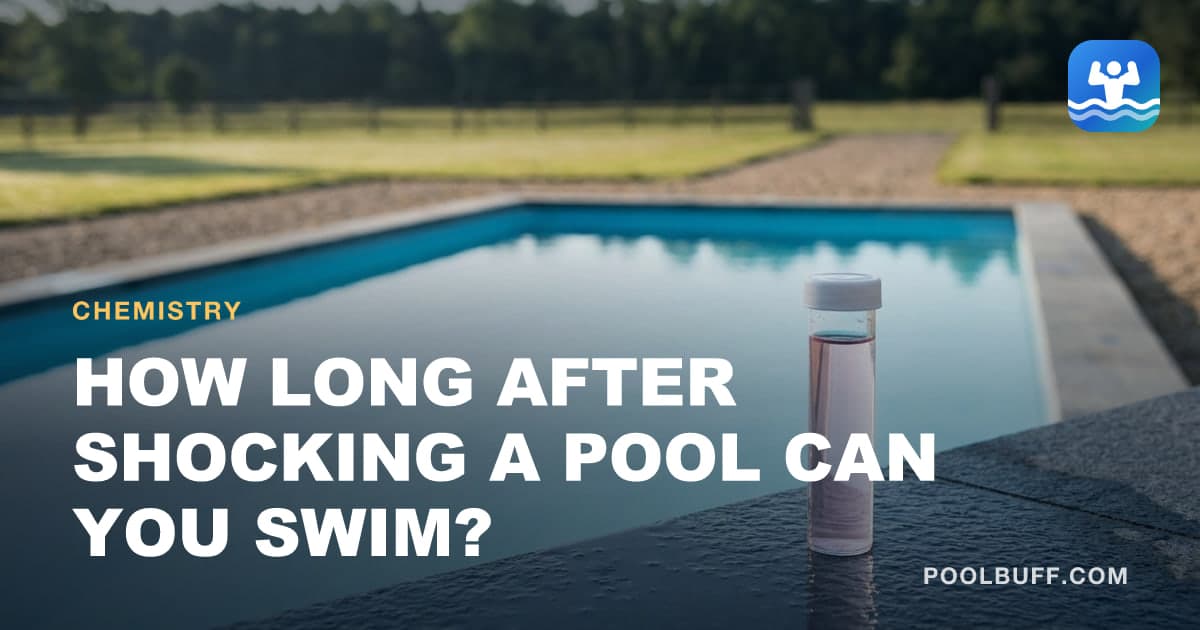
Every bottle says to wait 24 hours, and 24 hours is a number somebody picked because it is easy to remember.
Sometimes it is far too long. A light dose on a sunny pool can be swimmable by lunchtime, and you have written off a perfectly good afternoon. Sometimes it is not long enough — shock a pool with high stabilizer, or shock it hard after an algae bloom, and 24 hours later it can still be sitting well above where anyone wants to swim.
The pool does not know what time you added the chlorine. It only knows how much is still in the water.
Key takeaways
- Wait for a number, not a clock. Free chlorine at or below 4 ppm, the limit on current chlorine labels, is the gate.
- "Wait 24 hours" is a guess that is too long about as often as it is too short.
- Non-chlorine shock (MPS) lets you back in after roughly 15 minutes.
- Shock at dusk. Overnight is the cheapest waiting you will ever do.
- High cyanuric acid means a bigger shock dose, which means a longer wait.
The number that actually decides it
Free chlorine at or below 4 ppm. That is the gate, and it comes from the chlorine you poured rather than from anybody's rule of thumb.
Current pool chlorine labels from HTH, Clorox, BioGuard, Leslie's and KIK all prohibit swimming above 4 ppm of free chlorine, and a couple of OxyChem labels say 3. Each label also says that using the product any other way is a violation of federal law.
It is a legal line more than a safety cliff. The CDC's model health code lets a public pool run up to 10 ppm while it is open, though it defers to the label. Its annex says it found no data suggesting health risks at 4 ppm or even well above it. But the label is the instruction that came with the product.
One catch if your stabilizer is high. This site's everyday chlorine target is about 11.5% of your CYA, which passes 4 ppm once CYA is above about 35, so a pool held on that target sits above the label's line. How to lower chlorine in a pool takes that conflict head on.
The second half of the gate is pH between 7.2 and 7.8. This gets forgotten, and it matters more than the chlorine number for how the water feels. Chlorine that has been added as cal hypo pushes pH up; liquid chlorine does too, briefly, before settling. Water at 8.2 stings eyes at any chlorine level, and people blame the shock for something the pH did.
So the test before anyone gets in is two numbers, not one. If you have a drop-based kit it takes ninety seconds.
So how many hours is it, really?
Assuming a normal shock on an outdoor pool with the pump running, 8 to 24 hours covers most of it. Four things move you within that window, and they are worth knowing because you can control three of them.
How much you added. Obvious, and still the biggest factor. Doubling the dose does not double the wait, but it lengthens it considerably.
Sunlight. UV destroys free chlorine, which is a nuisance every other day of the year and a favor here. A sunny day after a shock burns the excess off fast. A cloudy one, or a heavily shaded pool, drags it out.
Cyanuric acid. The higher your stabilizer, the more chlorine a proper shock requires in the first place — shock level is about 40% of your CYA — and stabilizer's whole job is to slow the sun down. A pool at 80 ppm CYA is starting from a bigger number and losing it more slowly. Both push the same direction.
Whether the cover is on. A solar cover blocks the UV that is doing the work. Leaving it off after a shock is free and makes a real difference.
Which is why the practical advice is unglamorous: shock at dusk. The chlorine does its work overnight when there is no sun to waste it, the pool is unused anyway, and the waiting happens while you are asleep. By mid-morning most pools have come back down on their own.
Granular shock has an extra rule
Everything above is about the chlorine dissolved in the water. Granular products come with a second hazard that has nothing to do with the reading.
Undissolved granules on the floor are a contact risk. Cal hypo sitting in a pile against a vinyl liner will bleach it, and against skin it will burn. This is not a subtle effect, and it is the reason granular products say to pre-dissolve in a bucket before adding, and to brush the floor afterward.
If you have added granular shock and can see anything on the bottom, nobody swims — regardless of what the test says about the water. Brush it, run the pump, and check again.
Liquid chlorine avoids this entirely, which is one more argument for it on a pool that gets shocked often.
The exception: non-chlorine shock
Potassium monopersulfate, sold as MPS or non-chlorine shock, changes the answer completely. It oxidizes the waste that makes water smell and sting without raising free chlorine at all, so there is no elevated chlorine level to wait out.
Most manufacturers put it at about 15 minutes with the pump running.
That is genuinely useful in narrow circumstances: an evening when the water needs freshening and people want to get in, an indoor pool where chloramines build up faster, a spa. What it will not do is kill algae or sanitize — it is not a substitute for chlorine, and using it as one is how people end up with a green pool and a shelf of empty bottles.
One trap worth knowing: MPS reads as combined chlorine on a DPD test for a day or so afterward. Do not add it in the evening, test the next morning, see combined chlorine and shock the pool again for no reason.
Getting back in sooner
If you have overshot and want the level down, the free options come first.
Run the pump and take the cover off. Circulation plus UV is what brings it down, and both are already available to you.
Let the sun do it. A hot, bright afternoon can drop a pool several ppm on its own.
Chlorine neutralizer — sodium thiosulfate — works, and it is worth keeping for a genuine overshoot. It is also very easy to overdose, and overshooting in that direction leaves the pool with no sanitizer at all, which is a worse problem than waiting an extra afternoon. Add a fraction of the stated dose, circulate, retest, and repeat if you need to. How to lower chlorine in a pool has the published doses, and why they disagree.
What does not work is dilution by garden hose. Replacing enough water to move the reading meaningfully means replacing a lot of water, and you will spend more time filling than you would have spent waiting.
The short version
Test, do not count. Free chlorine at or below 4 ppm and pH in the 7.2 to 7.8 band, and the pool is yours again.
Shock at dusk and that test usually passes before breakfast, which is the whole trick — the waiting is unavoidable, but it does not have to happen during daylight.
Go deeperShocking it properly in the first placeThe level that actually works for your stabilizer, and why stopping a day early is the common mistake.Frequently asked questions
How long after shocking a pool can you swim?
Until free chlorine is at 4 ppm or lower, which is the limit printed on current pool chlorine labels. In practice that is usually 8 to 24 hours after a chlorine shock, depending on how much you added, how much sun the pool gets and how high your stabilizer is. Test before anyone gets in rather than counting hours.
Is it dangerous to swim in a pool that was just shocked?
At the levels a residential shock reaches it is far more unpleasant than dangerous. Expect stinging eyes, dry and itchy skin, and faded swimwear. The real hazard is with undissolved granular shock, which can sit on the floor and bleach a vinyl liner or burn skin on contact, so never enter a pool where granules have not fully dissolved.
Can you swim right after using non-chlorine shock?
Almost. Potassium monopersulfate does not raise your chlorine level, so the usual waiting rule does not apply — most manufacturers say about 15 minutes with the pump running. That is the main practical reason to keep some around, and it is why it suits an indoor pool or a spa that gets used most evenings.
Why does my pool still read high chlorine the next day?
Usually one of three things. You dosed heavily, the pool is shaded or it was a cloudy day so sunlight has not burned the excess off, or your cyanuric acid is high enough to hold chlorine in reserve. None of them is a fault. Keep testing and it will come down; running the pump and leaving any solar cover off both speed it up.
How do I make chlorine drop faster so I can swim?
Sunlight and circulation do it for free — run the pump and take the solar cover off, because a covered pool holds chlorine far longer. Products sold as chlorine neutralizers work and are worth having for an overshoot, but they are easy to overdose, which leaves you with no sanitizer at all. Add a fraction of the stated amount, wait, and retest.