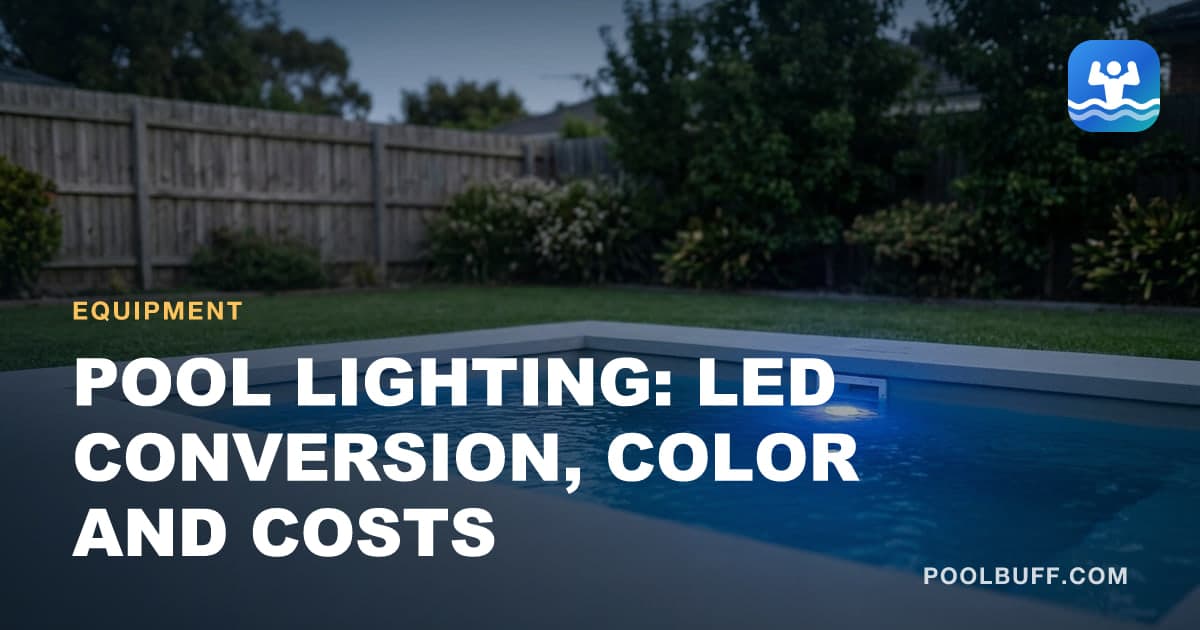
Lighting is the most under-rated upgrade in pool ownership.
Not because it's dramatic. Because it roughly doubles the hours you actually use the thing. A pool that's beautiful until dusk becomes a pool that's used until eleven, and that changes how you feel about owning it far more than a heater does.
Key takeaways
- Lighting is the cheapest way to double the hours you actually use the pool.
- LED retrofit bulbs drop into most existing niches, no re-plumbing or re-wiring required.
- Color-changing systems are genuinely fun and the sync between multiple lights is the annoying part.
- Pool light circuits require GFCI protection and proper bonding. This is licensed work.
- Never change a pool light with water in the niche and power on. People have died doing this.
The LED case
An old-style incandescent pool light draws 300–500 watts. An equivalent LED draws 40–70.
Run four hours a night for six months at $0.17/kWh:
| Watts | Season cost | |
|---|---|---|
| Incandescent 500W | 500 | ~$62 |
| LED 60W | 60 | ~$7 |
That's $55 a season on one light. Not transformative on its own — but add that you stop replacing $30 bulbs every year or two, and the LED lasts eight to fifteen years, and the payback is comfortable.
The real argument is quality of light, though. LEDs are brighter for the wattage, they don't yellow, and color systems are only possible with them.
Retrofit or full fixture?
Retrofit bulb. Drops into your existing niche and fixture. No re-plumbing, no conduit work, no digging. $150–$400 for the bulb. Our pool light picks cover how to tell which of the two you need.
This is the right answer for most conversions. Check the bulb is rated for your fixture's niche size and voltage — pool lights are commonly 12V or 120V, and you must match.
Full fixture replacement. Needed if the existing fixture is corroded, the lens is cracked, the gasket has failed, or you want a different beam pattern. $400–$1,200.
New niche. Only if you're adding a light where there wasn't one, which means breaking into the shell and running conduit. This is a construction job, best done during resurfacing when the pool is drained anyway.
Color systems
Color-changing LEDs are genuinely enjoyable and they're what most people buy now.
What's good: preset shows, dimming, and matching the pool light to landscape lighting for a coherent look. On a pool used for entertaining, it earns its cost.
What's annoying: synchronizing multiple lights. Most systems sync by cycling power in a specific pattern, and if two lights fall out of step you're flicking a switch on and off in a sequence from the manual to get them back. It's the single most common complaint.
Controller-based systems handle this properly and cost more. If you have three or more lights, get one.
Stay in one brand. Color systems from different manufacturers won't sync with each other, and you'll end up with a pool that's blue at one end and green at the other. The light pages here cover Pentair, Hayward and Jandy fixtures, with the voltage each one runs on.
Voltage, niches, and the cord nobody thinks about
Three physical details decide whether a light you like will actually fit the pool you have.
The niche. Most inground pools use a wet niche — a housing set into the wall that the fixture seats into and that fills with water. The fixture is cooled by that water, which is why an incandescent pool light must never be run dry, even briefly. Above-ground pools and some fiberglass shells use a surface-mounted or through-wall fixture instead, and the two are not interchangeable. A fixture is listed for particular niches, and not always only its maker's: Jandy lists its Infinite WaterColors niched light for several Pentair and Hayward niches. Check your niche's model number against the manual's list before buying.
Voltage. Pool lights run at 120V or at 12V through a transformer. Twelve volt is the safer arrangement and is required in some situations, but a retrofit bulb has to match what your existing wiring and transformer actually supply. A 12V bulb on a 120V circuit fails instantly; the reverse simply never lights.
Cord length. This is the detail that catches people. The cord runs from the fixture back to the junction box, and there has to be enough of it — usually several feet coiled in the niche — for the whole fixture to be lifted out and laid on the deck for servicing without disconnecting anything. Order one too short and you cannot change a bulb without an electrician pulling new cable through the conduit.
Measure the cord you have before ordering. It is part of the part number on every replacement fixture sold.
How many lights, and how bright
One light in the deep end is the standard builder specification, and on anything longer than about thirty feet it is not enough. The shallow end stays dim, and from the deck the pool reads as a dark hole with a glow at one end of it.
A workable rule is one fixture per 300 to 400 square feet of water surface, with a second added on any pool over roughly 30 feet long, or with an L-shape or a raised wall throwing a shadow. A 16-by-32 pool is comfortable with two.
Brightness is quoted in lumens, running from around 500 for an accent fixture to 5,000 and beyond for a main light. More is not automatically better. A single very bright fixture in clear water glares from the deck and washes out the color systems people pay extra for — two moderate lights illuminate a pool better than one fierce one, for the same reason two lamps light a room better than one bulb.
The electrical side
This is where it stops being a DIY job.
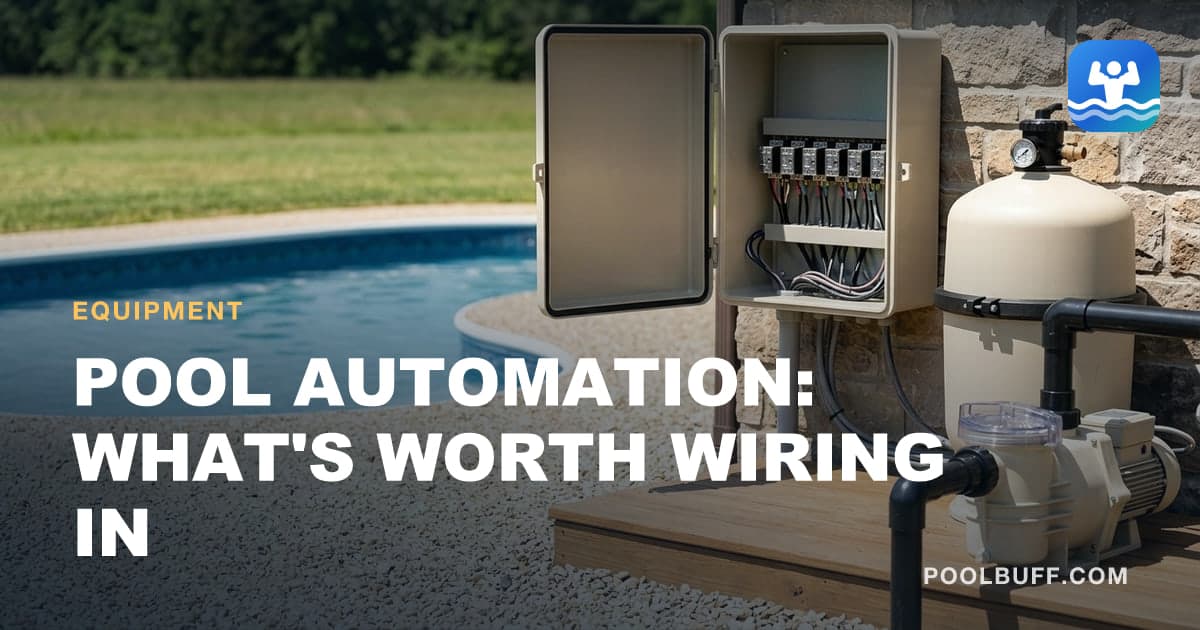
GFCI protection is required on pool lighting circuits. Ground fault protection is what stops a fault becoming an electrocution in a wet environment.
Bonding. The niche, the conduit and the fixture have to be part of the equipotential bonding grid — the buried copper network tying everything around the pool to the same electrical potential. This isn't grounding, it's a separate requirement, and it's what prevents a voltage difference existing across a swimmer.
Older pools frequently fail on both. A pool from the 1970s may have neither. An LED conversion is a sensible moment to have it brought up to standard, and you want that done before anything else.
If you are here because a light has stopped rather than because you want a brighter one, work through the dead-light checks first — the GFCI, the breaker and the transformer account for most of them, and a fair number of "failed" color lights turn out to be doing exactly what they were designed to do.
Landscape lighting
The other half of the job, and the half people skip.
The pool light alone lights the water and leaves everything around it black. Add low-voltage landscape lighting — a few uplights on specimen plants, low path lights, a warm wash on a boundary wall — and the whole space becomes usable rather than a lit pool in a dark yard.
Keep it warm-toned. Cool white landscape lighting next to a blue pool looks clinical.
Low-voltage landscape lighting is more DIY-friendly than pool lighting, but anything within the pool's bonding zone still falls under pool electrical rules. Check before you start.
Go deeperPoolside planting and designWhat to plant, what to avoid, and where lighting fits in.Frequently asked questions
Is it worth converting pool lights to LED?
Yes. An LED uses 75-85% less energy than the incandescent it replaces, lasts far longer, and runs cooler. A 500W incandescent replaced with a 60W LED running four hours a night saves roughly $30-$50 a season, and you stop replacing bulbs every year or two.
How much does a pool light cost to replace?
A drop-in LED retrofit bulb is $150-$400 plus installation. A complete new fixture is $400-$1,200. Color-changing systems sit at the higher end, and controllers add more. Labor is typically $150-$400 unless the conduit or niche needs work.
Can I change a pool light myself?
The bulb swap itself is mechanically simple, but pool light circuits involve GFCI protection and equipotential bonding, and the niche has water in it. This is licensed electrician territory in most jurisdictions and it's genuinely one of the more dangerous DIY jobs around a pool.
Do pool lights need GFCI protection?
Yes. Pool lighting circuits require ground fault protection under electrical code, and the niche and its conduit must be part of the equipotential bonding system. If your pool is old enough that this was never done, an LED conversion is a good moment to bring it up to standard.
How long do LED pool lights last?
Rated life is typically 30,000 to 50,000 hours, which at four hours a night is fifteen to thirty years. In practice the driver electronics or the seal usually fail before the diodes, so realistically expect eight to fifteen years — still far longer than an incandescent.