PoolRx · PoolRx
PoolRx Blue and Black
PoolRx's Blue and Black mineral units: what the EPA label says is in them, which size fits your pool, when to add a booster, and every unit and booster number.
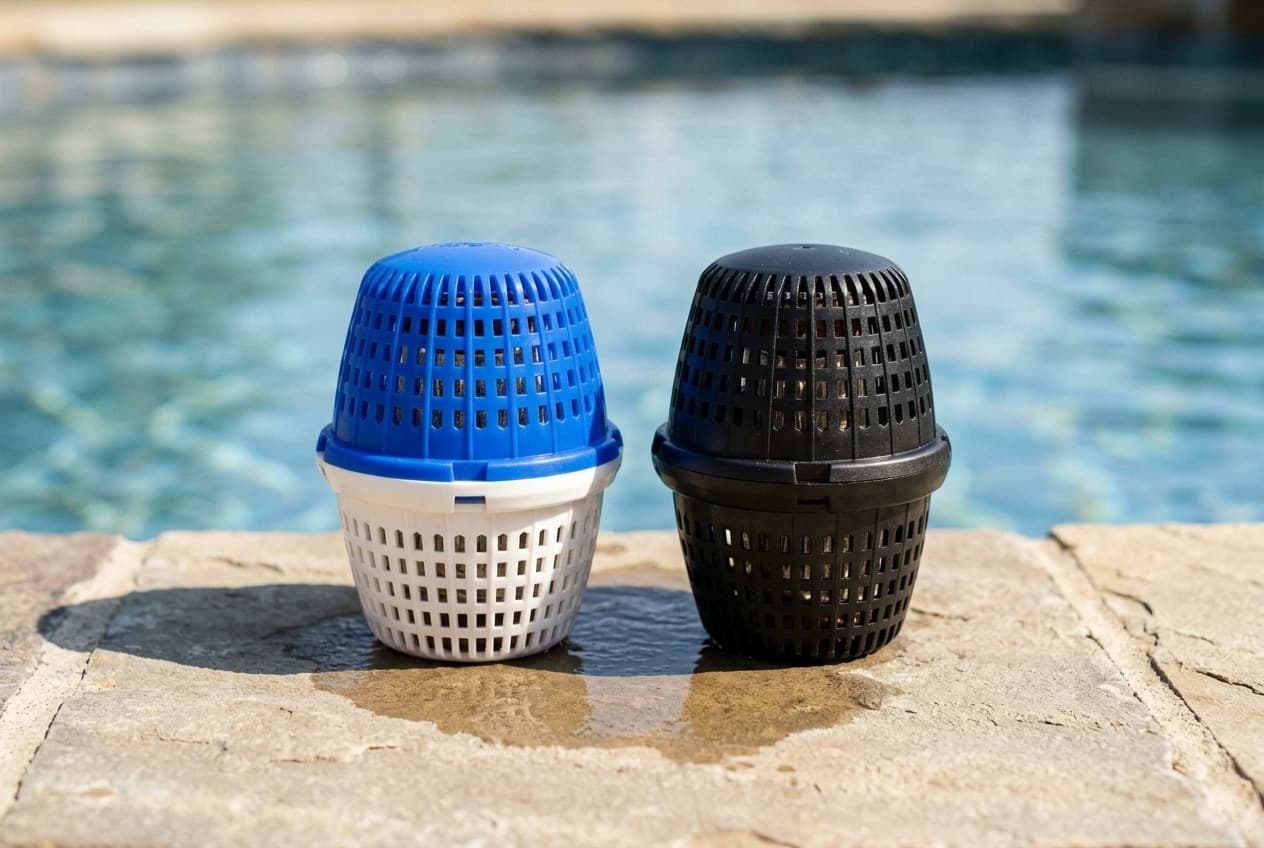
PoolRx's Blue and Black units are the same product in two sizes: a plastic shell holding a cylinder packed with blue mineral granules, which goes in the skimmer or the pump basket. The EPA registers it, under Reg. No. 79817-3, as a mineral algaecide. The Blue unit, #101001, treats 7,500 to 20,000 gallons, and the Black unit, #101066, treats 20,000 to 30,000. On 13 September 2026 PoolRx's own store had them at $75.00 and $94.00.
What is in it
The label lists one active ingredient: copper sulfate pentahydrate, chelated, at 52.8%, with the other 47.2% undisclosed. The Blue unit holds 0.72 lb (327 g) and the Black 1.2 lb (544 g), per the net weights on the label.
These are PoolRx's original units. PoolRx+ is a separate product under its own registration, 79817-4, sold as Blue/White and Black/White "with silver". Its label lists copper sulfate pentahydrate at 86.85%, zinc sulfate monohydrate at 1.51% and silver nitrate at 0.40%. PoolRx's FAQ describes silver as the difference between the two lines. Its salt pool FAQ also says there is "some zinc in the mineral formulation", though zinc is not an active ingredient on the Blue and Black label.
PoolRx says the minerals are chelated so they stay in solution rather than staining, and that they recharge each time they pass back through the cylinder. The label's approved wording includes "6 Month Algaecide", and it pairs the product with a constant low level of chlorine. It is not sold as a replacement for chlorine.
Which size
PoolRx's sizing chart:
- 7,500 to 20,000 gallons: Blue unit.
- 20,000 to 30,000 gallons: Black unit.
- 30,000 to 40,000 gallons: Blue unit and a Blue booster.
- 40,000 to 50,000 gallons: Black unit and a Blue booster.
- 50,000 to 60,000 gallons: Black unit and a Black booster.
Smaller pools and spas take other units in the same line: a White unit for 1,000 to 2,500 gallons, bought in bundles of two and three for pools up to 7,500, and spa units down to 100 gallons.
More is not better. PoolRx's FAQ says there is a wide margin for error in sizing, but that you can overdose. Too much mineral for the water cannot dissolve, and it settles on the floor or sticks to scale as blue granules. An undersized unit has the opposite problem: PoolRx says the water needs the proper concentration of minerals before algae cannot grow in it.
Before you install it
From PoolRx's directions for use:
- Test for copper and iron. Above 0.2 ppm, sort that out first. PoolRx's FAQ names well water, old copper plumbing, a copper heat exchanger and other copper products as the usual sources.
- Start with a clean filter. Clean or backwash it, and empty the skimmer and pump baskets.
- pH between 7.2 and 7.8.
- Chlorine below 10 ppm.
Test copper before the first unit, because you cannot usefully test it afterward. PoolRx's FAQ says the chelated minerals do not give an accurate or consistent copper reading, and that the reading will not be reliable until the minerals have been used up and filtered out, about six months later.
Installing it
The EPA label's directions:
- Clean or backwash the filter and clear debris from the skimmer and pump basket.
- Put the unit in the pump basket or the skimmer. The label says the pump basket is ideal, for flow.
- Add it when the pump has at least 3 to 4 hours left in its run cycle, so the granules dissolve out of the unit and through the filter.
- Run the pump in the heat of the day, and long enough to turn the pool over at least 1.5 times a day, which the label puts at 6 to 8 hours for most pools.
- Do not clean or backwash the filter for at least 2 weeks.
PoolRx's website adds filter settings to keep granules from lodging in the filter. On a sand filter, switch the valve to bypass or recirculate for a 12-hour run, then back to filter. On a cartridge filter, run without the cartridge for the cycle, then put it back. On a D.E. filter, use the minimum D.E. and do not pack the filter too full. Its green-to-clear page, written for PoolRx+, recommends a floater for D.E. filters.
The unit stays in the basket after the granules are gone. PoolRx's booster FAQ says the minerals need contact with the cylinder, and without it they lose their effectiveness within two to four weeks. It is safe to swim as soon as the unit is in, according to PoolRx.
Chlorine and the rest of the water
The label's maintenance ranges:
- Residential chlorine: min. 0.5 to 1.0 ppm. Commercial: 1.0 to 5.0 ppm.
- pH: 7.2 to 7.8.
- Total alkalinity: 80 to 120 ppm.
- Cyanuric acid: 10 to 80 ppm.
PoolRx's FAQ adds that you can keep chlorine higher if you wish. Whether 0.5 to 1.0 ppm is enough is a question of your stabilizer level. PoolBuff's view, and the arithmetic behind it, is in the PoolRx review and what cyanuric acid does to chlorine.
For a green or cloudy pool, PoolRx's directions say to hold chlorine at 2.0 ppm until it clears, clean the filter more often and vacuum. Its green-to-clear page for PoolRx+ adds pH at 7.2 to 7.4, daily checks, running the pump around the clock for faster results, and that the minerals may need replacing at about four months afterward because of the algae they killed.
The NSF listing is worth reading precisely. PoolRx and its boosters are certified to NSF/ANSI 50 as an algicide, but NSF's footnotes say the certification is for health effects only, that the products are not certified for performance claims, and that the maximum dose is 0.44 oz per 100 gallons.
What it does not mix with
- Bromine, sodium bromide and biguanides. The label says the units are not compatible with bromine or biguanides, and PoolRx's FAQ adds sodium bromide. With bromine, PoolRx says, the water can take on a yellow tinge or foam, in spas as well as pools.
- Other copper products. PoolRx's FAQ says not to use them, because you do not want to saturate the water, and that any copper that falls out would be the free, non-chelated copper.
- Granular cal-hypo, sprinkled in. PoolRx says all types of chlorine are compatible, but asks that cal-hypo be dissolved first, a pound to a 5-gallon bucket, and poured slowly around the deep end. Otherwise, it says, the granules can oxidize black or gray where they settle. The marks fade over a few weeks.
- UV and ozone are fine, PoolRx says. Its FAQ says phosphate removers are compatible, though the label says you do not need them, and PoolRx says that since most salt system makers ask for low phosphates, it understands owners who keep using one.
How long it lasts
- The minerals: up to six months. PoolRx says they are lost to algae kill, backwashing, filter cleaning and splash-out, so a pool that works them hard gets less.
- A booster: after four to six months, if needed. The signs PoolRx gives are algae coming back or dull water, and chlorine demand climbing back to where it was before PoolRx. PoolRx says the change is gradual, over about two weeks.
- The unit: replace it every 12 months, and start each season with a new one. In warm climates or a year-round season, the label says to add a booster when needed or after six months.
On a salt pool, PoolRx's FAQ says you can turn the chlorine generator down by about 50% from its previous setting, and that the zinc in the formula makes scale less likely to attach to the cell.
Handling and draining
The label carries the signal word DANGER. The granules are corrosive, cause irreversible eye damage, may be fatal if swallowed and are harmful if inhaled. Wear goggles, a face shield or safety glasses, and wash after handling. Store the product dry, in its container, below 120°F.
The label also says the product is toxic to fish and aquatic invertebrates. Before draining a treated pool, contact your local sanitary sewer and storm drain authorities and follow their discharge instructions. Do not let the water reach a gutter, storm drain or natural water body unless state and local authorities allow it.
Where PoolRx's documents disagree
- Skimmer or pump basket. The label says the pump basket is ideal, for flow. The FAQ recommends the skimmer if flow is good, because it gives the minerals more time to dissolve before the filter.
- How long the pump should run afterward. The label and product pages say at least 3 to 4 hours. The filter pressure FAQ says a minimum of 4 to 6.
- How fast the granules dissolve. PoolRx's pages give 1 to 6 hours, 4 to 6 hours and "within 6 hours".
- The filter after installing. The label says not to clean or backwash for two weeks. The website's post-installation directions say to clean the filter more often until the pool is clear.
- The Black booster's dose. The label says 12 oz for 20,000 to 30,000 gallons. PoolRx's product page for the Black booster says 8 oz per 7,500 to 20,000 gallons.
- Chlorine on the booster pages. They give only 1.0 to 5.0 ppm, the label's commercial range, without the residential minimum.
- Replacing PoolRx+ units. PoolRx+ pages say both "replace the unit every 4 to 6 months" and a new unit every year. The Blue and Black label says every 12 months, with boosters in between.
Buying it
PoolRx sells direct, and an alternate brand name, Leslie's MineralRx, appears on the same EPA registration. PoolRx's site warns that lookalike products show up in Amazon searches for PoolRx, using similar packaging and names, and that they are not EPA-registered or NSF certified. It names four Amazon sellers it trusts: R10 Store, Save More on Pool Supply, Poolzilla and Four Seasons Pool Supply.
The label gives PoolRx's phone number as 1-800-376-6579.
Which model do you have?
The model number is on the mineral cartridge label. Everything else in the range is shared — these are the parts that change with it.
| Model | SKU | Pool size | Net weight | Booster | Note |
|---|---|---|---|---|---|
| Blue unit | 101001 | 7,500–20,000 gal | 0.72 lb (327 g) | 102001 | $75.00 on PoolRx's store on 13 September 2026, and $37.00 for its booster. |
| Black unit | 101066 | 20,000–30,000 gal | 1.2 lb (544 g) | 102066 | $94.00 on PoolRx's store on 13 September 2026, and $56.00 for its booster. |
PoolRx Blue and Black units and boosters, and what goes wrong
Read off the manufacturer’s own documents and checked before it ships. Open a row for what the problem looks like and what the maker says to do — or start from the symptom and work down.
What is it doing?
PoolRx's FAQ covers both. Granules leaving the cylinder are normal: they are the minerals, and they start dissolving as soon as they are wet, which is why PoolRx says to run the pump at least 3 to 4 hours after installing. Granules still there days later usually mean weak flow over the unit, such as a skimmer with poor suction. In rare cases, PoolRx says, the holes in the top and bottom of the plastic shell are not punched all the way through, and it tells owners to push them through with a screwdriver. It says the delay does not shorten the unit's life.
Live pricing arrives when the retailer programs are approved.
PoolRx's FAQ says a filter can clog with the influx of minerals, and that high pressure with restricted flow means backwashing or cleaning the filter right away. The label separately says not to clean or backwash for two weeks after installing. Both documents start from a clean filter, which is what keeps the two instructions from colliding. The label also says to replace the unit every 12 months and to start each season with a new one. Both apply to the Blue unit too.
Live pricing arrives when the retailer programs are approved.
These are PoolRx's three signs that the minerals are used up. It says they are lost to algae kill, backwashing, filter cleaning and splash-out, and that the change comes on over about two weeks. The booster is 8 oz of the same granules. The label says to put it in the skimmer or pump basket with the unit left in place and at least 3 to 4 hours of pump run time left, then not to clean or backwash the filter for two weeks.
Live pricing arrives when the retailer programs are approved.
The EPA label gives the Black booster as 12 oz of granules for 20,000 to 30,000 gallons. PoolRx's product page for it repeats the Blue booster's 8 oz per 7,500 to 20,000 gallons, which reads as copied text; go by the label. PoolRx's sizing chart also uses a booster at installation in big pools, and for 50,000 to 60,000 gallons that is a Black unit with a Black booster.
Live pricing arrives when the retailer programs are approved.
PoolRx Blue and Black manuals and documentation
Hosted by the manufacturer. These open on PoolRx’s own servers, so they stay current.
- EPA-accepted label for PoolRx, Reg. No. 79817-3 (June 2023) — directions, sizes, part numbers and precautionsmanual
- PoolRx directions for use — installation and filter settingsmanual
- PoolRx sizing chart — units and boosters by pool volumespec
- Blue unit product page — ingredients, directions and maintenancespec
- Black unit product pagespec
- PoolRx FAQ — testing for copper once PoolRx is in the waterspec
- PoolRx FAQ — what a booster is and when it is neededspec
- NSF listings for PoolRx under NSF/ANSI 50spec
PoolRx Blue and Black units and boosters
Every unit, booster and refill number the manufacturer lists for this line, from its own documents and its EPA label. Marked rows are the ones covered above with a symptom and a diagnosis.
| Item | Description | Note |
|---|---|---|
| 101001 | Blue pool unit, 7,500 to 20,000 gallons what goes wrong | 0.72 lb (327 g) of granules |
| 101066 | Black pool unit, 20,000 to 30,000 gallons what goes wrong | 1.2 lb (544 g) of granules |
| 102001 | Blue booster, 7,500 to 20,000 gallons what goes wrong | 8 oz (227 g) |
| 102066 | Black booster, 20,000 to 30,000 gallons what goes wrong | 12 oz, per the EPA label |
| 101057 | Spa/hot tub unit, 100 to 400 gallons | 0.44 oz (12.5 g). Replaced every time the spa is drained, or every 4 to 6 months |
| 101055 | Spa/hot tub unit, 400 to 1,000 gallons | 0.88 oz (25 g). The label prints the number with a space, as 10105 5 |
| 101080 | Commercial unit | The label says to clean it every 12 months and replace it every 3 years |
| 102003 | Listed with the commercial unit, for 75,000 to 500,000 gallons | The label reads "commercial unit only; (needs part#; 102003)" without naming the part |
| 331001 | PoolRx+ Blue/White unit, with silver, 7,500 to 20,000 gallons | A separate product under EPA Reg. No. 79817-4, with zinc and silver added |
| 331066 | PoolRx+ Black/White unit, with silver, 20,000 to 30,000 gallons | PoolRx+, a different product from the Black unit, #101066 |
| 332001 | PoolRx+ Blue/White booster, with silver, 7,500 to 20,000 gallons | For PoolRx+ units. Dissolved in a bucket first, and never put into the unit |
| 332066 | PoolRx+ Black/White booster, with silver, 20,000 to 30,000 gallons | For PoolRx+ units |