If your pool switches to spa mode on its own, an actuator is doing it.
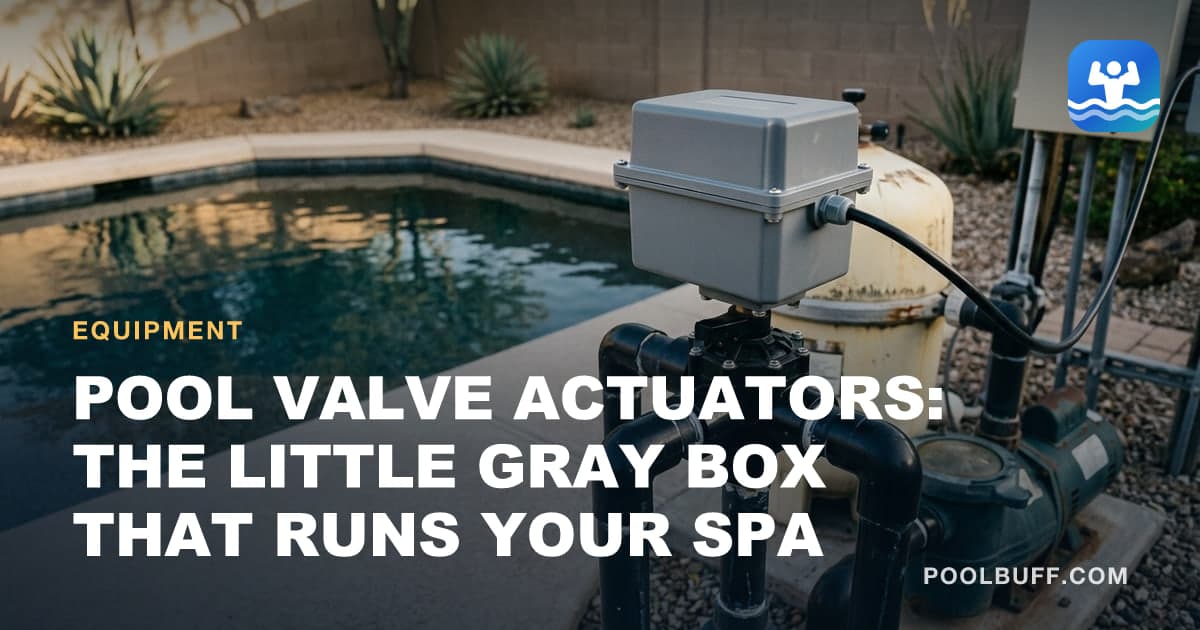
It's a gray box, about the size of a fist, bolted to the top of a diverter valve. Inside is a motor, a gear train, two cams and two limit switches. That's the entire device. Once you know what those four things do, most actuator problems solve themselves.
Key takeaways
- Set the valve's own travel stops first. The actuator has to be told a range the valve can physically do.
- The travel switch picks 90 or 180 degrees. The cams pick where inside that range it stops.
- Almost every actuator has a manual override so you can move the valve when the automation is down.
- Swapping two actuators is the fastest way to tell whether the fault is the actuator or the panel.
- An actuator that hums but does not move has stripped its gears. That is a replacement, not a repair.
What it's actually doing
The automation panel doesn't know where your valve is. It has no sensor and no feedback. It just sends power down one of two wires and waits.
The actuator turns until a cam inside presses a limit switch, which cuts the motor. Send power down the other wire and it turns back the other way until the second cam hits the second switch.
That's the whole story. The cams decide where the valve stops. Not the panel, not the software, not the app. Two pieces of plastic under the cover.
Which is why "my spa valve doesn't go all the way over" is almost never an electrical problem.
Where you'll find them
Three common jobs:
Pool and spa switching. Two actuators, one on the suction side and one on the return, moving together so the pump draws from the spa and returns to the spa.
Heater bypass. Sends water through the heater or around it, so you're not pushing full flow through a heat exchanger you aren't using.
Water features. A waterfall or deck jets on a schedule.
The pool/spa pair is the one that causes the most confusion, because when one actuator works and the other doesn't, you get water going into the spa and draining out of the pool. Or the reverse. It looks dramatic and it's usually one slipped cam.
Setting one up
Order matters here. Get it wrong and you'll be chasing your tail.
- 1
Set the valve's travel first
Before the actuator goes anywhere near it, turn the valve by hand and confirm it moves cleanly through the range you want. Set the valve's own internal stops if it has them. The actuator can only work inside a range the valve can physically do.
- 2
Pick 90 or 180 degrees
There's a small switch on the actuator, usually under the cover. A pool/spa valve normally needs 180. A simple on/off diversion is often 90. Get this right before you touch the cams, because changing it later moves everything.
- 3
Mount it with the valve in a known position
Turn the valve fully to one end by hand, then fit the actuator so its own position matches. Most have an arrow or a marker to line up. Skipping this is why some actuators end up permanently 90 degrees out.
- 4
Run it once and watch
Power it and let it drive to each end. Watch where it stops. Don't adjust anything yet — you need to see what it does before you know what to change.
- 5
Adjust the cams
Loosen the cam screw, nudge the cam a few degrees, tighten, run it again. Small moves. A cam controls one direction only, so change one at a time or you'll lose track of which did what.
Troubleshooting
Work through it in this order. The cheap checks first.
It does nothing at all
Check the manual override first. If the gears are disengaged from a previous repair, the motor can run happily and turn nothing.
Then check for voltage at the actuator while the panel is calling for the change. No voltage means the problem is upstream — a relay in the panel, a blown fuse, or a bad wire. Voltage present and no movement means the actuator.
It hums but doesn't turn
Stripped gears. The motor is spinning and the gear train isn't passing it on.
This is the most common failure on an older actuator, and it's usually caused by the valve underneath getting stiff. The actuator fights it, month after month, until the plastic gives up. Replace the actuator, but rebuild the valve at the same time or you'll be doing it again.
It runs continuously and never stops
A cam has slipped, or a limit switch has failed. The motor drives to the mechanical end and stalls there.
Cut power right away — leaving it stalled cooks the motor. Take the cover off and look at whether the cams still line up with the switch levers. A cam screw backing off over a few seasons is extremely common.
It only turns one way
One limit switch or one cam. The direction that works proves the motor and gears are fine, so the fault is on the side that doesn't.
Pool and spa are out of sync
One actuator is fine and one isn't. Swap the two actuators over. If the fault follows the actuator, it's the actuator. If it stays on the same valve, it's the panel, the wiring, or the valve itself.
That swap takes ten minutes and it's the single most useful diagnostic on the pad.
What wears out
Gears, from fighting a stiff valve. This is the big one, and it's preventable — a diverter valve that turns easily by hand won't kill an actuator.
Cam screws, backing off slowly until the stop position drifts.
Limit switches, eventually. They're mechanical and they click thousands of times.
Water ingress, if the cover gasket is missing or the housing is cracked. An actuator sitting in the open with a bad seal fills up and corrodes from inside.
The motor itself rarely fails first.
The maintenance nobody does
Once a season, put the actuator in manual, disengage the gears, and turn the valve by hand.
If it turns easily, you're fine. If it's stiff, pull the valve lid, clean the seal and lubricate it with silicone — never petroleum grease, which swells the rubber.
That one check, twice a year, is most of what keeps actuators alive. They don't die of old age. They die of pushing against a valve that nobody lubricated.
Go deeperThe valve underneathWhat each valve on the pad does, and how to rebuild a stiff diverter.Is it worth automating?
If you have a spa, yes. Manually turning two valves every time you want to sit in hot water gets old in about a week.
For a heater bypass, it depends on how much you run the heater. For a waterfall you switch on twice a summer, an actuator is around $150 to $280 to solve a problem your hand already solves for free.
Automate the things you'd otherwise do several times a week. Leave the rest on a handle.
Frequently asked questions
How does a pool valve actuator work?
A small gear motor drives the valve stem. The automation panel sends power on one of two wires depending on which direction it wants, and the actuator turns until an internal cam presses a limit switch and cuts the motor. That cam position is what decides where the valve stops.
Why does my valve actuator keep running and not stop?
A cam has slipped or a limit switch has failed. The motor never gets the signal to stop, so it drives to the mechanical end and stalls. Cut power, take the cover off and check whether the cams still line up with the switches before you replace anything.
Can I turn a pool valve by hand if the actuator is on it?
Yes. Every common actuator has a manual release, usually a lever or a knob that disengages the gears so you can turn the valve stem by hand. Some also have a toggle switch that drives the motor manually. Do not force the valve against an engaged gear train, though — that is how gears strip.
Are pool valve actuators interchangeable between brands?
The mounting pattern on most residential diverter valves is shared, so the major actuators bolt onto most valve bodies. The wiring is not always the same, though. Check the voltage and the wire assignment against your panel before you buy, because a 24 volt actuator on a 110 volt circuit is a one-time mistake.
How much does a pool valve actuator cost?
Expect roughly $150 to $280 for a mainstream 24 volt residential actuator in 2026, plus about an hour if a pro fits it. The valve underneath is far cheaper than the actuator on top, which is why it is worth rebuilding a stiff valve rather than making the actuator fight it.