Polaris · FREEDOM
Polaris FREEDOM Plus
The cordless Polaris robot with the underwater remote — the depth and temperature limits, and what the warranty will not cover.
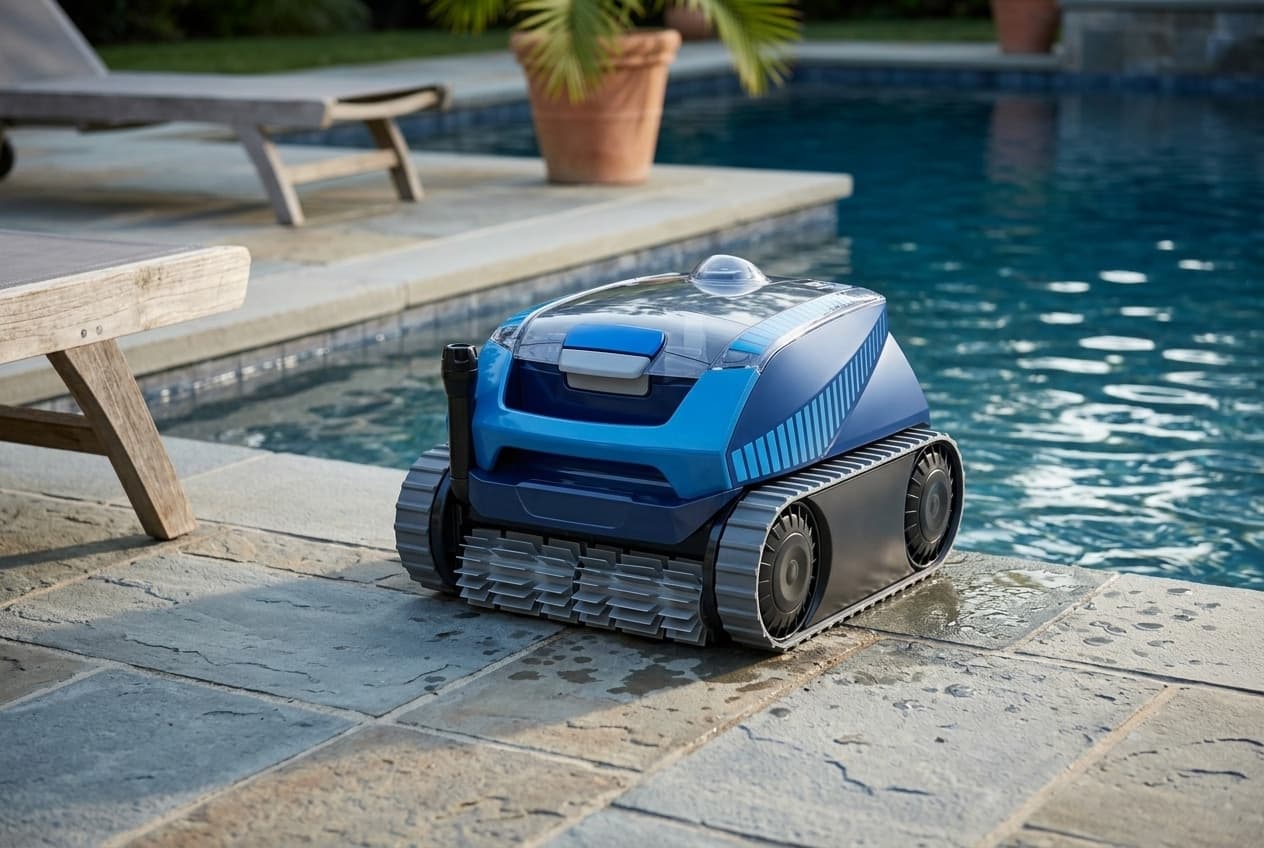
Three cleaners carry the FREEDOM name and they are not the same machine. Getting this wrong costs you either a remote you wanted or fifty dollars for one you already had.
FREEDOM Plus — SKU FFREEDOMP — is the one on this page. It ships with a hand-held remote that talks to the cleaner underwater, and an Easy-Charge caddy you can wheel to the pool.
FREEDOM — SKU FFREEDOM — is the same cleaning platform with no remote and a charging station rather than a caddy. Polaris's own specification tables differ on exactly two lines: retrieval modes, and transport caddy.
FREEDOM SC is a third variant again. Check the SKU on the box, not the name on the shelf.
The numbers that decide whether it suits your pool
Polaris does not publish a pool-length rating for this cleaner, and the "up to 50 feet" you will see on retail listings is the retailer's figure rather than the manufacturer's. Three published limits matter more.
Maximum operating depth is 13 feet. If you have a diving pool with a deep hopper, measure it. This is the constraint nobody mentions in a review, and it is in the manual's specification table in black and white.
Minimum depth is 15 inches, which means a tanning ledge or a shallow beach entry is not water this machine is rated to work in.
Water temperature has to be between 55°F and 95°F. Polaris repeats that in the warranty conditions, not just the specifications — so an early-spring pool at 50 degrees is not merely a poor result, it is outside the terms. The same table caps charging at a minimum of 40°F, which rules out a cold garage in January.
The cycle runs up to 2.5 hours and a recharge takes under 5. Since Polaris rates the machine by time rather than by pool size, the honest way to size it is the cycle: if one pass does not finish your pool, the answer is a second cycle tomorrow rather than a bigger robot.
What the remote actually buys you
This is the whole difference between the Plus and the plain FREEDOM, so it is worth being concrete about.
The remote uses LiFi — light rather than radio — to reach the cleaner underwater, which is a real engineering answer to a real problem, because Wi-Fi does not travel through water. It does three things: start and stop, drive the cleaner where you want it, and call it to the waterline on one button so you can lift it out.
That last one is the point. A wet robot is heavy, and the Easy Lift system brings it up the wall and lets the water drain as you pull it out.
Both models can do the retrieval without a remote, though. The Tap & Lift system means tapping the cleaner with your pool pole sends it up the wall, and Polaris documents it as the fallback for exactly the case where the remote is missing or flat. So the remote is a convenience and a driving control, not the only way to get the machine out.
The iAquaLink app is on both, over Wi-Fi, and gives you charging status, the two extra cleaning modes and a notification when the cycle ends. Note what is not there on either: no scheduling, and no dirty-canister indicator. Polaris's own spec table says No to both. If you want a robot that runs itself on a timetable, this is not it.
What the warranty will not cover
Polaris is unusually specific about the conditions, and they are conditions an owner can breach without realizing.
Do not leave it in the pool between cycles. The manual says so directly. This is the single most common way people treat a robot and it is against the instructions here.
Do not run it outside 55°F to 95°F water. Stated in the safety section and again as a warranty condition.
Never switch it on out of the water. The manual says doing so may void the warranty and can severely damage the motors — the pump and drive motors are water-cooled and water-lubricated by design.
Freeze damage is not covered. For winter, the instruction is to take it out and drain all water, then store it at 80 to 100% charge rather than flat.
Vinyl liners get an explicit disclaimer. Polaris states that some liner patterns can be abraded or have the pattern rubbed off by objects in the pool — brushes, floats, and automatic cleaners included — and that it is not responsible for pattern removal, abrasion or marking on vinyl. If your liner is patterned and you care about it, that paragraph is the one to read twice before buying any robot, not just this one.
On the coverage period itself: two years, and this cleaner is one of the few things Polaris sells that gets more than one. The current warranty statement singles out corded and battery-powered pool robotic cleaners for a two-year term, where a pressure-side cleaner gets a year. The manual carries no period at all, which is why the retailers quoting two years looked like guesswork — they were right. It runs from the date of retail purchase, covers the first purchaser only and does not transfer, so register the cleaner when you buy it.
The error codes, which the app will show you
Worth knowing before something goes wrong, because most of these are things you fix yourself in five minutes.
Errors 2 and 3 — traction motor, left or right. Debris is stopping a brush or track turning. Polaris's fix is to rotate each wheel a quarter turn in one direction until it moves freely, then repeat the other way.
Error 7 — cleaner floating. Clean the canister thoroughly, restart, then submerge the cleaner and shake it to release trapped air. Air in the body is the usual cause.
Errors 1 and 4 — pump motor. Check the fan impeller for hair and small debris, and clean the canister.
Errors 5 and 6 — drive motor consumption, and error 8 — out of water, both want a service center. Error 8 also has a reset: slide the switch left and hold 20 seconds off the charger, until no LEDs are lit.
Errors 10, 14 and 31 — communication, motor block and antenna — are all service calls. Polaris's technical support line is 1.800.822.7933.
Wear parts, and how often
Two things wear out on this cleaner in normal use, and both are designed to be changed by the owner.
Brushes carry a molded wear indicator — a raised groove that flattens as the rubber goes. Polaris says to replace them when the rubber is worn to the top of that indicator or every two years, whichever comes first, and to replace them even if the wear is uneven.
Tracks go the same way. Check the indicator, or replace them if they have gone loose on the wheels.
The filter canister is not a wear part but it is the thing that determines whether the cleaner works. Empty and rinse it after every cycle, and periodically wash it properly with soapy water and a soft brush. A loaded canister is the cause behind the floating error and behind most complaints that a robot has "stopped picking up".
How it compares to the rest of the range
This is a different proposition from the pressure-side cleaners Polaris is better known for, and the differences run deeper than the cord.
A Vac-Sweep needs a booster pump, which is roughly a kilowatt running whenever the cleaner runs, and it puts its debris in a bag you empty. This runs off a battery and filters into a canister, so it costs almost nothing per cycle and it works with the pump off — which also means it does nothing for circulation while it cleans.
The trade is the battery. A pressure cleaner has no part that ages the way a lithium-ion pack does. Fluidra's catalog does list the FREEDOM Plus battery block as a part, R1021600, but the manual's instruction for anything past the brushes, tracks and canister is a service center, which is a different ownership risk from a cleaner whose every wear part you can fit yourself. The robotic cleaner roundup sets it against the corded machines, where the cord is the thing you are trading away and the battery is the thing you are taking on.
The parts list is in Fluidra's catalog
The manual points to the Polaris website for a spare parts list and exploded view. The list is in Fluidra's 2024 product catalog addendum, document 57119_SA, which prints an exploded view of the FREEDOM Plus with remote and caddy, FFREEDOMP, and 48 keyed parts. Fluidra, Polaris's parent company, publishes the catalog for dealers, and the copy linked here is hosted by Doheny's.
Most of the robot is shared with the original FREEDOM, whose 2023 catalog page lists the same motor block, body housing, tracks, brushes and canisters. What differs is the LiFi hardware: a different battery block (R1021600), the antenna (R1021700), the remote (R1021400) and its clip, a different charger block (R1026500), and a caddy and trolley. The charger top, R0972800, is the same number on both.
The owner jobs haven't changed. The manual still names the brushes, tracks and filter canister as what you replace yourself, and sends motor, battery and antenna faults to a service center.
Which model do you have?
The model number is on the cleaner label. Everything else in the range is shared — these are the parts that change with it.
| Model | SKU | Note |
|---|---|---|
| FREEDOM Plus | FFREEDOMP | One cleaner, two numbers. Polaris lists FFREEDOMP and FRP550CTLR side by side with specification columns identical line for line, so either number on a box is this machine. The unit itself is stamped TYPE EB37. In the box: cleaner, remote control, charging caddy and removal hook. |
Polaris FREEDOM Plus parts, and what goes wrong
Read off the manufacturer’s parts list and checked before it ships. Open a row for what a bad one actually does — or start from the symptom and work down, which is the cheaper order.
What is it doing?
The brushes carry a molded wear indicator, a raised groove that flattens as the rubber goes. The manual says to replace them when the rubber reaches the top of the indicator or every two years, whichever comes first, and to replace them even if the wear is uneven. Fluidra marks this 2-pack as a suggested stocking part.
Live pricing arrives when the retailer programs are approved.
Check the tracks against their wear indicator, and replace them if they've gone loose on the wheels. Debris stopping a brush or track from turning is also behind errors 2 and 3; the manual's fix is to turn each wheel a quarter turn in one direction until it moves freely, then the other way.
Live pricing arrives when the retailer programs are approved.
A loaded canister is behind the floating error and most complaints that the robot has stopped picking up. Empty and rinse it after every cycle and wash it periodically with soapy water and a soft brush. For error 7, clean it, restart, then submerge the cleaner and shake it to let trapped air out. The fine filter canister, R0897800, is the optional alternative.
Live pricing arrives when the retailer programs are approved.
For the pump motor errors, the manual says to check the fan impeller for hair and small debris and to clean the canister.
Live pricing arrives when the retailer programs are approved.
The manual sends both to a service center rather than to the owner. Polaris's technical support line is 1.800.822.7933. Fluidra's catalog lists the motor block as this kit.
Live pricing arrives when the retailer programs are approved.
A service call, per the manual, like errors 10 and 14. Fluidra lists the antenna separately from the remote itself, R1021400.
Live pricing arrives when the retailer programs are approved.
Polaris FREEDOM Plus manuals and documentation
Hosted by the manufacturer. These open on Polaris’s own servers, so they stay current.
Polaris FREEDOM Plus warranty
2 years parts
Two years, which is double the one year the rest of the Polaris range gets — the current warranty statement sets that term for corded and battery-powered pool robotic cleaners specifically. The manual itself carries no period, which is why retailers quoting two years used to be the only source; the statement confirms them. Coverage runs from the date of retail purchase, is limited to the first purchaser and is not transferable, so register the cleaner when you buy it. What the manual adds is what voids or excludes coverage, and that is worth reading before you buy: running it outside 55°F to 95°F water, leaving it in the pool between cycles, freeze damage, turning it on out of the water, and pattern wear on a vinyl liner.
Polaris FREEDOM Plus complete parts list
Every part on the manufacturer’s exploded diagram, in their numbering. Marked rows are the ones covered above with a symptom and a diagnosis.
48 parts
| No. | Part | Description | Note |
|---|---|---|---|
| 1 | R0972700 | Motor block kit what goes wrong | 1 in the cleaner |
| 2 | R1021600 | Battery block, LiFi | |
| 3 | R1021700 | LiFi antenna what goes wrong | |
| 4 | R1021400 | Remote control, LiFi | |
| 5 | R0902400 | Short flange, black | 2-pack; 2 in the cleaner |
| 6 | R0973200 | Body housing, navy blue | |
| 7 | R0902800 | Complete cover, clear | |
| 8 | R0902900 | Latch, gray | |
| 9 | R0903000 | Polaris badge | |
| 10 | R0973100 | Handle, cyan | |
| 11 | R0905500 | Canister inlet flap spring | |
| 12 | R0972100 | Lower housing chassis | |
| 13 | R0895300 | Track what goes wrong | 2-pack; 2 in the cleaner |
| 14 | R0895600 | Drive gear kit | 2-pack; 2 in the cleaner |
| 15 | R0895700 | Flow outlet | |
| 16 | R0896300 | Chassis float | |
| 17 | R0896400 | Brush roller | 2-pack; 2 in the cleaner |
| 18 | R0896500 | Roller support | |
| 19 | R0896600 | Outer bearing | 2-pack; 2 in the cleaner |
| 20 | R0896700 | 12-point gear | 2-pack; 2 in the cleaner |
| 21 | R0897200 | Brush what goes wrong | 2-pack; 2 in the cleaner. Marked as a suggested stocking part |
| 22 | R0897300 | Wheel, black | Sold singly; 4 in the cleaner |
| 23 | R0897800 | Fine filter canister | Optional; not in the box |
| 24 | R0898000 | General purpose canister what goes wrong | Comes standard. Marked as a suggested stocking part |
| 25 | R0898300 | Canister seal | |
| 26 | R0898500 | Inlet channel | |
| 27 | R1025600 | Rear grid, gray | |
| 28 | C60 | Ball bearing | Sold singly; 2 in the cleaner |
| 29 | R0516700 | Screw 4 x 12 mm | 5-pack; 15 in the cleaner |
| 30 | R0608500 | Screw 4 x 16 mm | 5-pack; 2 in the cleaner |
| 31 | R0633200 | Impeller what goes wrong | |
| 32 | R0638900 | Screw 4 x 25 mm | 5-pack; 4 in the cleaner |
| 33 | R0897400 | Rear flap door kit | |
| 34 | R0898400 | Canister inlet flap | |
| 35 | R0657900 | Motor block shaft pin | 5-pack; 1 in the cleaner |
| 36 | R1000900 | Power switch | |
| 37 | R0973400 | Hook, cyan | |
| 38 | R0972400 | Clip hook | |
| 39 | R1021300 | Remote control clip, LiFi | |
| 40 | R1021800 | Trolley clip cover | |
| 41 | R0565000 | Caddy handle | |
| 42 | R0565100 | Caddy wheel | 2-pack; 2 in the caddy |
| 43 | R0632800 | Complete lower part, trolley | |
| 44 | R0972800 | Charger top | |
| 45 | R1026500 | Charger block with 1A, US | |
| 46 | R0634400 | Trolley tube | |
| 47 | R1024800 | Trolley accessories | |
| 48 | R0639500 | Complete caddy kit |
Buy the cleaner
One retailer for now. More get added here as their programs are approved, and this becomes a comparison rather than a link.