Polaris · Vac-Sweep 360
Polaris Vac-Sweep 360
The one Polaris pressure-side cleaner that runs without a booster pump — what a dedicated return line has to deliver instead.
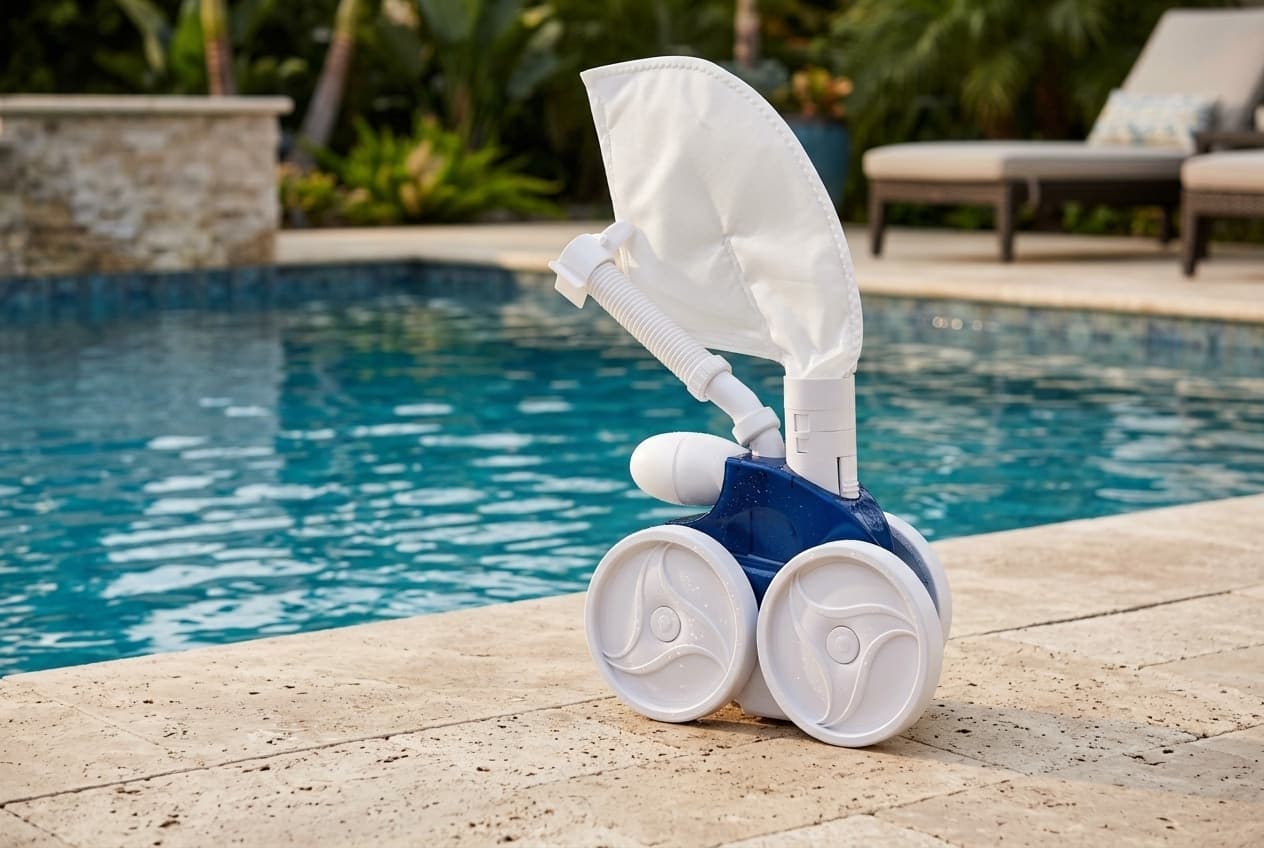
The 360 is the exception in the Polaris pressure-side line: it does not need a booster pump. Everything else about it matches the 380 — three venturi jets, all-wheel belt drive, a 2¼ inch vacuum inlet, a single-chamber bag, three wheels with two on one side and one on the other. The difference between the two models is which pump pushes the water, and on a 360 the answer is the filter pump you already own.
That is the reason to consider it over the Vac-Sweep 280 or the 3900 Sport, both of which need a second motor on the pad — a Polaris PB4-60 or a Pentair LA01N — running every hour the cleaner runs.
Polaris's own page says both things
Worth knowing before you shop, because it has confused a lot of buyers.
The 360's product page on Polaris's site carries a promotional block headed "Powered By a Required Booster Pump", which reads: a compatible Polaris booster pump is required to power your cleaner. It sits a few inches below the same page's specification table, where Requires Booster Pump is answered No, and below the page's own description, which says the cleaner works "without the need for a booster pump."
Three primary sources agree against the promotional block: the specification table, the product description, and the in-ground cleaner family brochure, which lists the 360 as the only one of the four pressure-side models not requiring a booster. The block is template text that appears on the pressure-side cleaner pages generally. The 360 does not take a booster pump.
What it needs instead
Not needing a booster is not the same as needing nothing. The 360 comes ready to thread into a 1½ inch female fitting on a dedicated return line, and that line is the requirement.
If the pool has one, you also want a diverter valve on it, because that valve is how you set the cleaner's speed. If it does not, Polaris sells adapter kits and they are worth naming, because "my pool has no dedicated line" is usually solvable:
- Two or three return lines — the eyeball fitting connection kit, 9-100-8001, which puts a wall fitting and a pressure relief valve into a second line and an eyeball regulator into a third
- A 1 inch plastic pipe cut flush with the wall — the 1 inch stub pipe connection kit, 9-100-8002
- A 1½ inch plastic pipe cut flush — the 1½ inch kit, 9-100-8003
- A directional eyeball with no 1½ inch threaded socket behind it — the eyeball adapter connection kit, 9-100-8005
One more, for when the cleaner is out of the pool: the UWF eyeball fitting, 6-511-00, goes into the empty wall fitting so the pool circulates properly in the meantime. Leaving the return open is a common oversight.
And a plumbing rule that gets missed on pools with panels: plumb the cleaner line upstream of solar heating, ozone generators and anything else that induces air. Air through the cleaner upsets its balance, and the effect looks like a mechanical fault.
Twenty-eight to thirty-two, and check it before first use
Polaris puts the wheel speed check in the setup instructions, not in troubleshooting, and almost nobody performs it.
The cleaner has to run between 28 and 32 RPM. That is a different window from the 3900 Sport's 30 to 36, so do not carry the number over from another Polaris. To measure it:
- Mark a tire on the single-wheel side with tape or a leaf tucked into the tread.
- Turn the pump on and hold the cleaner below the water line — the count is wrong if it is out of the water.
- Count that wheel's revolutions for one minute.
Below 28 — check the filter screen in the quick disconnect, then the skimmer, pump basket and filter, then the hoses and swivels for leaks, then open the diverter valve further.
Above 32 — close the diverter valve first, and only then unscrew the pressure relief valve until the speed comes down.
The order matters. The diverter valve is the coarse control and the relief valve is the trim. Nearly every entry in the manual's troubleshooting table ends with "check the wheel RPM," which is a fair signal about how many complaints are a setting rather than a fault.
The hose is a measurement, not a length
The end of the feed hose must land within 6 inches of the farthest point of the pool, longer or shorter, measured with the pump running and pressure on. Cut the excess from the first section, the one attached to the quick disconnect, not from the end.
Then the three floats go on at fixed positions: one against the back-up valve, one at 4 feet and one at 7 feet upstream. Getting that wrong is the reason a hose tangles, and a tangled hose is the reason a cleaner covers half the pool.
If the hose is short, buy a section rather than improvising. And lay the hose out in the sun before you start, which relaxes the coils and is the cheapest thing on this page.
The belts are the part that is not covered
Polaris's current warranty covers the cleaner for one year and the frame for five. The wear list that is covered for nothing at all names bags, tires, sweep hoses, sweep hose scrubbers and belts.
That last one lands harder on a 360 than on the rest of the line, because this is the belt-drive cleaner — the 280 is shaft-driven and the 3900 Sport runs a stainless chain. Two belts, small and large, sold together as 9-100-1017, and the diagnostic is one you can do in a minute: with the pump off, spin each of the three wheels by hand. They should all turn together. One that spins alone has lost a belt or lost its tension.
Note also that the older printed manual gave the frame ten years. The current Polaris warranty statement sets five for the frames of all its in-ground pressure-side cleaners, and that is the figure that applies to a cleaner bought today.
The rebuild kit is warranted differently
A detail buried in the warranty statement that changes the arithmetic on an aging 360.
Purchased replacement parts carry ninety days. The exception, named specifically: Factory Rebuild Kits for Polaris pressure cleaners are warranted for one year.
The 360 kit, 9-100-9060, is a pre-assembled base plus tires, wheels, bearings, belts, gears, turbine, thrust jet, in-line back-up valve, bag, head float and sweep hose. What it does not include is the frame and the hoses — which is to say it replaces nearly everything that wears, and reuses the two things that mostly do not.
So on a cleaner with four or five worn items, the kit is not only cheaper than the parts individually. It is the version that comes with four times the coverage.
The conditions people trip over
Three that are not obvious, all from the manufacturer's own documents.
Chemistry is a warranty condition. Polaris lists pH 7.2 to 7.8, cyanuric acid 30 to 100 ppm, total alkalinity 80 to 120 ppm and 100 to 150 for vinyl, total dissolved solids under 1,500 ppm not counting salt, and hardness under 800 ppm. Outside those, a failure is excluded. The pH and alkalinity calculator covers two of them.
Take the cleaner out before you shock. The manual says to remove it before any chemical shock treatment, and the warranty separately excludes damage from introducing chemicals upstream of the cleaner hose. A cleaner left in during a shock dose is sitting in the strongest water in the pool.
Freeze damage is not covered, and the winterizing step has two parts people do half of: drain all the water out of the cleaner, and take the universal wall fitting out of the pool wall. The removal tool for the second, if it will not come by hand, is 10-102-00.
Fine tuning, once it runs
The thrust jet on the back of the body sets the direction, and eleven o'clock is the factory setting. Polaris's own instruction is to leave it there unless the pool shape demands otherwise — a cleaner that has stopped covering the far end is more often a hose length or a wheel speed problem than a thrust jet one.
For the sweep hose, the adjustment screw on the feed pipe turns counterclockwise for more motion and clockwise for less, with the pump off. Aim for a gentle sweep. If it is spraying over the deck, tighten the screw, check the scrubber, and consider the TailSweep PRO accessory.
And one check that catches a real fault: with the pump running, turn the cleaner upside down and look into the vacuum tube. All three jets should be flowing evenly. Fewer than three, or uneven, is an obstruction — and it shows up as a cleaner that has quietly lost its suction without anything looking wrong.
Which model do you have?
The model number is on the cleaner label. Everything else in the range is shared — these are the parts that change with it.
| Model | SKU | Tire | Drive | Requires booster | Note |
|---|---|---|---|---|---|
| Vac-Sweep 360 | F1 | C-10 white, C11 black, PosiTrax for tile and fiberglass | All-wheel belt drive | No | The only cleaner in the Polaris pressure-side line that does not need a booster pump. Everything else about it matches the 380 — three venturi jets, belt drive, a 2¼ in. vacuum inlet and a single-chamber bag — so the difference between the two models is which pump pushes the water. Polaris sells one factory tune-up kit for both. |
Polaris Vac-Sweep 360 parts, and what goes wrong
Read off the manufacturer’s parts list and checked before it ships. Open a row for what a bad one actually does — or start from the symptom and work down, which is the cheaper order.
What is it doing?
Two belts drive all three wheels on a 360, and they are the part that makes it a 360 rather than a 280. Polaris's warranty names belts among the wear items it does not cover, so treat them as a scheduled replacement. The check takes ten seconds: with the pump off, spin each wheel by hand — they should all turn together, because the belts tie them together.
Live pricing arrives when the retailer programs are approved.
The cheapest part on the cleaner and the first item in the manual's own list for a cleaner running below 28 RPM. It sits inside the quick disconnect and keeps grit out of the bearings and the turbine, which is why pulling it out to gain pressure is a bad trade. Polaris's installation step is explicit that it must be firmly seated before the quick disconnect goes in.
Live pricing arrives when the retailer programs are approved.
Every three and a half minutes this valve interrupts the feed and reverses the cleaner, which is how it gets off a step or out of a corner. Test it out of the water: the jet should come on and go off on that cycle. When it stops cycling the cleaner parks itself and stays there, which reads as a drive fault and is not one. The mechanism alone is 9-100-1204 and the case kit 9-100-1202.
Live pricing arrives when the retailer programs are approved.
The white float on the front of the body, and the single most under-diagnosed part on this cleaner. It appears in three separate troubleshooting entries — will not back up, will not climb, running in circles — and the test is the same each time: take it off and shake it. Water inside means a new one. It also has to be pushed all the way forward against the body, which is easy to leave undone after a bag change.
Live pricing arrives when the retailer programs are approved.
Three of them. When the tread rounds off, the cleaner slides back down the wall it used to climb. Black is C11 for dark-bottom pools, and there is a separate PosiTrax tire that Polaris says is only for tile and fiberglass surfaces — fitting those to a plaster pool is the wrong direction. A named wear item, not covered.
Live pricing arrives when the retailer programs are approved.
Seven rings on the 360's sweep hose. They exist to be abraded so the hose is not, which means checking them is what stops you buying the whole hose. Rotating them as they wear is Polaris's own suggestion for getting more life out of a set.
Live pricing arrives when the retailer programs are approved.
The nub on the end of the sweep hose. It is consumable by design and it fails in two opposite ways: worn away, and the hose sprays over the deck; out of position, and it blocks the orifice so the hose gets pulled into the vacuum tube. If overspray is the problem, the TailSweep PRO accessory, part TSP10, is Polaris's own answer.
Live pricing arrives when the retailer programs are approved.
Collecting debris before it reaches your filter is the whole argument for this cleaner, and a split seam undoes it. Polaris also lists a full bag as a cause of the cleaner listing to one side, so emptying at half full is not fussiness. A leaf bag is 9-100-1012, a fine sand and silt bag 9-100-1015, and disposables come in threes as 9-100-1013.
Live pricing arrives when the retailer programs are approved.
Eight of them, and the part that grit destroys when the filter screen is missing or blocked. They seize gradually, so the cleaner gets slower over a season rather than stopping. Spin each wheel with the cleaner dry: anything gritty is a bearing, and a dragging wheel costs far more speed than the part costs.
Live pricing arrives when the retailer programs are approved.
Built into the quick disconnect, and the fine trim for wheel speed once the diverter valve has done what it can. It is also the pressure test: with the tester held underwater and the large hole covered, water should be escaping here. If nothing does, the cleaner is not getting enough flow and no amount of tuning will fix that.
Live pricing arrives when the retailer programs are approved.
Four of them let the feed hose untwist as the cleaner works. Seized swivels wind the hose into a coil, which shortens its reach and drags the cleaner back toward the wall — easily mistaken for a back-up valve fault. Check them with the cleaner running, not on the deck.
Live pricing arrives when the retailer programs are approved.
Three floats hold the feed hose off the pool floor, and they go waterlogged with age. A sinking hose is named as a cause of a cleaner that turns only one way and of a cleaner that will not back up, so the hose being on the surface is worth a glance every time you look at the pool.
Live pricing arrives when the retailer programs are approved.
A pre-assembled base with the tires, wheels, bearings, belts, gears, turbine, thrust jet, back-up valve, bag, head float and sweep hose — everything except the frame and the hoses. It is also the only replacement part Polaris warrants for a full year rather than ninety days, which is worth putting against the cost of buying four or five worn items separately.
Live pricing arrives when the retailer programs are approved.
If you are doing the job anyway
These come apart without tools and they wear at similar rates. Replacing one worn item on a cleaner whose others are equally worn buys very little, which is the argument for the rebuild kit once several are due.
The wear kit
The four items Polaris names in its warranty as things it does not cover, in the versions this cleaner uses. They will all need doing eventually, and they are why a 360 that has 'stopped working' has usually just worn out.
- Tire, MaxTrax, whiteC-10
- Wear rings, sweep hoseB-10
- Belt kit, small and large9-100-1017
- Sweep hose scrubber9-100-3105
It parks in one spot
The back-up valve and the head float produce the same complaint and cost very different amounts. Shake the float first; if there is water in it, that is the whole repair.
- In-line back-up valve9-100-1200
- Float, headA-20
It has gone sluggish
Grit kills bearings and the screen is what keeps grit out. Doing the screen without the bearings leaves the damage; doing the bearings without the screen means doing them again.
- Filter screen, wall fitting and quick disconnect6-504-00
- Ball bearing9-100-1108
Polaris Vac-Sweep 360 manuals and documentation
Hosted by the manufacturer. These open on Polaris’s own servers, so they stay current.
- Owner's manual (LP50 Rev. D)manual
- Quick start guide (H0409900)guide
- Exploded parts diagram, in the earlier owner's manual (LP-50)diagram
- Factory rebuild kit instructions (TL-829 Rev. B)manual
- In-line back-up valve mechanism replacement (TL-801)manual
- Quick disconnect replacement (TL-821)manual
- Universal wall fitting connector assembly installation (TL-820)manual
- In-ground cleaner family brochure (SL825)spec
- Polaris limited warranty (H0355004 Rev. N)spec
Polaris Vac-Sweep 360 warranty
1 year parts, 5 years on the frame labor
One year from the date of retail purchase, and five years on the frame — Polaris's current warranty statement sets five years for the frames of all its in-ground pressure-side cleaners, superseding the ten years printed in the older revision of this cleaner's manual. Wear-and-tear items are not warranted at all, and the list names bags, tires, sweep hoses, sweep hose scrubbers and belts. Belts matter here more than on the rest of the line, because this is the belt-drive cleaner. Purchased replacement parts carry ninety days, with one exception worth knowing: a Factory Rebuild Kit for a Polaris pressure cleaner is warranted for a full year. Coverage is limited to the first retail purchaser, is not transferable, and does not follow the cleaner to a new installation site.
Manufacturer’s termsPolaris Vac-Sweep 360 complete parts list
Every part on the manufacturer’s exploded diagram, in their numbering. Marked rows are the ones covered above with a symptom and a diagnosis.
71 parts
| No. | Part | Description | Note |
|---|---|---|---|
| 1 | 9-100-1014 | All-purpose bag what goes wrong | Wear item, not covered by warranty |
| 2 | 9-100-1152 | Housing, turbine, upper | |
| 3 | 9-100-1114 | Hub cap | 3 required |
| 4 | 9-100-5107 | E-clip, stainless steel | 10 required |
| 5 | 9-100-1108 | Ball bearing what goes wrong | 8 required |
| 6 | C-10 | Tire, MaxTrax, white what goes wrong | 3 required; wear item, not covered by warranty |
| 7 | 9-100-1008 | Wheel, double-side | 2 required |
| 8 | 9-100-1017 | Belt kit, small and large what goes wrong | Wear item, not covered by warranty |
| 9 | 9-100-7011 | Shield, bearing | 3 required |
| 10 | 9-100-1005 | Frame | Covered for 5 years |
| 11 | 9-100-5125 | Screw, 8-32 x ½ in. stainless pan head | 11 required |
| 12 | 9-100-1139 | Axle block assembly | 2 required |
| 13 | 9-100-1010 | Belt divider, transfer pulley | |
| 14 | 9-100-3135 | Collar, bag tie | |
| 15 | 9-100-1007 | Transfer pulley and drive shaft assembly | |
| 16 | 9-100-5115 | Screw, 8-32 x ¾ in. stainless pan head | 5 required |
| 17 | 9-100-5130 | Lock washer, axle block | 4 required |
| 18 | 9-100-1132 | Drive train gear kit with turbine bearing | |
| 19 | 9-100-1103 | Turbine wheel with bearing | |
| 20 | 9-100-1116 | Wheel, single-side | |
| 21 | C-131 | Thrust jet kit | |
| 22 | 9-100-7008 | Sweep hose barb, complete | |
| 23 | B-20 | Adjustment screw, sweep hose | |
| 24 | B-15 | Sweep hose attach clamp, white | |
| 25 | 9-100-3005 | Base weight | |
| 26 | 9-100-7170 | Hose clamp for the water management system | 6 required |
| 27 | 9-100-7009 | Jet retainer | 2 required |
| 28 | 9-100-7014 | Water management system | |
| 29 | 9-100-1155 | Housing, turbine, lower | |
| 30 | 9-100-3105 | Sweep hose scrubber what goes wrong | Wear item, not covered by warranty |
| 31 | 9-100-5132 | O-ring, in-head timer and feed pipe assembly | |
| 32 | 9-100-7030 | Top and base assembly | |
| 33 | 9-100-1002 | Feed pipe and timer blank assembly | |
| 34 | A-20 | Float, head what goes wrong | |
| 35 | 9-100-1011 | Sweep hose, complete | Wear item, not covered by warranty |
| 36 | B-10 | Wear rings what goes wrong | 7 required; wear item, not covered by warranty |
| 37 | 9-100-3008 | Wall fitting connector assembly | |
| 38 | 6-500-00 | Universal wall fitting | |
| 39 | 6-504-00 | Filter screen, wall fitting and quick disconnect what goes wrong | |
| 40 | 6-505-00 | O-ring, wall fitting and quick disconnect | |
| 41 | 9-100-3009 | Pressure relief valve what goes wrong | |
| 42 | 9-100-3006 | Quick disconnect, universal wall fitting | |
| 43 | 9-100-3109 | Hose nut | 12 required; reversed threads |
| 44 | 9-100-3102 | Feed hose, 6 ft | 4 required |
| 45 | 9-100-3002 | Swivel, hose what goes wrong | 4 required |
| 46 | 9-100-1206 | Float, feed hose what goes wrong | 3 required |
| 47 | 9-100-1200 | In-line back-up valve what goes wrong | |
| 48 | 9-100-1202 | Case kit, in-line back-up valve | |
| 49 | G57 | Collar, back-up valve | |
| 50 | 9-100-1204 | Mechanism, in-line back-up valve | |
| 51 | 9-100-3103 | Feed hose, 1 ft | |
| — | 9-100-1205 | Booster valve seat, in-line back-up valve | |
| — | C11 | Tire, MaxTrax, black | Wear item, not covered by warranty |
| — | B2 | Weight, sweep hose | |
| — | G21 | Ladder guard, 2 panels | |
| — | G58 | O-ring kit, back-up valve | |
| — | 6-511-00 | Eyeball fitting, universal wall fitting | |
| — | 9-100-1012 | Leaf bag | Wear item, not covered by warranty |
| — | 9-100-1013 | Disposable all-purpose bag, pack of 3 | |
| — | 9-100-1015 | Sand and silt bag | |
| — | 9-100-3100 | Feed hose complete with wall fitting, no back-up valve | |
| — | 9-100-8001 | Eyeball fitting connection kit | |
| — | 9-100-8002 | Stub pipe connection kit, 1 in. | |
| — | 9-100-8003 | Stub pipe connection kit, 1½ in. | |
| — | 9-100-8005 | Eyeball adapter connection kit | |
| — | 9-100-9060 | Factory rebuild kit what goes wrong | Warranted for 1 year, where other purchased parts get 90 days |
| — | 10-102-00 | Universal wall fitting removal tool | |
| — | TSP10 | TailSweep PRO, reduces sweep hose overspray | |
| — | 5820 | UniCover, white | |
| — | 9-100-6000 | Pressure stick | |
| — | 9-100-8021 | Vinyl eyeball kit |