Hayward · Universal H-Series
Hayward Universal H-Series with OmniX
Hayward's current gas heater, with OmniX built in: the six sizes, what the new display and app add, the flow and clearance numbers, and every error code.
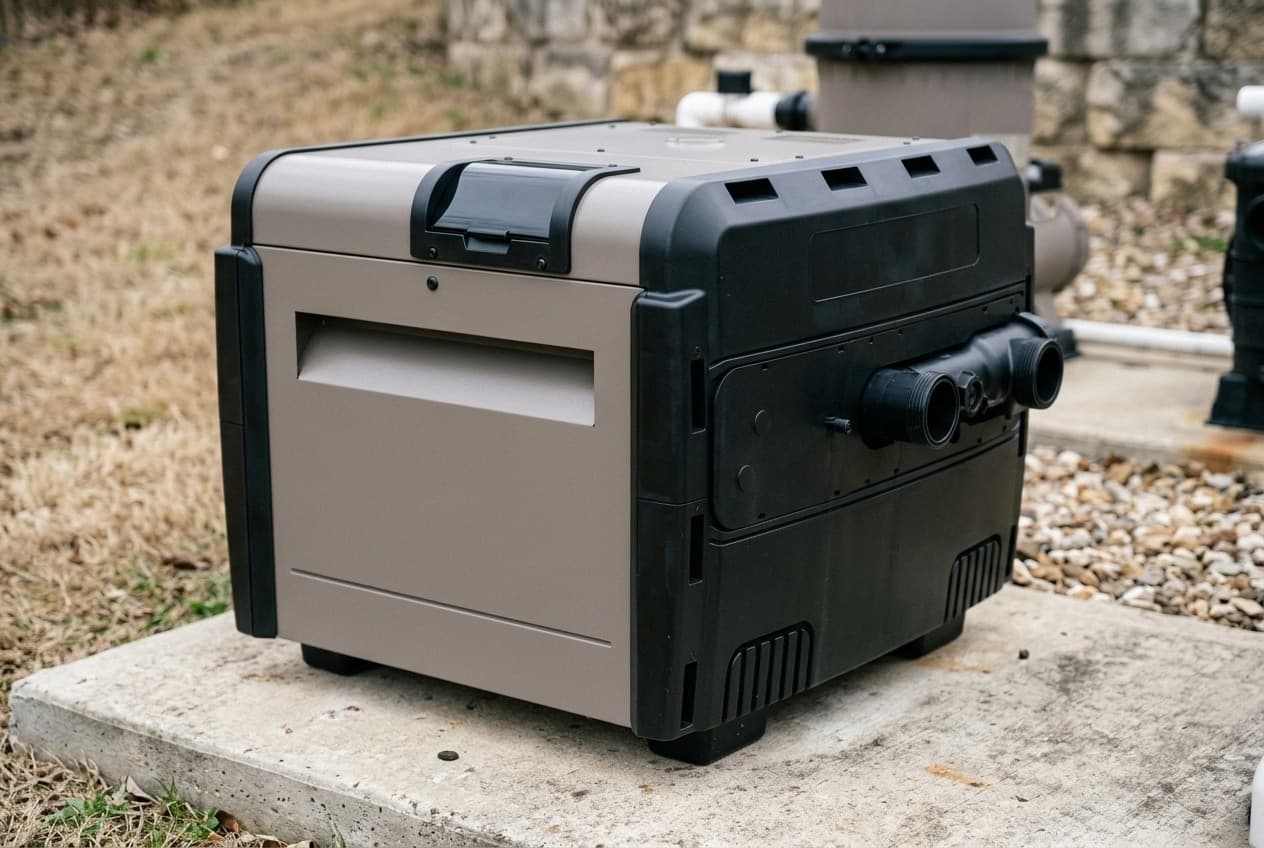
The Universal H-Series with OmniX is Hayward's current gas pool heater. Hayward's page for the older Universal H-Series H400FDN says it has been discontinued, and names the HS400FDN as its replacement. Hayward's 2026 price schedule lists every W3HS version as new.
It comes in six sizes: 135, 150, 200, 250, 400 and 500 thousand BTU an hour. N on the end is natural gas and P is propane. There is no 300 or 350, which the older line had, and the 135 is new.
Not just the old heater with an app
It's easy to read these as the H-Series with a new display bolted on. Hayward's own documents say otherwise. Put the two brochures side by side and the cabinets have changed:
- Narrower. The HS400 is 34 inches wide against 36 for the H400. The 250 went from 28 to 25, the 200 from 25 to 22, and the 150 from 21 to 19.
- The 250 got more efficient. 84% on the HS250FD against 83% on the H250FD. The 400, 200 and 150 carry over at 84%, 83% and 82.7%.
- Different clearances. The HS manual asks for 18 inches in front, where the H-Series install manual asks for 24. It wants an overhang at least 72 inches above the heater, where the older manual said three feet.
So measure your pad against this manual, not the old one. A replacement that fits the space the old heater left is likely, since it's narrower. But the overhang rule doubled.
What didn't change is the thing that set the H-Series apart. Every size has a cupronickel heat exchanger at no extra cost. That matters on salt pools and anywhere the water runs aggressive, and Pentair's MasterTemp charges for it and gives up efficiency to get it.
What OmniX adds
The Universal Display. A color screen under a flip-up cover on top of the heater. From it you set pool and spa temperatures, create presets and schedules, and read diagnostics, errors and events. The setpoint range is 65°F to 104°F for both pool and spa, and both ship set to 65°F.
The OmniX app, over Bluetooth. You claim the heater from the app by pressing the H button on the display, and you can use an existing OmniLogic login. The app shows the heater's status and history, sets schedules and countdown timers, and has an Extend Pump Runtime setting that keeps the pump running past its schedule until the water reaches temperature.
Remote control needs the OmniX Gateway. Bluetooth only reaches as far as your phone does. To control the heater away from home, Hayward says you have to buy the OmniX Gateway, W3GATEWAYX1, and put it on your home network.
Hayward automation, over a wire. The heater connects to OmniLogic, OmniPL, OmniHub and S3 Omni controls with a 3-conductor serial link, which the brochure calls RS-485. Hayward says the control needs firmware R1.0.0 or later. Once connected, the display shows the heater's Hayward Unique Address, which you use to find it in the control's setup. Other brands of automation can still run it with the ordinary 2-wire on/off or 3-wire pool/spa connection.
A retrofit for older heaters. Hayward's product pages list OmniX retrofit kits for existing Universal H-Series heaters from 2016 or newer that have the current bezel cutout.
Sizing it
Hayward's brochure sizes by pool surface area, for a 30°F temperature rise, a 3½ mph average wind and up to 2,000 feet of elevation:
- HS150: up to 450 square feet
- HS200: 600 square feet
- HS250: 750 square feet
- HS400: 1,200 square feet
- HS500: 1,500 square feet
For an indoor pool, divide the surface area by 3 first. The brochure doesn't size the 135.
For a spa, the brochure gives heat-up times for a 30°F rise on an insulated, covered spa. A 500-gallon spa takes 23 minutes on a 400, 36 minutes on a 250, and an hour on a 150.
Keep the efficiency in perspective. The FTC energy labels on these heaters put them at 82% to 84%, on a scale that runs from 82% for the least efficient similar model to 96% for the most. The HS135 sits right at 82%. This is a conventional heater, at the bottom of that scale. What it buys is fast heat and cupronickel as standard, not low running cost. The heater types compared covers when a heat pump makes more sense.
Flow, and the pressure switch
The minimum flow runs from 20 GPM on the 135, 150 and 200, to 25 on the 250, 30 on the 400 and 40 on the 500. The maximum is 125 GPM on every size. Above that, Hayward requires a manual bypass valve. You set it with a flow meter temporarily on the heater outlet, then take the handle off so nobody moves it.
Hayward is blunt about both ends. Damage from flow outside the range voids the warranty, and it says the minimum has to be calculated or measured with the in-floor cleaning system running, plus any other jets.
The heater proves flow with a water pressure switch, and it needs at least 1 psi to close. Hayward notes that some two-speed pumps can't reach that on low speed, and then the pump has to run on high to heat. The same applies to a variable-speed pump turned down to save power: give it a heating speed.
The switch is set at the factory for a heater at deck level. Above or below the water, it needs adjusting, and the manual gives the procedure. Counterclockwise lowers the pressure needed to close it, for a heater above the water. Clockwise raises it, for a heater below. Afterward, switch the pump on and off several times and confirm the heater stops the moment the pump does.
If the heater sits less than 3 feet above the water, Hayward wants eyeball or directional fittings on the returns, to build enough back pressure for the switch. More than 3 feet above, it wants a loop in the return line so the heater doesn't drain during a filter change.
Where it can go
Outdoors, it needs no vent pipe. The clearances from combustibles are:
- Top: unobstructed
- Front: 18 inches
- Back: 6 inches, or 12 against vinyl siding, which can discolor
- Water connection side: 12 inches
- Far side: 6 inches
Then the location rules, several of which void the warranty if ignored:
- At least 5 feet from the inside wall of the pool or spa, unless there's a solid barrier between them
- No overhang less than 72 inches above the top, and the space under one has to be open on three sides
- Not under a deck, and not within 24 inches of outdoor HVAC equipment
- No roof runoff straight onto it. A sloping roof without a gutter can void the warranty
- No sprinkler spray. Hayward says damage from sprinklers isn't covered, and mist carried on the wind counts
- Near the ocean, out of direct sand and salt spray, which also isn't covered
Indoors, it can vent through negative pressure (Category I) or positive pressure (Category III) systems, with kits by model, and it needs combustion air openings sized to the total BTU input. The HS135 isn't rated for indoor use at all.
Hayward ships tie-down brackets and sheet metal screws. You supply four stainless ¼ inch concrete screws at least 1½ inches long, and four stainless fender washers at least 1½ inches across.
Gas and electrical
The heater ships with the gas connection on the left. Hayward wants a CSA-certified manual shutoff outside the cabinet and within 6 feet of the heater, and a union outside the cabinet so the gas manifold can come out for service.
Pressure at the gas valve inlet: 4.5 to 10.5 inches of water column on natural gas, and 10 to 13 on propane. The manual has pipe sizing tables by fuel, input and distance. As one example, a 400 on low-pressure natural gas needs 1¼ inch pipe up to 100 feet from the meter.
Two warnings from the manual that come up on real pads. On propane, don't let the tank fall below 30% full, or the heater can soot up and Hayward won't be responsible. And Hayward isn't responsible for a heater connected to a natural gas well.
Electrically, the HS150 to HS500 ship wired for 240 V and convert to 120 V by swapping a voltage selector jumper. The HS135 is 120 V only. All draw 5.5 A at most, and Hayward recommends a 15 A breaker, a disconnect within sight of the heater, and a No. 8 AWG solid copper bonding conductor. It also recommends a sacrificial anode to protect the heat exchanger from galvanic corrosion.
Converting between fuels takes a conversion kit for the size, installed by a qualified service agency. Above 2,000 feet takes the FDXLHAK1931 high altitude kit.
Water chemistry, by Hayward's numbers
Hayward's manual says heat exchanger damage from unbalanced water isn't covered, and gives its own targets:
- pH: 7.4 to 7.6
- Total alkalinity: 80 to 120 ppm
- Calcium hardness: 200 to 400 ppm
- Chlorine: 1 to 3 ppm, or bromine 2 to 4 ppm
- Salt: 2,700 to 5,000 ppm
Don't put chlorine or bromine tablets in the skimmer, which sends concentrated chemical through the heater. An automatic chlorinator goes downstream of the heater, with a check valve between the two. Hayward also suggests keeping the heater bypassed until the water is balanced. Just close the bypass again before heating, or the exchanger will be damaged.
They're close to how to balance pool chemistry, which allows total alkalinity down to 70 ppm. On a salt pool, the cell's own salt target is the one to follow, as long as it stays under Hayward's 5,000.
What the error codes mean
The display shows a two-letter code. From the manual's code index:
- LO: the limit string is open. With no call for heat, that's the water pressure switch, usually because the pump is off, and the heater just waits. During a call for heat, it means a high limit or the vent pressure switch opened, and the heater locks out.
- IF: the heater failed to light after three tries, or lost flame ten times. It locks out and resets itself after 60 minutes.
- HS: water over 105°F. It resumes when the water cools.
- SF: the two temperature sensors disagree by 5°F or more, or read out of range.
- AO and AC: the air pressure switch is stuck open or stuck closed.
- IO: the igniter circuit is open.
- HF: flame sensed with the gas valve off.
- bD: an internal fault, including a gas valve relay check failure.
- PF: reversed polarity, low voltage or a missing ground on the power supply.
- CE: the display and the ignition control can't communicate.
- Sb: a keypad button is stuck.
A heater wired to power all the time shows LO whenever the pump stops. When the pump restarts, it waits 2 minutes before firing. Wiring it to the load side of the pump's timer avoids that, as long as the pump primes quickly.
The lighting sequence is worth knowing when you're watching it. A 30-second blower pre-purge, about 20 seconds for the igniter to heat, then a 4-second trial for ignition. After the call for heat ends, the blower runs 30 more seconds. The manual's reset instructions still refer to a MODE button and a STANDBY setting, which belong to the older heater's keypad rather than this display. A heater that won't heat covers the checks to make before any of this.
Winter
Hayward says not to use the heater for freeze protection or to hold water just above freezing. If it runs in freezing weather, the pump has to run continuously. Freeze damage isn't covered.
Where it freezes, drain the heater at season's end: standby, power off, gas valve off, gas supply off, pump off, then pull the plastic drain plug on the header. On ASME models, open the brass drain valve instead. A heater below the pool's water level has to be isolated with valves, or the pool partly drained, first.
Buying one
These are Expert Line heaters sold through pool professionals, with three years parts and one year labor. The HS135's product pages give it two years parts. The W3 Open Line versions are approved for online sale and get one year parts and no labor. That's a big gap on a heater, because the labor on a gas heater repair is rarely small.
Hayward's 2026 minimum advertised prices for the Open Line versions: $2,699 for the 135, $3,299 for the 150, $3,999 for the 200, $4,299 for the 250 and $5,399 for the 400, natural gas or propane. There's no Open Line 500. Each costs $300 more than the older W3H model of the same size, which is still on the schedule.
Amazon's listings for the W3HS250FDN and W3HS400FDP both showed as currently unavailable when rechecked, so this page has no store link. Hayward's warranty covers only products bought from Hayward or an authorized seller, so check who's selling before you buy anywhere.
Where Hayward's documents disagree
- Weight. The manual gives 135, 140, 165, 195 and 245 pounds for the 150 to 500. The brochure gives 110, 123, 134, 160 and 223, and its figures for the 150 to 400 are the older H-Series weights. Hayward's product pages give shipping weights of 129 to 237 pounds. This page uses the manual.
- The HS135. The manual gives it the HS150's 19 inch width and 135 pounds. Its sell sheet says 21½ inches wide, 29¾ deep and 22½ high, and 100 pounds, and its product pages give 21.5 by 29.75 by 22.5 inches. The sell sheet also promises three years parts where the product pages say two.
- The spec table. Hayward's HS400FDN product page lists "Refrigerant: Yes" for a gas heater.
- Copied text. The manual tells you to use the display "to operate your pump", labels a wiring illustration "Connection at Heat Pump", and gives H400FDN as its example model number.
- Conversion kits. The manual's own table prints two kit numbers with letters in place of digits, which this page notes rather than guesses.
Which model do you have?
The model number is on the heater label. Everything else in the range is shared — these are the parts that change with it.
| Model | SKU | Input | Thermal efficiency | Minimum flow | Width | Weight | Online version | Note |
|---|---|---|---|---|---|---|---|---|
| HS135FD | HS135FDN | 135,000 BTU/hr | 82% | 20 GPM | 19 in. in the manual, 21½ in. on the sell sheet | 135 lb in the manual, 100 lb on the sell sheet | W3HS135FDN, Open Line | Hayward's above-ground model. Propane is HS135FDP. Hayward's product pages list both as Expert Line with two years parts and one year labor, and its above-ground sell sheet (LITHSABGSS26) says three years parts and one year labor from a Totally Hayward partner. The 2026 price schedule lists the Open Line W3HS135FDN and W3HS135FDP. The manual says it runs on 120 V only, wires to a 3-prong plug, and is not rated for indoor installation or for high altitude. Its FTC label gives 82.0%. |
| HS150FD | HS150FDN | 150,000 BTU/hr | 82.7% | 20 GPM | 19 in. | 135 lb | W3HS150FDN, Open Line | Propane is HS150FDP. The FTC energy label gives 82.7%. |
| HS200FD | HS200FDN | 199,900 BTU/hr | 83% | 20 GPM | 22 in. | 140 lb | W3HS200FDN, Open Line | 199,900 BTU/hr input. Propane is HS200FDP. |
| HS250FD | HS250FDN | 250,000 BTU/hr | 84% | 25 GPM | 25 in. | 165 lb | W3HS250FDN, Open Line | Propane is HS250FDP. The ASME version is 28 in. wide and 195 lb, with a bronze header. |
| HS400FD | HS400FDN | 399,900 BTU/hr | 84% | 30 GPM | 34 in. | 195 lb | W3HS400FDN, Open Line | 399,900 BTU/hr input. Propane is HS400FDP. The ASME version is 36½ in. wide and 225 lb. |
| HS500FD | HS500FDN | 500,000 BTU/hr | 83% | 40 GPM | 40 in. | 245 lb | None listed | Propane is HS500FDP. The brochure gives a 1 in. gas connection on the natural gas version and ¾ in. on propane. The ASME version is 40½ in. wide and 260 lb. There is no Open Line version in Hayward's 2026 price schedule. |
Hayward Universal H-Series with OmniX manuals and documentation
Hosted by the manufacturer. These open on Hayward’s own servers, so they stay current.
- In-ground pool and spa gas heaters owner's manual (51301060001 Rev. D, 2026)manual
- Owner's manual in Spanish (1022819 Rev. A)manual
- Universal H-Series with OmniX brochure, with the sizing and specification tables (LITUHSBRO26)spec
- Universal H-Series above-ground heater sell sheet, HS135FDN and HS135FDP (LITHSABGSS26)spec
- FTC energy label, HS250FD and HS400FD (51301591001)spec
- FTC energy label, HS135FD (51301591101)spec
- FTC energy label, HS150FD (51301590901)spec
- FTC energy label, HS200FD and HS500FD (51301590801)spec
- Front dimension drawingdiagram
- Hayward 2026 MAP schedule, with the W3HS pricesspec
- 2026 Open Line warranty termsguide
Hayward Universal H-Series with OmniX warranty
3 years parts, 1 year labor
Three years parts and one year labor on the Expert Line HS150 to HS500, per their product pages and Hayward's 2026 Expert Line terms. The HS135's product pages give two years parts and one year labor, while its sell sheet says three years parts from a Totally Hayward partner. The W3 Open Line versions sold online get one year parts and no labor. Both sets of terms treat heating elements and o-rings as wear items, covered for manufacturing defects only, which Hayward says normally show up within 30 days. The manual adds exclusions: freezing, sprinkler spray, sand and salt spray near the ocean, flow outside the rated range, heat exchanger damage from water chemistry, and non-Hayward replacement parts. The brochure's "3+ year parts and labor" applies only when the heater is sold by a Totally Hayward partner.
Manufacturer’s termsHayward Universal H-Series with OmniX parts
Hayward publishes no parts list for the HS models yet. The owner's manual has a Service Parts section that names the replaceable parts, from the igniter and flame sensor to the heat exchanger and header, but its two parts pages are printed blank. Hayward's online parts diagrams return nothing for the HS135FDN through the HS500FDN, the HS400FDP, the HS400FDNASME or the W3HS400FDN, and answer "There is no parts list for the specified Model" for the HS400FDN. None of the nine HS product pages checked carries a parts document either. The manual does give numbers for the accessory kits: the FDXLHAK1931 high altitude kit, the CHXRLV1930 pressure relief valve for non-ASME models, gas conversion kits such as FDXLGCKW400NP (natural gas to propane) and FDXLGCKW400PN (propane to natural gas) for the 400, the indoor vent kits, and the W3GATEWAYX1 OmniX Gateway. Its conversion table misprints two sizes: the 150's propane to natural gas kit has the letters I, S and O where 1, 5 and 0 belong, and both 500 kits read FDXLGCKWS00, with an S for the 5. For anything else, order through a Hayward dealer with the full model number off the rating plate. For the older heater without OmniX, the Universal H-Series page has Hayward's complete diagram.