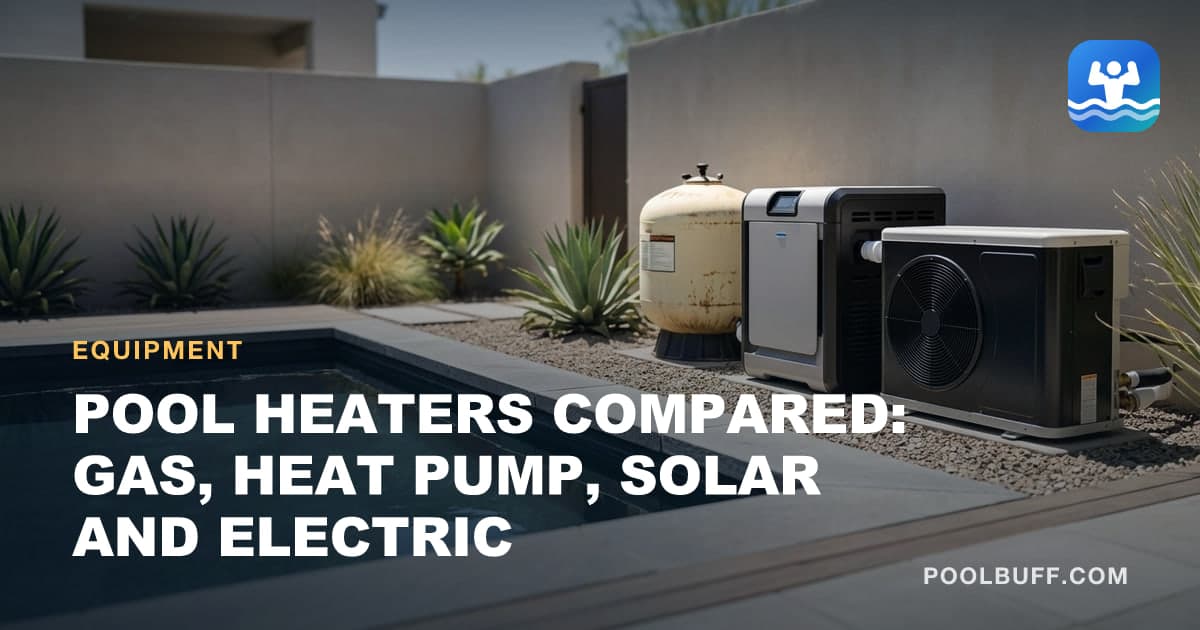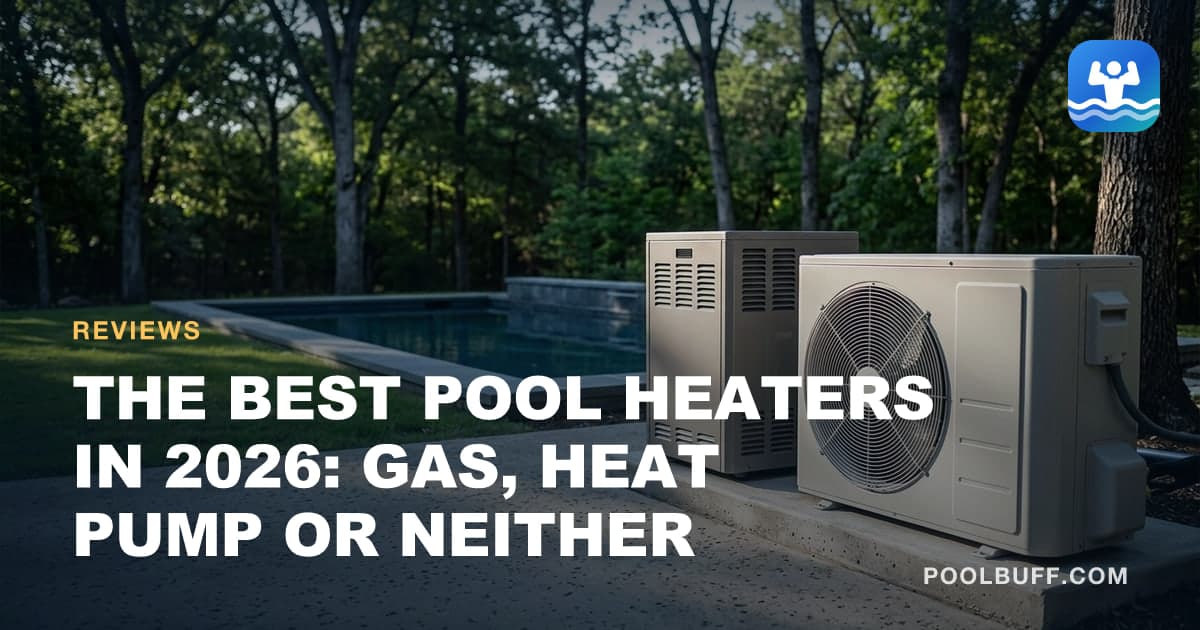
Pool heating is the one purchase where the running cost dwarfs the purchase price, and where the right answer changes completely depending on how you actually use the pool.
Buy the wrong type and you do not get a slightly worse result. You get a heater that costs a fortune to run for someone who wanted it on all season, or one that cannot warm the pool by Saturday for someone who wanted it warm by Saturday.
Key takeaways
- Gas heats fast and costs a lot per hour. Heat pumps are the opposite on both counts.
- Heat pumps move heat rather than making it, so output falls as the air cools and they stop to defrost near 50°F.
- A cover saves more energy than any heater upgrade. Fit one before you size anything.
- Gas heaters are gas appliances. Several manufacturers void warranty without licensed installation.
- Undersizing is the common mistake and it never recovers — it just runs constantly.
My picks at a glance
- 1
Pentair MasterTemp 400
Best gas heater · occasional heating, spas, and getting warm by this evening
- 2
Raypak Digital 406A natural gas
Best gas value · the same job for less money
- 3
Jandy JXiQ 400
Best for a tight pad · Jandy systems, and equipment pads with no room to spare
- 4
Hayward HeatPro W3HP21405T
Best heat pump · long seasons in mild climates, swimming most days
Beyond these picks, every heater with a page here — gas and heat pump — is listed with its parts and manuals.
Fit a cover before you size anything
This is the single most useful thing on this page, and it comes before the product decision.
An uncovered pool loses the majority of its heat from the surface, mostly to evaporation, mostly overnight. Heating one without a cover means running the heater against that loss continuously — you are, quite literally, heating the sky.
A solar cover costs a fraction of any heater here and cuts heat loss dramatically. Fit one first, then size the heater against a covered pool. People routinely buy a heater one size up to compensate for a cover they never bought, and then pay for that decision every month for a decade.
Gas vs heat pump pool heaters
| GasMy default | Heat pump | |
|---|---|---|
| Time to temperature | Hours | Days |
| Cost per degree | High | Typically a third to a half of natural gas, far less against propane |
| Works in cold air | Yes, any temperature | Loses output as air cools; stops to defrost near 50°F |
| Install needs | Gas line, venting, licensed fitter | Heavy electrical circuit |
| Best for | Occasional heating, spas | Holding temperature all season |
| Servicing | Combustion parts, more to go wrong | Refrigeration circuit, fewer wear items |
The pattern is consistent: gas buys speed, a heat pump buys cheapness, and neither buys both. Everything else — brand, panel, warranty — matters far less than getting that choice right. The full type comparison covers solar and electric resistance too, which suit narrower cases.
Pentair MasterTemp 400
Best for occasional heating, spas, and getting warm by this evening
400,000 BTU, which will lift a typical residential pool a couple of degrees an hour rather than overnight. The rotating digital panel is genuinely easier to read at the pad than the alternatives, and low-NOx certification means it is legal where that is required. This is the default gas heater for a reason.
Strengths
- Fast enough to heat on demand rather than on schedule
- Works in any air temperature, which heat pumps do not
- Well-supported, and every service tech knows them
Trade-offs
- Expensive to run — gas heating is the priciest way to warm water
- Needs an adequate gas line, which is its own install cost
- More components than a heat pump, so more eventually fails
Raypak Digital 406A natural gas
Best for the same job for less money
Same output class as the MasterTemp and usually a chunk cheaper. Despite the 406 in the name, Raypak rates the copper version at 399,000 BTU. A long-standing choice on service trucks, and its service menu shows pilot flame strength, run hours and the last ten faults, which is most of what a diagnosis needs. Raypak gives two years of parts and labor, but in the US only on a heater from an authorized dealer, and it can reject a claim on one bought from an unauthorized internet seller.
Strengths
- Comparable output for noticeably less money
- Service menu shows flame strength, run hours and fault history
- Long track record and good parts availability
Trade-offs
- Raypak can reject warranty claims on heaters from unauthorized internet sellers
- The cupronickel version is rated lower, at 360,000 BTU
- Same gas running costs as any gas heater
- Same licensed-install requirement
Jandy JXiQ 400
Best for Jandy systems, and equipment pads with no room to spare
The third major brand, and the one that gets left out of two-way comparisons. The JXiQ400NK is 399,000 BTU in a cabinet Jandy says fits a two-foot-square pad, with a copper exchanger and the VersaFlo bypass that earns its heat exchanger five years of warranty. If your automation is Jandy AquaLink, it also works with the iAquaLink app. Buy it from a dealer: Jandy's warranty does not cover its heaters bought online at all.
Strengths
- Compact for its output, which solves a genuine siting problem
- Five-year heat exchanger warranty with VersaFlo, from a dealer
- Low gas pressure switch and temperature-rise sensing catch installation faults
Trade-offs
- Bought online, as this listing is, it carries no Jandy warranty
- Same licensed-install requirement as any gas heater
- Premium pricing with the same gas running costs
Hayward HeatPro W3HP21405T
Best for long seasons in mild climates, swimming most days
Sold as 140,000 BTU and rated at 138,000 in 80°F air, with a titanium heat exchanger rated for salt pools up to 5,000 ppm. It moves heat from the air rather than burning anything, which makes it dramatically cheaper per degree — and dependent on there being warmth in the air to move. In 50°F air Hayward rates it at 82,000 BTU, and around there it stops to defrost. In a mild climate it is the cheapest way on this page to hold a pool at temperature.
Strengths
- Running cost a fraction of gas for the same temperature
- Titanium exchanger, rated for salt pools up to 5,000 ppm
- Nothing burns, so no gas line and no combustion servicing
Trade-offs
- Slow — think days to reach temperature, not hours
- Output falls as air cools, to a little under 60% at 50°F, where it also stops to defrost
- Needs a 230 V circuit on a 50 A breaker, often a new one
- The W3 version sold online gets one year parts and no labor, against five years and two from a dealer
Putting numbers on the sizing
The rule of thumb that actually works is BTU against surface area. Take the pool's surface in square feet and multiply by roughly 200 to hold a comfortable temperature in mild conditions, or by 300 and up if you want to raise the temperature quickly or you are heating into genuinely cool weather.
A 16-by-32 pool is 512 square feet, which puts it near 100,000 BTU for gentle holding and 150,000 or more for real heating. That is also why the 400,000 BTU units on this page exist: on a large or exposed pool they are not overkill, they are what it takes to move that much water in an afternoon.
For heat pumps the headline BTU means less than it looks, because output is not a fixed figure. Hayward sells the HeatPro MCHX 140K as 140,000 BTU, rates it at 138,000 in 80°F air with 80°F water, and at 82,000 in 50°F air — a little under 60%. Compare units at the temperature you will actually run them — manufacturers publish it, just further down the spec sheet than the number on the box.
The other heat pump figure is COP, the coefficient of performance: heat delivered divided by electricity consumed. A COP of 5 means five units of heat for one unit of power, which is the whole running-cost advantage — the machine is moving heat rather than making it. COP falls with air temperature too, and for the same reason the BTU does: the HeatPro's is 5.7 in 80°F air and 4.0 at 50°F.
What "hours" and "days" actually mean
Worth converting that table into something you can plan a weekend around.
Water takes about 8.34 BTU per gallon per degree. A 20,000-gallon pool therefore needs roughly 167,000 BTU for every single degree of rise, before accounting for anything it loses along the way.
Run a 400,000 BTU gas heater at its real-world efficiency and you are gaining around two degrees an hour. Ten degrees is an afternoon. That is the "hours" in the table, and it is why gas suits the person who decides on Friday that the pool should be warm on Saturday.
Put a heat pump producing 100,000 BTU on the same pool and those ten degrees take about seventeen hours of running — which, spread across a normal pump schedule and set against what the pool gives back overnight, is two to three days on the calendar. That is the "days". It is also why the cover paragraph came first: without one, an uncovered pool can chase a heat pump all season and never quite arrive.
Where the money actually goes
The purchase price is the smaller number over any realistic ownership period.
A gas heater run regularly through a season will spend more on fuel in two or three years than it cost to buy. That is not an argument against gas — it is an argument for being honest about how often you will use it. Gas suits the owner who heats for a weekend, a party, or a spa, and leaves it off the rest of the time.
A heat pump inverts it: higher purchase, install often comparable, and running costs low enough that holding a pool at temperature all season becomes reasonable. The catch is the one the spec sheet buries — as air temperature falls, so does output. Hayward's 140K keeps a little under 60% of it at 50°F, but around there it also has to stop and defrost, sometimes for hours, and its manual tells owners to wait for warmer air when it will not heat. In a mild climate that limit rarely bites. In a cold one it defines the product.
Working the numbers for your own climate is worth the twenty minutes. The answer is often not the heater someone recommended.
Sizing, briefly
Undersizing is the common mistake and it does not self-correct. An undersized heater runs continuously and still fails to reach temperature on the week you most wanted it.
Size on surface area rather than volume, because surface is where heat leaves. Size for the coldest month you actually intend to swim, not the average. And size assuming a cover, then fit the cover — sizing generously to compensate for not having one is paying capital cost to avoid a cheap accessory, forever.
Go deeperWhat heating actually costsGas against heat pump against solar, run through real numbers for a season.Frequently asked questions
Is a gas heater or heat pump better for a pool?
It depends entirely on how you swim. Gas heats fast and costs a lot per hour, which suits occasional use — warming the pool for a weekend, or running a spa. A heat pump is slow and cheap to run, which suits keeping a pool at temperature all season. If you heat on demand, buy gas. If you hold a temperature, buy a heat pump.
At what temperature does a pool heat pump stop working?
There is no single cutoff. Output falls as the air cools: Hayward rates its HeatPro MCHX 140K at 138,000 BTU in 80°F air and 82,000 in 50°F air. Around 50°F the air coil also has to defrost, which can stop heating for anything from 15 minutes to several hours, and Hayward's manual tells owners to wait for warmer air when the unit will not heat. In a climate with cool shoulder seasons that is exactly when you wanted heating, which is why gas still exists.
How much does it cost to heat a pool?
Gas is expensive per hour and heat pumps are roughly a third to a quarter of it for the same result, though they take far longer. The variable that dwarfs both is whether you use a cover. An uncovered pool loses most of its heat from the surface overnight, so heating one without a cover is heating the sky.
Do I need a licensed installer for a pool heater?
For a gas heater, effectively yes, and often as a warranty condition rather than only a legal one. It is a gas appliance requiring correct line sizing, venting and combustion air. Several manufacturers make warranty contingent on installation by a licensed pool professional. A heat pump is electrical rather than combustion, but the circuit usually needs an electrician.
What size pool heater do I need?
Bigger than you think, because undersizing never recovers — an undersized heater simply runs constantly and still fails to reach temperature on a cold week. Size on surface area, your coldest intended swimming month and whether you use a cover. The rule of thumb people quote assumes a cover; without one, add substantially.