Jandy · TruChlor
Jandy TruChlor
Jandy's tablet feeder in three versions: the inserts for a slow pump and when to pull them, what may go in it, opening it safely, and every part number.
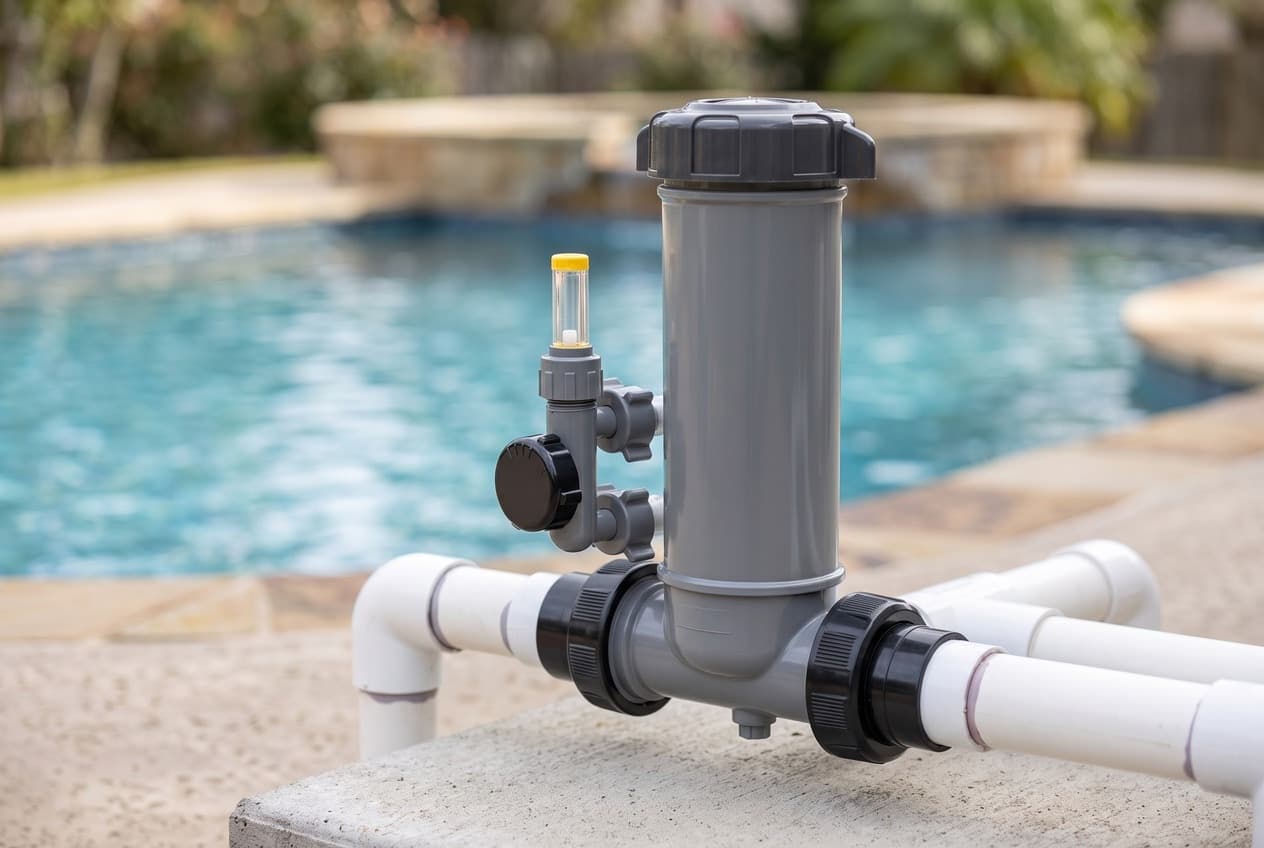
TruChlor is Jandy's erosion feeder: a gray PVC canister of trichlor tablets with a clear lid, a dial valve on the side and a flow indicator above it. It comes in three versions. Two go in the return pipe, and one stands beside it on its own base. How tablet chlorinators work covers what any feeder does and why it goes last on the pad. This page is about Jandy's: which version you have, the inserts that suit a slow pump, what the manual lets you put in it, and how to open it without breathing what's inside.
Which one you have
Jandy's 2026 catalog lists three:
- TCLINCG, the in-line feeder.
- TCLVSCG, the in-line VS. It's the same feeder with three inserts installed at the factory for low flow, and it's the number Jandy's product page shows.
- TCLOFFCGB20, the off-line feeder, with a molded base and a clamp for 2-inch pipe.
All three have the same cover, O-ring, grate, valve and drain plug. The unions and the inserts belong to the in-line versions. The base, the clamps and the tubing belong to the off-line one.
If your feeder has a white body and a black lid, it may be the older Jandy Erosion Feeder, the JEF-IN or JEF-OFF. Jandy still sells it, and its 2026 catalog lists it with the commercial feeders. It holds about 6 pounds of tablets, around 13, where the TruChlor holds nine 3-inch tablets or 5 pounds of 1-inch ones. Its lid, knob and drain plug have their own numbers, and the only part the two lists share is the union kit, R0449000.
The inserts, and when to take them out
The VS model's inserts are a low flow inlet, a cone and an outlet. The manual says they're for systems with a two-speed or variable-speed pump where the flow at low speed is below 50 gallons a minute. The feeder needs at least 20.
With a single-speed pump, or a low speed above 50 gallons a minute, the manual says to take the inserts out. So a VS model on a single-speed pump should have them removed.
Going the other way, an in-line TCLINCG can take the inserts later. Jandy sells them as R0967000, and its product page says they go in or come out without tools. That's the part to buy if the pad gets a variable-speed pump after the feeder went in.
The manual also says an installation with a variable-speed pump must use the insert kit. That overlaps with the 50-gallon rule, and one case falls between them: a variable-speed pump whose lowest speed stays above 50. The product page and sell sheet give the VS model's range as 20 to 50 gallons a minute, which fits the 50-gallon rule. If that's your pump, it's the question to put to Jandy's technical support.
Where it goes
The manual puts the in-line feeder downstream of the filter and the heater, and says in a caution box never to install it before the heater. Highly chlorinated water damages heaters. A check valve goes ahead of the feeder, between it and the heater, and the manual's drawing shows it there. If there's a heater, Jandy also wants a fireman's switch, the timer contacts that shut the heater off before the pump. Pool timers explained covers how that works.
The rest of the manual's plumbing rules:
- Point the arrows on the body in the direction of the water returning to the pool.
- Leave 6 inches of straight pipe between an elbow and the inlet. An elbow right at the inlet makes turbulence that stops water from getting into the feeder.
- Glue the unions into 2 or 2½-inch PVC with PVC cement only, and let it dry fully. The union nuts go on hand tight.
- Put it on the main return line, separate from waterfalls and cleaner lines.
- Put it before any ozone or AOP injector, so gas and bubbles don't build up inside it.
- No copper plumbing. The manual says it will damage the feeder.
A pool and spa combination with 2-inch plumbing gets its own note. The feeder goes on the pool return after the valve that diverts water to the spa. At least 6 inches of 1½-inch pipe runs from that valve into the feeder's inlet on 1½-inch unions, and 2-inch pipe continues on the outlet side. Jandy says that makes up for the water sent to the spa.
The off-line version sits level, as close to the filter and pump as it can. Holes in the base let you anchor it to the pad, but the hardware isn't included. The manual takes the inlet from the pipe after the pump and filter, and the outlet after the heater, or after the filter if there's no heater. Each connection starts with a ¾-inch hole drilled in the pipe, under a clamp. Hayward's and Pentair's off-line feeders use 3/8-inch holes, so don't go by a hole left from an old feeder.
From the clamps, the lines are either the black flexible tube supplied, on compression nuts and cones, or ½-inch Schedule 40 PVC, on ½-inch socket nuts with an O-ring seated in each. The PVC isn't included.
What goes in it
The manual's list is short:
- Slow-dissolving trichlor tablets only. The manual's DANGER notice says never to mix chemical products, because it could cause an explosion and fire.
- 1-inch or 3-inch tablets for a pool, 1-inch for a spa. Never mix tablet types.
- No calcium hypochlorite in any form. How the chlorine types differ covers why the two can't meet.
- No bromine. The manual and the label on the feeder both say so. Pentair's feeders take bromine tablets, and Hayward sells a separate brominator, but a TruChlor is chlorine only.
- A feeder you didn't buy new. If you're not the original owner, or you're not sure what's been in it, the manual says to flush it thoroughly with fresh water first.
The canister holds nine 3-inch tablets, or 5 pounds of 1-inch tablets. The sell sheet says its opening is 4.25 inches across, which is what makes loading and cleaning easier.
Setting the dial
Jandy doesn't publish an output in pounds a day, so the dial is a matter of testing.
Start with the pool already holding a proper chlorine level. The manual says 1 to 3 ppm of free chlorine, though what you actually need depends on your stabilizer. Set the valve at 50%. Turn it counterclockwise for more flow and more chlorine, and clockwise for less. Run the pump at least 6 to 8 hours, and test every day for the first five days.
Hot weather, warm water and heavy use all make the pool burn more. The manual says to raise the setting a few days ahead of them when you can. If 3-inch tablets can't keep up, switch to 1-inch ones, which erode faster.
Opening it
The manual says the feeder may be under pressure, and it warns about the fumes. Wear eye and hand protection, don't smoke near it, and never open the lid while the pump is running. Jandy's order:
- Shut off the pump and turn the control valve to closed. The check valve keeps water out of the feeder.
- Loosen the cap, but don't take it off. Wait one minute for water and fumes to drain.
- With the valve still closed, lift the cap off slowly, tilting it away from you so any gas goes the other way.
- Check that the grate inside is still where it belongs.
- Fill with tablets, then fill the body with water and bleed the air out of the lines.
- Put the cap back with its O-ring clean, lubed with silicone and in place. Hand tight only.
- Turn the knob clockwise to 0, then counterclockwise to 100, then back to your setting.
That last step isn't fussiness. Jandy says turning the knob through its full range after each refill keeps its range of motion and its O-ring seal. Try to refill before the tablets run out.
The rest of the time, the manual says to keep the return line to the pool open so gas can't collect.
Backwashing and pump-off time
With no water moving, the water in and around the tablets gets very strong, and gas can build. Jandy's warning:
- Set the dial to zero before anything stops the flow through the feeder.
- Keep backwashes short.
- Don't leave the pump off for long stretches.
- Keep swimmers out until full flow is back.
When it stops working
The manual's troubleshooting table, in order:
- Flow indicator not moving, or low chlorine. The valve assembly may be clogged. It detaches, so build-up and debris can be cleaned out. If that's not it, chlorine may have gummed up the body. Take the grate out and break the residue loose.
- Leaks at the connections. Check the O-rings, and replace any that are damaged.
- A cloudy lid. Chlorine exposure. Wipe it, and if it stays cloudy, sunlight and fresh air will clear it. Don't leave the feeder open while that happens. Put a replacement lid on meanwhile.
- Low chlorine in the pool. Add tablets, run the pump longer each day, or switch from 3-inch to 1-inch tablets.
Green water or algae is the one case Jandy doesn't put down to the feeder. It points to the water chemistry, pH and stabilizer among it, and to a pool professional.
Winter
Where the pad freezes, the manual says to drain the feeder through the plug in the bottom, take out every remnant of undissolved tablet, and rinse the body with clean water. Then winterize the rest of the system as usual. Closing a pool for winter covers that, and the tablet chlorinator guide explains what happened to an owner who left half-dissolved tablets in a closed feeder.
Where Jandy's documents disagree
- Variable-speed pumps above 50 gallons a minute. The manual says to remove the inserts above 50 at low speed, and also that a variable-speed installation must use them. The product page's 20 to 50 range fits the first rule.
- Pools or spas. The product page and sell sheet describe the TruChlor for in-ground pools. The manual also covers spas, with 1-inch tablets, and pool and spa combinations.
- One dimension. The manual's drawing labels the in-line feeder's depth 16-15/16 inches, beside 175 millimeters. Those can't both be right. 175 millimeters is under 7 inches, and the drawing shows that side much narrower than the 16-inch height. The page leaves the depth out.
- Two part names. The catalog calls R0967000 the VS upgrade conversion kit, and the manual calls it the variable speed insert kit. The catalog calls R0449000 Jandy universal unions, and the manual calls it the universal union assembly. The numbers match, so either name gets the same part.
Which model do you have?
The model number is on the chlorine feeder label. Everything else in the range is shared — these are the parts that change with it.
| Model | SKU | Plumbing | Low-flow inserts | Connections | Note |
|---|---|---|---|---|---|
| TruChlor In-Line | TCLINCG | In the return line | Not fitted | Jandy unions, 2 or 2½ in. | The in-line feeder without the variable-speed inserts. Jandy sells the three inserts as R0967000, which its catalog calls the VS upgrade conversion kit, and its product page says they go in or come out without tools. |
| TruChlor In-Line VS | TCLVSCG | In the return line | Factory installed | Jandy unions, 2 or 2½ in. | The number Jandy's product page shows. The same in-line feeder with the three variable-speed inserts, a low flow inlet, a cone and an outlet, installed at the factory. The page and the sell sheet give it 20 to 50 gallons a minute. |
| TruChlor Off-Line | TCLOFFCGB20 | Beside the pipe, on two lines | Not used | Clamp on 2 in. pipe, other sizes sold separately | Stands on its own molded base beside the pipe, fed through two lines from clamps on the plumbing. Jandy's catalog lists it with the base and a 2-inch clamp. Clamps for 1½, 2½ and 3-inch pipe are sold separately. It runs on flexible tubing or on ½-inch Schedule 40 PVC, and the manual covers both. |
Jandy TruChlor parts, and what goes wrong
Read off the manufacturer’s parts list and checked before it ships. Open a row for what a bad one actually does — or start from the symptom and work down, which is the cheaper order.
What is it doing?
The seal under the lid. The sell sheet says the O-rings on the cap and the valve assembly are Viton, to stand up to chlorine. Jandy's manual says to check them for damage, breaks and swelling whenever you service the feeder, and to lube this one with silicone O-ring lubricant only. Never oil or grease: in contact with trichlor, oil may start a fire. Jandy doesn't name a lubricant part.
Live pricing arrives when the retailer programs are approved.
The dial valve and the yellow-topped flow indicator above it, sold as one assembly. The manual's troubleshooting table lists a clogged valve first for reduced flow, low chlorine or a flow indicator that won't move. The assembly detaches, so any build-up or debris can be cleaned out of it. Replace it when cleaning doesn't bring the flow back.
Live pricing arrives when the retailer programs are approved.
The grate keeps pieces of tablet from clogging the outlet, and the check valve keeps water out of the canister while the lid is off. When chlorine gums up inside the body, the manual says the grate comes out so the residue can be broken loose, or the feeder won't perform. Check where the grate is sitting after every refill, because loading tablets can knock it out of place.
Live pricing arrives when the retailer programs are approved.
The low flow inlet, cone and outlet that make an in-line TruChlor a VS model. The manual says they're for systems running below 50 gallons a minute at low speed, and that the minimum operating flow is 20. Jandy's page says they go in or come out without tools. The manual calls the same kit the variable speed insert kit.
Live pricing arrives when the retailer programs are approved.
The whole lid, clear center and ring, with its O-ring. For a cloudy lid, the manual says to take it off and wipe it. If it stays cloudy, sunlight and fresh air will clear it. Never leave the feeder open without a lid. If the lid has to stay off to clear, put a replacement on in the meantime.
Live pricing arrives when the retailer programs are approved.
The plug in the bottom of the body, which the manual has you pull to drain the feeder where it freezes. Rinse out every remnant of undissolved tablet before putting it back.
Live pricing arrives when the retailer programs are approved.
If you are doing the job anyway
All three versions share the cover, its O-ring, the grate, the valve and the drain plug. The unions and the inserts are in-line parts, and the base, clamps and tubing are off-line parts.
The flow indicator won't move and the tablets aren't dissolving
The two parts the manual's troubleshooting table names for low flow and low chlorine: the valve, which clogs with build-up, and the grate, which is there to keep tablet pieces out of the outlet. Clean both first, and replace what won't come clean.
- Replaceable valve and flow indicatorR0966600
- Grate and check valve assemblyR0966500
Jandy TruChlor manuals and documentation
Hosted by the manufacturer. These open on Jandy’s own servers, so they stay current.
- TruChlor erosion feeder installation and operation manual (H90010 Rev A, 2022)manual
- TruChlor product page, with its specificationsspec
- TruChlor sell sheet (98158 SL, 2022)spec
- Fluidra 2026 product catalog, the three TruChlor models on page 257spec
- Fluidra 2026 product catalog, TruChlor in-line and off-line parts diagrams on page 274diagram
- The older Jandy Erosion Feeder, JEF-IN and JEF-OFF, product pagespec
- The older Jandy Erosion Feeder sell sheet (1362 SL, 2021)spec
- Jandy limited warranty (H0333803)warranty
Jandy TruChlor warranty
1 year parts
One year from retail purchase under Jandy's standard term, since feeders aren't among the exceptions that get longer. Purchased replacement parts carry ninety days. The warranty doesn't cover labor, and it doesn't apply to Jandy products bought through the Internet or an e-commerce platform, apart from valves under 3 inches, parts and accessories. Among its exclusions is introducing chemicals upstream of the heater, which is where the manual says this feeder must never go.
Manufacturer’s termsJandy TruChlor complete parts list
Every part on the manufacturer’s exploded diagram, in their numbering. Marked rows are the ones covered above with a symptom and a diagnosis.
| No. | Part | Description | Note |
|---|---|---|---|
| Cover | R0966800 | Cover assembly with O-ring what goes wrong | |
| Cover | R0966900 | Cover O-ring what goes wrong | |
| Body | R0966500 | Grate and check valve assembly what goes wrong | |
| Body | R0966600 | Replaceable valve and flow indicator what goes wrong | |
| Body | R0967600 | Drain plug kit what goes wrong | |
| In-line plumbing | R0449000 | Jandy universal unions, pair | The manual calls it the universal union assembly, with 2 unions |
| In-line plumbing | R0967000 | VS upgrade conversion kit, three inserts what goes wrong | The manual's name is the variable speed insert kit, VS version only |
| Off-line plumbing | R0967100 | Base assembly | |
| Off-line plumbing | R0967200 | Hose clamp assembly for flexible hose | Two used |
| Off-line plumbing | R0966700 | Hose clamp assembly for hard pipe | Two used |
| Off-line plumbing | R0967300 | Tubing adapter and union nut assembly | Two used |
| Off-line plumbing | R0976100 | Off-line tubing | |
| Off-line clamps | R0975700 | Clamp kit, 1½ in. pipe | |
| Off-line clamps | R0975800 | Clamp kit, 2 in. pipe | The size the TCLOFFCGB20 comes with, per its catalog listing |
| Off-line clamps | R0975900 | Clamp kit, 2½ in. pipe | |
| Off-line clamps | R0976000 | Clamp kit, 3 in. pipe |