Poolguard · Floating pool alarm
Poolguard PGRM-SB2 Floating Alarm
Poolguard's floating pool alarm, the PGRM-SB2, and the PGRM-SB Safety Buoy it replaced: how each is tethered, which pools each is rated for, and how to test it.
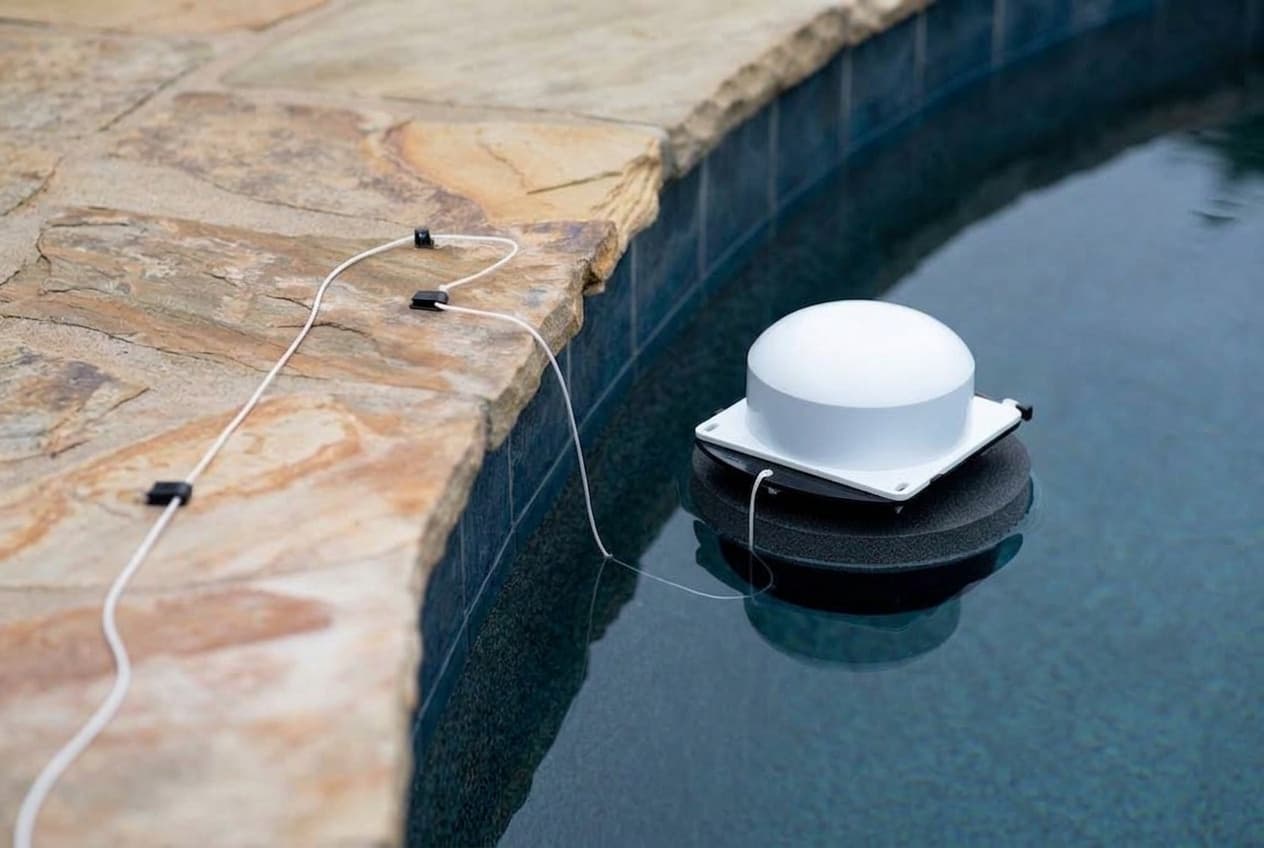
The PGRM-SB2 is Poolguard's floating pool alarm. Instead of sitting on the deck like Poolguard's PGRM-2, it floats in the water, tied to the pool edge by a tether, and uses what Poolguard calls sub-surface detection. When someone enters the pool, the water action reaches the float and the horn sounds, at the pool and on a remote receiver in the house. NSF certifies it to ASTM F2208, the residential pool alarm standard. Poolguard lists it at $249.95.
It replaced the PGRM-SB Safety Buoy, a red floating alarm built for above-ground pools. The two work the same way, but they're rated for different pools and carry different warranties, so check which one you're buying. The Amazon listing linked here is the older SB.
Like every Poolguard alarm, its manual says it's a safety alarm system and not a life saving device. It isn't meant to replace supervision, fences, gates, covers or locks, and some devices may not detect gradual entry.
PGRM-SB2 or PGRM-SB
PGRM-SB2, the current model:
- Rated for any pool or spa up to 20 x 40 feet or 800 square feet
- Warranty: 2 years
- Looks like a white dome on a black float
- Battery: press two locking tabs and lift the dome
- Storage: don't lay it on its side
- Serial number: on the pool unit
PGRM-SB Safety Buoy, the earlier model:
- Rated for above-ground pools up to 30 feet round or 18 x 36 feet, and spas
- Warranty: 1 year
- Looks like a red housing on a float
- Battery: remove four screws and lift the housing
- Storage: a red storage stand is included
- Serial number: on the back of the remote receiver
Poolguard markets the SB2 for in-ground pools, quick-set, soft-sided and portable above-ground pools, and spas. The SB manual only covers above-ground pools and spas.
What comes in the box
For the PGRM-SB2:
- The alarm
- The tether string, already attached, and the tether clip
- The remote receiver and its power supply
- The red reset/sleep key
- The operating manual
The 9 V battery isn't included. Poolguard recommends an alkaline Energizer No. 522.
Keep the red key away from children. The manual warns that its internal magnet may be harmful if swallowed, and it's the thing that silences the alarm.
Tethering it
The tether keeps the float where it can work, close to the wall. From the manual:
- Don't tie the tether to a pool ladder.
- Pick a spot for the clip that's clean and dry. The clip has an adhesive back meant for smooth surfaces like metal, plastic or vinyl. Concrete or wood may need a separate adhesive or another way to fix the string.
- Peel the backing and press the clip down firmly, with its open end facing away from the water.
- Adjust the string so the edge of the floating platform sits no more than 5 inches from the pool wall, while leaving enough slack for the alarm to float freely.
- Cut off the extra string, tie a knot in the end, and slide it into the clip. The knot holds it.
Be careful putting the clip on a vinyl liner. The manual warns that removing it later can tear the vinyl.
Where to put it
The placement rules, from the SB2 manual:
- Not on the same side of the pool as the ladder.
- Not near a return line, and not where a return points toward the alarm. Point every return eyeball fitting down. Poolguard says the pool still circulates properly that way.
- Not close to a waterfall or other water feature.
- Not with any type of pool cover.
The SB2 is rated for pools up to 20 by 40 feet, or 800 square feet, and NSF's listing says Poolguard's alarms were tested on a 16 by 32 foot pool. Call Poolguard at 1-800-242-7163 if your pool is larger than 800 square feet, has more than two return lines, is an irregular shape, or has water features. The manual says customer service will tell you how many alarms you need and where to put them.
No on/off switch
In the pool, the alarm is always on and can't be turned off. A green light on top flashes about once every 10 seconds while it's monitoring, and about twice a second while it's sounding. Out of the pool, the light stops flashing and the alarm is off.
Taking it out sets the horn off, and so does putting it back. The red key handles both, on the reset/sleep area on the front of the dome:
- To silence it once it's out of the pool, hold the key there for 3 to 4 seconds. That puts it to sleep, and it wakes up by itself when you put it back in.
- To reset it after an alarm with the unit still in the pool, place the key there.
- To put it in silently, hold the key there for 1 second until it beeps. You then have 10 seconds to put it in the pool.
- To take it out silently, hold the key there for 1 second until it beeps. You then have 5 seconds to lift it out.
Poolguard says the silent feature is only for the people responsible for taking the alarm out of the pool.
The manual also says not to lay the alarm on its side, which can set it off and makes damage more likely. Moving the sensor assembly sounds the horn too.
After sounding for about 5 minutes, it resets itself.
Test it every time it goes in
From the manual:
- Go to the point in the pool farthest from the alarm.
- Push something with the approximate size, weight and volume of your smallest child off the edge. Poolguard suggests a 4-gallon jug of water, or three 1-gallon jugs tied together.
- The alarm should sound when the water action reaches it, which can take a few seconds.
- Reset it, let the water settle, and repeat from another point.
Because the alarm may detect the same entry more than once, the manual suggests taking it out and putting it to sleep while the pool settles between tests.
Feet in the water, splashing, waves from a leaf skimmer or a small object won't set it off. The manual says that's by design.
The remote receiver
The receiver sounds in the house whenever the float sounds, from up to 200 feet away, and keeps going for about 3 seconds after the pool unit is silenced. It plugs into a 120 V outlet, and the manual says not to use it outdoors.
- Put it on the same level as the pool or above it, not in a basement.
- Keep it away from steel walls and large metal objects.
- A spot by a window overlooking the pool is ideal.
- Untie the power cord before plugging it in. It comes tied in a bow.
If it doesn't pick up the signal, try moving it a little left or right, or to another room. If nothing works, call customer service.
The receiver also carries the low battery warning. If it beeps about once every 10 seconds, the 9 V battery in the float is low. The float beeps the same way.
Changing the battery
On the SB2, press the two locking tabs toward each other and lift the dome cover. Attach the battery snap firmly and seat the battery in its holder. That sets the horn off, so have the red key ready. Close the dome until the tabs lock, then hold the key on the reset/sleep area for 3 to 4 seconds to put it to sleep. Clean off any leakage or corrosion when you replace an old battery, and take the battery out if you're storing the alarm for a long time.
On the older SB, you remove the four black screws and nuts holding the red housing to the base and lift the housing off, taking care not to pull the internal cable or bend the antenna.
False alarms
Both manuals say every pool alarm false alarms sometimes, and that a false alarm is better than none. The causes they name:
- Wind strong or steady enough to rock the water up and down the pool wall. Light wind and rain won't set it off. On very windy days, take the alarm out.
- Putting it back too soon after swimming. Wait for the water to stop moving, about 10 to 30 minutes.
- An automatic cleaner, if the cleaner or its hose hits the alarm. Run the cleaner at night and the alarm in the day, or find a spot the cleaner doesn't reach.
- Water features and returns aimed at the alarm.
If it won't sound at all, check the connection between the battery and the battery snap, check that the test was done properly, and make sure the return eyeball fittings point down.
What it's certified to
NSF lists the PGRM-SB2 and the older PGRM-SB under both ASTM F2208, for performance, and NSF/ANSI 50, for material safety and pool and spa temperatures. For the SB2, NSF's listing specifies ASTM F2208-2008 and NSF/ANSI/CAN 50-2024. The SB2 manual says it meets or exceeds Tennessee's pool alarm requirements under the Katie Beth Law, and Poolguard's product page says it meets New York, California, Connecticut, Florida and Tennessee alarm codes.
The SB2 manual adds an FCC note: install and operate it with at least 20 cm between the transmitter and any part of the body.
Where Poolguard's documents disagree
- "The only floating alarm NSF certified to ASTM F2208." Poolguard's product page says this of the SB2. NSF's listing also certifies Poolguard's own earlier floating alarm, the PGRM-SB.
- Which pools. The SB manual rates the Safety Buoy for above-ground pools up to 30 feet round or 18 by 36 feet. The SB2 manual rates the SB2 for any pool up to 20 by 40 feet or 800 square feet. A 30-foot round pool is about 707 square feet, so both cover it, but only the SB2 is rated for in-ground pools.
- Water level. The SB manual says the alarm automatically compensates for variations in water level. The SB2 manual doesn't say.
- Where to push the test jug. The SB manual says off the top edge or rail, for above-ground pools. The SB2 manual says off the deck edge.
Buying it
Poolguard's product page lists the PGRM-SB2 at $249.95 with a two-year warranty, and sells it through the dealers its website lists. The Amazon listing linked here is the older PGRM-SB, which is still NSF-listed but rated for above-ground pools and spas, with a one-year warranty. For an in-ground pool, buy the SB2 from a dealer or look at the PGRM-2.
Which model do you have?
The model number is on the pool alarm label. Everything else in the range is shared — these are the parts that change with it.
| Model | SKU | Rated for | Warranty | Note |
|---|---|---|---|---|
| PGRM-SB2 | PGRM-SB2 | Any pool or spa up to 20 x 40 ft or 800 sq ft | 2 years | Poolguard's current floating alarm, list price $249.95. A white dome on a black floating platform; the battery is reached by pressing two locking tabs and lifting the dome. |
| PGRM-SB Safety Buoy | PGRM-SB | Above-ground pools up to 30 ft round or 18 x 36 ft, and spas | 1 year | The earlier red Safety Buoy. It came with a red storage stand, and its battery is reached by removing four screws. Poolguard's alarms page no longer lists it, but its manual is still on Poolguard's site and NSF still lists it. |
Poolguard PGRM-SB2 Floating Alarm manuals and documentation
Hosted by the manufacturer. These open on Poolguard’s own servers, so they stay current.
Poolguard PGRM-SB2 Floating Alarm warranty
2 years parts
Two years on defects in parts and workmanship for the PGRM-SB2, from the date of purchase, so keep the receipt. The older PGRM-SB carried one year. For either, call Poolguard's customer service before sending anything back: the manuals say unauthorized returns are not accepted and that proper repair is only ensured when the unit goes back to the manufacturer. The model and serial number are on the pool unit of the SB2, and on the back of the remote receiver of the SB.
Poolguard PGRM-SB2 Floating Alarm parts
Poolguard publishes no part numbers for its floating alarms. Its website has no parts or store section, and neither manual lists a part number. The PGRM-SB2 manual lists what comes in the box: the alarm, the tether string and tether clip, the remote receiver and its power supply, the red reset/sleep key and the manual. The older PGRM-SB added a red storage stand. If anything is missing or lost, both manuals say to contact the place of purchase or PBM Industries, which makes Poolguard, to buy a replacement, and they say an additional remote receiver can be bought from PBM by phone or mail. You supply the 9 V alkaline battery; Poolguard recommends Energizer No. 522. For a fault, the manuals send you to customer service at 1-800-242-7163, because repair is done by returning the unit to the manufacturer.
Buy the pool alarm
One retailer for now. More get added here as their programs are approved, and this becomes a comparison rather than a link.