A hot tub that keeps needing water is losing it somewhere: into the air, onto the ground, or into the cabinet where the pumps and the electrics live. That last one is why this isn't a job to rush.
I read the owner's manuals, support pages and warranties of fourteen hot tub makers for this page, and the service documents of Balboa and Gecko, who make pumps and control packs. On where to look, they mostly agree. On what you're allowed to fix, they don't, and I've named who says what.
Key takeaways
- Some water loss is normal. Canadian Spa Company calls a drop of about 1 to 2 inches a week normal, and DOE found evaporation very small on covered tubs.
- The pump and heater unions are the first place to look. Bullfrog, Caldera, Hot Spring, D1, Coast and pump maker Gecko say hand-tight only. Cal Spas and an older Arctic page reach for channel-locks.
- No spa maker I read gives owners a fix for a pump shaft seal, a jet, a glue joint or the shell. Only the pump maker Gecko publishes a seal replacement.
- Who may fix it varies by maker. Arctic calls union leaks user serviceable, Marquis says customers may not dismantle spas, and Hot Spring, Caldera and Cal Spas void coverage for repairs by anyone but their own people.
- No maker's manual or warranty names a stop-leak product, for or against. Several void coverage for unapproved chemicals, so ask the dealer before pouring one into a tub under warranty.
Is it a leak, or just use?
Some water always goes. Caldera says a tub loses water to evaporation and to spillage with regular use. Arctic adds what gets carried out on skin and swimsuits, and Jacuzzi says to top up often in hot or windy weather.
Only one maker I read puts a number on it. Canadian Spa Company says a drop of about 1 to 2 inches a week is normal, from condensation, evaporation or high humidity. It doesn't say under what conditions. The Department of Energy, testing tubs for its energy test procedure, found the water lost to evaporation very small with the covers on.
So take the people out of the test. Mark the waterline with a strip of tape, which is Canadian Spa Company's tip for its soft-sided tubs, and leave the cover on with nobody using it. Marlig, which makes a leak sealer, says to measure the loss over 24 hours. A covered tub that still drops steadily isn't losing it to bathers.
Water on the ground isn't proof either. Cal Spas says splashing, rain and condensation dripping off the cover can all leave water around a tub that isn't leaking.
Before you open anything
Power off at the breaker. Jacuzzi says to turn the power off if you suspect a leak. Caldera and Hot Spring both turn it off at the breaker before the equipment door comes off. Master Spas adds that a tub fed by more than one circuit needs every one of its breakers off.
Look, but don't open the control box. Hot Spring and Caldera list opening it as a don't: there are no owner-serviceable parts inside, and opening it voids the warranty.
If the water has reached the electrics, stop. Master Spas says that if water is getting into any component in the equipment area, turn off the breaker and refer it to qualified service. Hot Spring says a damp control box has to dry out completely before the GFCI is tested, and that any component the water damaged gets replaced.
A leak into the control box is also one of the reasons makers give for a GFCI that keeps tripping. If yours is doing both, the leak comes first.
Where to look
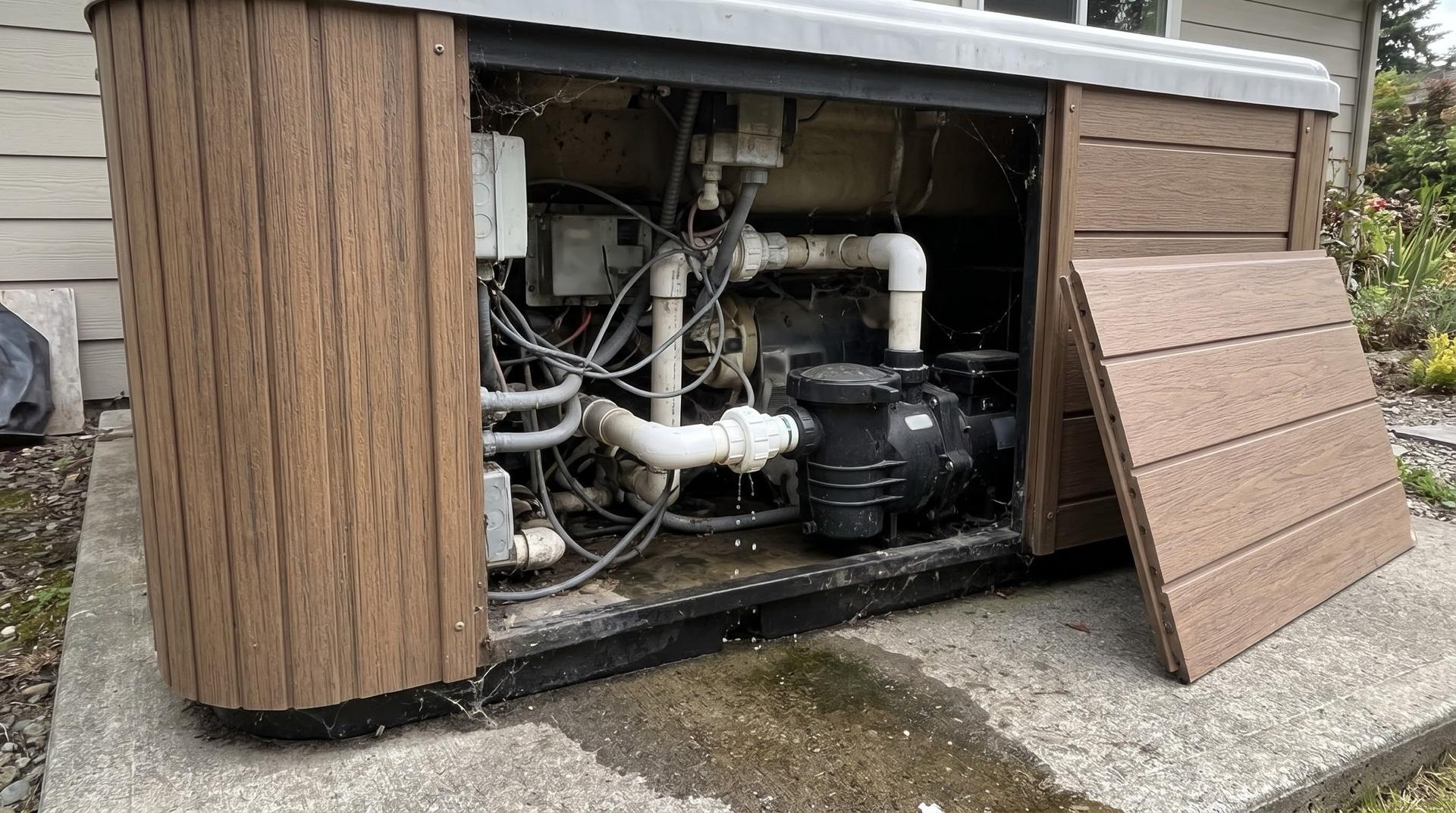
With the power off and the door off, start at the equipment. Several makers spell it out:
- Bullfrog: check every fitting and all the equipment in the compartment. In its filling steps, it checks with the pumps off, then again with them running.
- Marquis: its manual has a section called Leakage Detection. Check around the pumps, and look at the pump seals, heater gaskets and pump gaskets every month.
- Cal Spas: start with the union connections at the pumps, the heater and the filter housing. It says these loosen over time and often drip on and off.
- Arctic: reach under each union and feel for water.
- Canadian Spa Company: take the side panels off, find the leak and photograph it. It says that's what it needs to send parts or a technician.
Some tubs are foam-filled behind the panels. D1 says a leak in plumbing buried in foam takes a service person longer to find, and the wet foam has to be replaced.
Not every plumbing leak lets water out. Cal Spas says a leak on the suction side pulls air in instead, which shows up as bubbles at the jets and a pump that won't prime. That's the airlock and surging jets guide, not this one.
The leak points, and who fixes each
Pump and heater unions
Arctic's video calls the unions the most common place for a spa to leak. They're the big threaded collars either side of each pump and the heater: two per pump and two on the heater, by Master Spas' count.
Each union seals on an O-ring. Balboa's pump troubleshooting table gives one cause for a union that leaks: an O-ring that's over- or under-tightened, pinched, or not seated properly. Arctic adds that most union leaks show up right after a water change, when the temperature swing works on the gasket.
How tight is tight? This is where the makers split.
- By hand only: Bullfrog, Caldera, Hot Spring, D1 and Coast. Gecko's Aqua-Flo pump manuals say "Hand tighten only. Do not use tools." Arctic's video says hand-tight is all a union needs, and that going further can break it.
- With channel-locks: Cal Spas, to loosen unions when bleeding air, and Arctic's older tech support pages, to tighten a leaking one.
I'd start by hand, as the pump makers say. If a union still weeps once it's hand-tight, Balboa's list points at the O-ring rather than more force. Coast's manual warns not to lose the O-rings when you take a union apart.
A new O-ring is cheap. Bullfrog's parts store listed its 1½-inch pump union O-ring at $9.99 on 19 November 2026, on back order, and says to drain the tub before replacing one. Other makers don't publish prices, and Balboa and Gecko sell only through dealers and distributors.
The pump shaft seal
If the water is coming from the pump itself rather than a union, Gecko's pump manual lists three things to check, in this order: the shaft seal, the unions, and whether the O-rings are seated.
Marquis says pump seals wear out over time, faster with poor water chemistry, and that catching a failure early saves a lot of money. Arctic's warranty is blunt about why: the seal itself is covered, but damage from a seal left leaking isn't, and that includes the bearings, the motor end and the capacitor. It makes reporting a seal failure your job. Cal Spas adds that chlorinating shock can damage pump seals.
No spa maker I read gives owners a procedure for replacing one. Gecko does, for its own pump: power off at the main, drain the lines, and replace both halves of the seal every time the pump comes apart. It's the same kind of seal as on a pool pump, and the pool pump leak guide explains how one fails. On a tub under warranty, this is a dealer job.
The heater
Marquis puts the heater gaskets on its monthly check. Cal Spas says the heater's unions develop leaks as their gaskets age, and that moisture or mineral deposits around the heater connections can be the first sign. Bullfrog's parts store lists the O-ring flange gasket between its Gecko control and the heater at $6.99.
The drain valve
A little weeping is normal while you're draining. Master Spas says water may drip from the drain with its cap off, and that the valve has to go back fully closed with the cap on afterward.
Marquis says to keep the valve closed at all times and not to rely on the cap to hold the water. Doing otherwise, it says, risks freeze damage to the valve.
Canadian Spa Company describes two loose parts on its drain. The retainer flange works loose with use, and you'll see the drain valve wiggle; it tightens with a screwdriver. Further in, the big nut behind the cabinet panel and the pipe fitting behind it both tighten by hand. Bullfrog sells its drain cap for $18.99.
The filter housing
Marquis warns that tightening the filter too hard can crack the filter or its housing: tighten it until it's just snug. Hot Spring says not to sit on the filter lid, which can crack.
Jets, glue joints and the shell
None of the manuals I read gives an owner a fix for a leaking jet body, a glue joint or the shell. Cal Spas says shell cracks are relatively uncommon, and that a leak you can't find needs a professional with specialized equipment.
These are warranty items. Hot Spring's and Caldera's top warranties name leaks from the wall fittings, jet fittings, internal plumbing, internal glue joints, drains, hoses and bonded parts. Cal Spas covers jet body grommets. If your leak is here and the tub is in warranty, call the dealer before you touch it.
Overfilling and sun
Two leaks aren't faults. Master Spas says that if bathers push the water up to the air controls, diverters or topside panel, it will leak out of the shell and possibly into the equipment area. And Arctic says leaving the tub uncovered in direct sun can warp plastic parts until some fittings leak, which its warranty doesn't cover.
Freeze damage
Freezing splits things. Marquis says that not following its cold-weather steps will result in cracked fittings and glue joints. Arctic's support pages say a frozen tub can crack the unions, and D1 says draining alone won't prevent freeze damage, because the water left in the plumbing still expands.
Most warranties won't pay for it. Master Spas, Cal Spas and Arctic exclude freeze damage, ThermoSpas excludes damage from water below 32°F, and Hot Spring's and Caldera's manuals warn that winterizing done wrong leads to freeze damage not covered by warranty. The winter guide has the makers' rules for keeping a tub from freezing.
Winterizing has its own trap. Bullfrog's steps leave the unions loose until spring, and Caldera's say to tighten the pump unions before filling. Skip that and the tub leaks the day you fill it.
What the warranties cover
A leak from a defect is the dealer's problem while the warranty lasts. The catch is what each warranty counts as a leak, and who's allowed to fix it.
| Plumbing leaks | Repairs by others | |
|---|---|---|
| Hot Spring | 5 years on Highlife and Limelight, 2 on Hot Spot, 1 on Freeflow | Not covered if anyone other than an authorized Watkins representative made or attempted them |
| Caldera | 5 years on Utopia and Paradise, 2 on Vacanza, 1 on Fantasy | Same Watkins wording as Hot Spring |
| Jacuzzi | 5 years on the 2025 J-300; 1 year on Play, unions included | J-300: the owner accepts liability for repair work by anyone else. Play: any company may do it, but damage it causes may void the warranty, and pump seals are wear parts |
| Sundance | 5 years on the 2025 880 Series | The owner accepts liability for repair work by anyone else |
| Bullfrog | 5 years on equipment, including leaks from any fitting beneath the shell | Anyone may do maintenance or repairs, but damage they cause is not covered |
| Master Spas | 5 years, parts and labor | Voidable after repairs by a service center it hasn't approved |
| Cal Spas | 5 years, including jet body grommets | Void if anyone other than its designated representative attempted repairs |
| Marquis | 5 years on Crown, 3 on Vector21 and Elite, excluding gaskets and seals; 2 on Celebrity | Customers may not dismantle spas. Celebrity excludes loose unions, pump seals and gaskets, and pays $60 of labor a time |
| Arctic | 5 years on Custom, 3 on Classic and Core | Union leaks are the owner's to fix and excluded; any other repair by anyone but a factory dealer voids it |
| ThermoSpas | 10 years prorated, pump seals included; 1 year of labor | Void after repairs by anyone but its representative |
Tightening a union is maintenance, not a repair, in most manuals. Caldera's manual has the owner check that the unions are hand-tight before the first fill. Caldera's, Hot Spring's Hot Spot manual, Marquis' and Hydropool's all have you loosen a union to let air out of a pump and tighten it again. Taking a pump apart is a different matter, and Marquis' warranty says a customer may not dismantle the spa.
Three more things the warranties agree on:
- Report it fast. Hot Spring gives you 30 days from finding the problem, and Master Spas and Jacuzzi's Play warranty 10.
- Access is your cost. Jacuzzi, Sundance and Cal Spas make access to the repair the owner's responsibility. Bullfrog charges non-standard access costs to the owner. Hot Spring won't pay to remove a deck or a custom fixture.
- Water damage isn't covered. Jacuzzi's warranties exclude it, and ThermoSpas tells owners to check their homeowner's policy.
Stop-leak products
None of the manuals or warranties I read names a stop-leak product, for it or against it. The nearest clauses are about chemicals. Bullfrog voids coverage for damage from any non-approved chemical substance, Cal Spas for unapproved chemicals, and ThermoSpas and Arctic for chemicals they haven't approved. None of them says whether a leak sealer counts. On a tub under warranty, ask the dealer first.
If you go ahead, read the label, because the job is longer than pouring in a bottle. Marlig's Fix A Leak directions for hot tubs:
- Take all the cartridge filters out, and have the water at 70°F or warmer.
- One 8-ounce bottle treats 250 to 1,000 gallons.
- Run the jets 4 to 6 hours, alternating speeds, with someone watching. Brush the floor and do it again the next day.
- Leave the tub off for 48 hours to confirm the leak has stopped.
- Drain it if nights stay above 40°F, wipe off the residue, and leave it empty for 4 to 7 days.
Marlig says most hot tub repairs last 1 to 2 years. Lo-Chlor's Spa Leak Sealer works differently: air blowers off, stir it back up every 45 minutes because it sinks, then drain and leave the tub empty for at least 48 hours.
Neither gives a size limit for a spa leak. Marlig's only figure, up to ⅛ inch, is on its pool page. And these are strong alkalis: the safety data sheet for Leisure Time's Leak Seal lists 30 to 40% sodium silicate, signal word Danger, and serious eye damage. Wear eye protection.
A union you can reach and tighten doesn't need one.
Don't let it run low while you find it
A leak drops the water past the point the pumps and heater need. Hot Spring says weak or surging jets mean low water or a clogged filter. Balboa's controls shut the tub down when there isn't enough water in the heater, and the error codes guide lists those messages.
Bullfrog says not to power up a tub without water in it at all, because of the damage to the pumps and heater. Hydropool says never to let a pump run unprimed for more than 5 minutes.
Every maker marks the right level differently. Hot Spring's 2025 Highlife manual says about 1½ inches above the highest jet, Marquis two-thirds of the way up the skimmer openings, and Arctic the bottom of the pillows. Use your own manual's mark, and top up to it while you track the leak down.
Where the makers disagree
- Wrench or hand. Bullfrog, Caldera, Hot Spring, D1, Coast and Gecko say unions are hand-tight. Cal Spas and Arctic's older tech pages use channel-locks, and Arctic's own video warns that more than hand-tight can break one.
- Whose job a union leak is. Arctic calls it user serviceable and excludes it from the warranty. Jacuzzi's Play warranty covers unions for a year. Marquis' Celebrity warranty excludes loose unions altogether.
- Pump seals. ThermoSpas covers them. Arctic covers the seal but not what a neglected leak damages. Jacuzzi's Play warranty calls seals wear parts, and Marquis excludes seals and gaskets.
- Outside repairs. Bullfrog and Jacuzzi's Play line let anyone work on the tub and exclude only the damage. Hot Spring, Caldera, Cal Spas, Master Spas, Marquis, Arctic and ThermoSpas void or limit coverage instead.
Frequently asked questions
How much water should a hot tub lose in a week?
Canadian Spa Company says a drop of about 1 to 2 inches a week is normal, from condensation, evaporation and humidity. It gives no conditions. DOE's own testing found evaporation very small with the cover on, so a covered tub that nobody is using should lose little.
Should you tighten hot tub unions with a wrench?
Most makers say no. Bullfrog, Caldera, Hot Spring, D1 and Coast say hand-tight, and Gecko's pump manuals say "Do not use tools." Arctic's own video warns that going past hand-tight can break the union. Cal Spas and an older Arctic support page use channel-locks, so check your own manual.
Will fixing a hot tub leak myself void the warranty?
It depends on the maker and the repair. Hot Spring, Caldera, Cal Spas, Master Spas, Marquis, Arctic and ThermoSpas void or limit coverage for repairs by anyone but their own service people. Bullfrog and Jacuzzi's Play line let anyone work on the tub but won't cover damage the work causes. Hand-tightening a union is in most manuals as owner maintenance.
Do hot tub stop-leak products work?
No hot tub maker I read says either way. Marlig, which makes Fix A Leak, says most hot tub repairs last 1 to 2 years. Its directions take two days of running and end with a drain and 4 to 7 days empty. Bullfrog, Cal Spas, ThermoSpas and Arctic void coverage for unapproved chemicals, so ask your dealer before using one on a tub under warranty.
Why is my hot tub leaking after I refilled it?
Arctic says most union leaks show up right after a water change, because the temperature swing works on the gasket. After winterizing, the unions may also still be loose: Caldera says to tighten the pump unions before filling. Check them by hand once the tub is full and again with the pumps running.