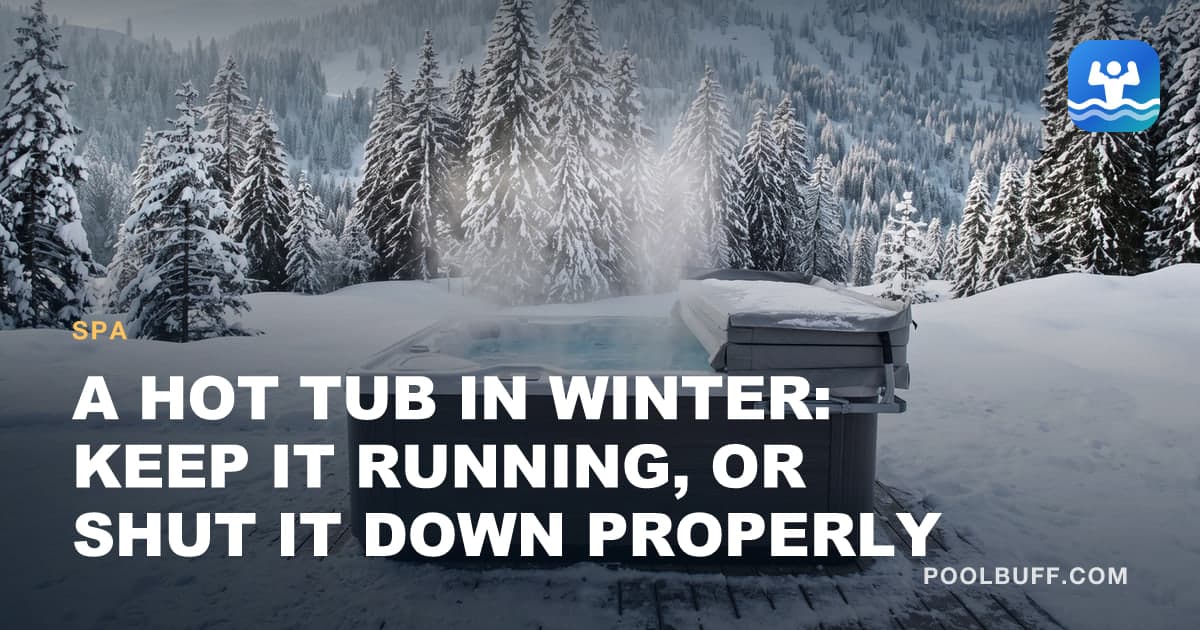
A hot tub in the snow is one of the best things about owning one. It's also the season when a tub can do itself real damage in a single night.
There are two ways through a winter: keep it running and keep an eye on it, or shut it down and get every drop of water out. Doing something in between is how plumbing cracks.
Everything below comes from the spa makers' owner's manuals, warranties and websites, from the two companies whose controls run most of those tubs, Balboa and Gecko, and from DOE and CPSC. Where the makers disagree, which is often, I say so.
Key takeaways
- A full, running, covered tub protects itself: the controls start the pumps when they sense freezing. Balboa says that only works when the tub has power.
- Freeze protection starts at different points: 68°F air around Gecko's control box, 55°F in a Marquis heater housing, 39°F in a Hydropool heater chamber.
- If the power or the GFCI is off in freezing weather and won't come back, Balboa, Jacuzzi and Sundance say to drain it.
- Winterizing means getting the water out of the pipes, pumps and heater, not just emptying the shell. Seven makers recommend the dealer do it.
- Antifreeze is where the makers split: Cal Spas forbids it, Caldera and Hot Spring allow only propylene glycol, and Jacuzzi and Sundance don't mention it.
- Clear snow off the cover. Bullfrog says anything over 2 inches.
Keep it running, or shut it down?
The makers split on this, and the split is sharp.
Keep it running. Master Spas says it "does not recommend winterizing your spa," and that damage from doing it isn't covered. Cal Spas recommends keeping the tub around 80°F, filled and operating, through the cold months. It warns that its own winterizing procedure "does not guarantee against ice damage" inside the tub. Bullfrog's site says a tub doesn't need winterizing unless it will be left unattended for six weeks or more. Arctic's site says to just keep it running.
Winterize it if you won't use it. Jacuzzi and Sundance say that if you don't intend to use the tub in severe freezing weather, all the water should come out of the tub and its equipment. ThermoSpas says the same. Caldera, Hot Spring and Arctic's own manual say to drain and winterize a tub left unused in severe cold, to avoid freezing from a power or equipment failure.
What the two camps share is a person. A running tub is only safe if someone notices when it stops. Bullfrog says to have someone check every week that the tub is working, and ThermoSpas says to inspect it every day in cold weather. Jacuzzi and Sundance say to check periodically that the power hasn't been interrupted.
My habit: if someone can look at the tub at least once a week, it stays full and running. If nobody can, it gets winterized properly, by the dealer or by the steps below.
How freeze protection works
Every running tub I read about protects itself the same way. When the control's sensors read cold, it starts the pumps, and on some tubs the heater, to keep water moving through the pipes.
- Balboa says the pumps and blower run continuously or periodically, depending on conditions. Its user guides say freeze protection stays active in both the high and low temperature ranges, the "vacation" setting included.
- Gecko calls it Smart Winter Mode. Its FAQ says the mode is always enabled and can't be turned off by hand. Its maintenance mode does suspend it, for 30 minutes.
- Optional freeze sensors. Balboa and Marquis both offer an extra sensor for colder climates.
The makers don't agree on when it starts, or even where they measure:
| Starts at | Measured | |
|---|---|---|
| Gecko controls | 68°F | In the air where the control box sits |
| Marquis | 55°F | In the heater housing |
| ThermoSpas | Below 44°F | Not stated |
| Balboa (2013 technician manual) | Below 40°F | Either sensor |
| Sundance (2019 manual) | Below 40°F | In the water |
| Hydropool (Gecko control) | 39°F, running to 41°F | In the heater chamber |
| Hot Spring, Caldera, Bullfrog, Cal Spas, Jacuzzi | Not in their manuals | Not stated |
Caldera's website gives 40°F for its tubs, but its manual gives no figure. Gecko's 68°F and Hydropool's 39°F aren't a contradiction so much as two different sensors: one reads the air around the control box, the other the water in the heater.
It needs power. Freeze protection "only functions when there is proper power running to the spa, and the control system is operational," Balboa's technician manual says. Jacuzzi and Sundance say their tubs protect themselves "when operating properly." Jacuzzi's website goes further than its manual and claims freeze protection works even during power outages. I'd trust the manual.
The equipment bay can freeze first. Caldera and Hot Spring both warn that below 10°F with strong wind, the jet pump can partly freeze even while the water stays at temperature. Both sell an insulating kit for the equipment compartment, and Hot Spring says to take it out when the weather warms to about 60 to 70°F, or the jet pump can overheat.
Run the filtration longer in hard cold. Jacuzzi's J-200 manual says at least 8 hours a day when it's below 32°F. Its J-300 manual and Sundance's 880 manual say to run filtration or circulation 24 hours.
Don't turn it down too far. Hot Spring warns that in freezing weather, the risk of the water freezing during an outage or a fault rises as the set point drops. Cal Spas recommends about 80°F, and Bullfrog's lowest setting is 80°F. Watch your warranty's limits too: Bullfrog excludes damage from water outside 40 to 110°F, Master Spas outside 34 to 104°F, and Marquis outside 32 to 120°F.
When the power goes out, or the GFCI trips
This is the night that cracks pumps. Freeze protection is off, and nothing is moving the water.
Get the power back first. Balboa's user guide says that if freezing conditions exist, a tripped GFCI "should be reset immediately or spa damage could result." Hot Spring warns that a high-limit or thermal cutoff trip that goes unnoticed in sub-freezing weather can let the water freeze.
If it won't come back, the manuals say drain. Balboa says that if the GFCI won't reset in freezing conditions, drain the tub until it works again. Jacuzzi and Sundance say that in a prolonged outage during severe freezing temperatures, all the water should come out of the tub and its equipment.
Jacuzzi's own outage page says the opposite: keep the cover on, add blankets over it, don't drain, and wait, because no one knows how long the power will stay out. That's advice for a short outage. The manuals are the ones with a plan for a long one.
Buying time. Hydropool says to put a low-wattage space heater under the cabinet in the equipment area while a service call is arranged, and not to leave it unattended. CPSC's heater advice is to keep a heater away from water and never leave one running unattended, which is hard to square with a heater left in a spa cabinet overnight. ThermoSpas suggests a small submersible pump in the footwell, pointed up to make a waterfall, with the cover and panels kept on.
If you run the tub from a generator, CPSC's rules apply: never inside a home, garage or shed, and never plugged into a wall outlet to feed the house.
How long you have. No manual says. The makers' blogs range from "a couple of hours" for the plumbing and equipment (Master Spas) to about five days at −20°C (Arctic, from testing it hasn't published). Neither gives a method, so I wouldn't plan around either.
Snow, ice and wind on the cover
Clear the snow. Caldera, Hot Spring and Jacuzzi all say snow buildup can break the cover's foam core. Bullfrog puts a number on it: gently remove anything over 2 inches. No spa maker I read publishes a snow-load rating for its cover.
Use a brush, not a shovel. Arctic says a shovel can damage the cover. Marquis says not to use anything hard, sharp or metal on ice, and names a windshield scraper.
Watch the lifter. Hot Spring says to check for ice around the gas springs and pivots of its lifter. Both Hot Spring and Marquis say their lifters aren't meant for wind above 25 mph, and suggest extra straps where winds are high. Bullfrog warns that a cover that isn't locked down can blow off.
Think twice about a tarp. Caldera's and Hot Spring's cover-care lists say not to put any plastic tarp or drop cloth over the cover, because the foam core can melt, and that damage isn't covered. Master Spas' warranty excludes damage from covering the tub "with plastic film of any kind."
Using it in the cold
Close the air controls after a soak. Jacuzzi and Sundance both say to close them when the tub isn't in use, to cut heat loss. Open them again before you judge the jets.
Allow time to heat up. Master Spas says its 240-volt tubs heat about 3 to 4°F an hour with the cover on, and its 120-volt tubs about 1°F. Bullfrog allows about four hours to go from 80 to 100°F.
Mind the steps. Hot Spring warns that wet surfaces are slippery getting in and out. On an icy deck that matters more. CPSC's limit of 104°F for the water applies in winter too.
Shelter it if you can. Sundance says a sheltered spot cuts running costs. Master Spas suggests an insulating ground cloth under the tub in cold climates.
It costs more. The standby watts in a tub's energy rating come from a test with the air no warmer than 63°F. DOE's version adjusts the result to 56°F, and DOE says heat loss rises roughly in line with the gap between the water and the air. Caldera and Hot Spring say the heater cycles more in the cold. A tub in a freezing yard will use more than its label, as the running costs page works through.
Drain before the freeze. Hot Spring doesn't recommend refilling when the air is below 50°F. Caldera says tap water below 50°F can trip the high-limit and stop the tub. Master Spas says that if you must drain in freezing weather, do it quickly with a submersible pump, then refill right away or winterize at once. The drain and refill guide has the rest.
Go deeperTub won't hold its temperature?The cold-weather cases first, then the checks in order.How to winterize a hot tub
Winterizing is not draining. An empty shell with water left in the pumps, heater and pipes is still a tub that can crack. The point is to get every drop out of the plumbing.
Think about the dealer first. Seven makers recommend having the dealer do it: Arctic, Caldera, Hot Spring, Jacuzzi, Sundance, Bullfrog and Hydropool. Caldera and Hot Spring warn that getting it wrong "can lead to freeze damage not covered by warranty," and Bullfrog's site says the same. Master Spas goes further: if you winterize at all, any damage that results isn't covered.
If you're doing it yourself, the steps below follow the makers' manuals. Your own manual wins wherever it differs.
- 1
Turn off the power
2 minSwitch the tub off at its breaker or disconnect before any water comes out. Jacuzzi and Sundance make this step one. Gecko's pump instructions say to disconnect all electrical power, and to drain the pump thoroughly to prevent damage in freezing conditions.
- 2
Drain the tub and open the air controls
1 to 2 hoursDrain it as your manual describes. As the level drops below the seats, Jacuzzi says to get the water out of them and into the footwell, with a wet/dry vac if needed. Jacuzzi and Sundance say to open all the air controls and leave them open until you use the tub again.
Bullfrog says to super-sanitize the water before winterizing. Caldera's site says the opposite: let the chemicals break down until chlorine reads zero.
- 3
Take out the filter
10 minRemove the cartridge, clean it, and store it somewhere dry, as Caldera's steps say. A filter cleaner gets the oils out before it sits for months. Caldera also says to leave the filters out at start-up until the antifreeze is gone.
- 4
Clear the plumbing with the shop vac
30 to 45 minCaldera says a 5-gallon combination vacuum and blower is a must where it falls below 32°F. Vacuum the jets from the top down, blocking any jet that pulls air with a rag, then the filter suction fittings and the main drain.
The makers don't agree on suck or blow. Marquis vacuums each jet, highest to lowest. Hot Spring's Highlife manual, Master Spas and Hydropool use the blower side to push water out through the jets. ThermoSpas says you must use a canister-type wet vacuum.
- 5
Drain the pumps and heater
20 minRemove the drain plugs on the pumps and loosen the unions so the pumps and heater empty. Jacuzzi says to expect one to two gallons, and to keep it from flooding the equipment bay.
What to do with the plugs depends on the maker. Bullfrog says to leave them out and the unions loose until spring. Jacuzzi, Sundance and ThermoSpas say to put the plugs back. Caldera says to bag them and store them by the pumps. Marquis says to take the pumps out and store them indoors.
- 6
Add antifreeze, or don't
15 minThis is the biggest split in the manuals:
- Cal Spas forbids it: "irreversible damage will occur to seals and spa finish, voiding your warranty."
- Caldera and Hot Spring allow only propylene glycol, poured into the standpipes, filter suction fittings and jets.
- Bullfrog, Master Spas and Hydropool call for non-toxic RV antifreeze. Hydropool says to get all the water out first, because mixing it with water significantly reduces its protection.
- Jacuzzi, Sundance, Marquis and ThermoSpas give no antifreeze step at all.
Every maker that mentions automotive antifreeze says never to use it. Getting it out in spring differs too: Bullfrog says RV antifreeze needs no flushing, Master Spas says to flush thoroughly, and Caldera and Hot Spring superchlorinate at double strength to destroy it, then drain again.
- 7
Cover it, and check on it
15 minDry the shell, put the cover on and fasten every tie-down or lock.
Bullfrog, Caldera and Hot Spring put plywood on top to carry the snow, and Caldera, Hot Spring, Cal Spas, ThermoSpas, Hydropool and Master Spas call for a tarp over a winterized tub. Cal Spas, Jacuzzi and Sundance say to put nothing heavy on the cover. Follow your own manual.
Master Spas says to check through the winter that water isn't getting in around the cover, and never to let an empty shell sit below 0°F. If yours will, keep it filled and running instead.
Starting it again. If the tub has sat empty in freezing weather, Jacuzzi and Sundance say water may still be frozen in parts of the pipes, and to talk to the dealer before restarting. Hot Spring's Hot Spot manual says the fill water must be between 50 and 70°F to avoid tripping the high-limit, and Caldera warns about tap water below 50°F.
Inflatable hot tubs
These come with limits the hard-shell makers don't print.
- Intex says not to use its PureSpa when the air or water is at or below 39°F, and to drain, clean and store it indoors when the temperature drops below that in freezing regions.
- Bestway says not to use its AirJet inflatable spa at 14°F, and to take it down and store it for a long absence when it may fall below 42.8°F.
Both have heater-based freeze protection for the occasional cold night, but neither is built to run through a hard winter.
What the warranties say about freezing
- By name: Cal Spas, Master Spas, Arctic, ThermoSpas and Hydropool exclude freeze damage outright. Cal Spas lists power outages and snowstorms among the causes it won't cover.
- By water temperature: Bullfrog, Marquis and Master Spas exclude damage from water outside a set range.
- Through misuse: Hot Spring's manual says freezing caused by poor maintenance falls under its misuse and abuse exclusion. Jacuzzi's warranty page says letting a tub freeze is a common way to damage the plumbing that isn't covered. Caldera's manual says getting the winterizing wrong can lead to freeze damage not covered by warranty.
Sundance's warranty doesn't mention freezing, but it excludes operating the tub other than as the manual says, and the manual says to protect it from freezing. Plan on a frozen tub being your bill.
Where the makers disagree
- Running versus winterizing. Master Spas, Cal Spas, Bullfrog's site and Arctic's site say keep it running. Jacuzzi, Sundance, ThermoSpas, Caldera, Hot Spring and Arctic's own manual say winterize a tub you won't use.
- How long away before winterizing. Caldera and Hot Spring say past two weeks with no one looking after it, and Cal Spas past 14 days. Bullfrog says six weeks, and offers its Away mode before that.
- Where freeze protection starts. Gecko 68°F in air, Marquis 55°F, ThermoSpas 44°F, Balboa and Sundance's older manual 40°F, Hydropool 39°F. Five makers' manuals give no figure.
- Whether it works without power. Balboa says it needs power; Jacuzzi's website says it protects even during outages.
- Draining in an outage. Balboa, Jacuzzi's manual and Sundance's say to drain if power won't return. Jacuzzi's outage page says don't.
- Filtration in hard cold. Jacuzzi's J-200 says 8 hours a day; its J-300 and Sundance's 880 say 24.
- Antifreeze. Forbidden by Cal Spas, propylene glycol only at Caldera and Hot Spring, RV antifreeze at Bullfrog, Master Spas and Hydropool, not mentioned by Jacuzzi, Sundance, Marquis or ThermoSpas.
- How much antifreeze. Bullfrog's manual says half a gallon to a gallon in the filter hole; Bullfrog's site says 1 to 6 gallons by size. Arctic's site says 1 to 1.5 gallons.
- Diluting it. Caldera's site says to dilute it as the bottle directs. Hydropool says mixing it with water significantly reduces its protection.
- Pump plugs. Out all winter at Bullfrog, back in at Jacuzzi, Sundance and ThermoSpas, pumps removed and stored indoors at Marquis.
- Tarps. Caldera and Hot Spring call for one in their winterizing steps and warn against one in their cover care. Master Spas advises a watertight tarp but excludes damage from plastic film.
- Weight on the cover. Bullfrog, Caldera and Hot Spring put plywood on it; Cal Spas, Jacuzzi and Sundance say nothing heavy on it.
- How often to check. ThermoSpas says every day in cold weather, Bullfrog every week, Jacuzzi and Sundance periodically.
Frequently asked questions
Should I leave my hot tub running in winter?
If you'll use it, or someone can check it every week, yes. Master Spas doesn't recommend winterizing at all, Cal Spas says to keep it filled and operating, and Bullfrog says it doesn't need winterizing unless it will be left for six weeks or more. Jacuzzi, Sundance, ThermoSpas, Caldera and Hot Spring say to winterize a tub you won't be using.
How cold is too cold for a hot tub?
No maker of a hard-shell tub gives an air temperature limit for a running tub. Caldera and Hot Spring warn that below 10°F with strong wind the jet pump can partly freeze even with the water at temperature, and sell an insulating kit for the equipment bay. Inflatable tubs do have limits: Intex says not to use its spa at or below 39°F, and Bestway puts its cutoff at 14°F.
What should I do if the power goes out in winter?
Keep the cover on and get the power back. Balboa says to reset a tripped GFCI immediately in freezing weather, and to drain the tub if it won't reset. Jacuzzi and Sundance say to remove all the water in a prolonged outage during severe freezing temperatures. No manual says how long a covered tub lasts without power.
Do I need antifreeze to winterize a hot tub?
It depends on the maker. Cal Spas says not to use it at all, because it damages the seals and the finish and voids the warranty. Caldera and Hot Spring allow only propylene glycol, and Bullfrog, Master Spas and Hydropool call for RV antifreeze. Jacuzzi and Sundance give no antifreeze step. Nobody allows automotive antifreeze.
Can I drain and refill a hot tub in winter?
Do it before the freezing weather if you can. Hot Spring doesn't recommend refilling when the air is below 50°F, and Caldera says tap water below 50°F can trip the high-limit and stop the tub. Master Spas says to drain quickly with a submersible pump, then refill right away or winterize at once.
Is freeze damage covered by the warranty?
Cal Spas, Master Spas, Arctic, ThermoSpas and Hydropool exclude it by name. Bullfrog, Marquis and Master Spas also exclude damage from water outside a temperature range. Hot Spring, Caldera and Jacuzzi tie freezing to their misuse or winterizing clauses. Assume a frozen tub is on you.
Should I clear snow off the hot tub cover?
Yes. Caldera, Hot Spring and Jacuzzi say snow buildup can break the foam core, and Bullfrog says to remove anything over 2 inches. Use a brush rather than a shovel, as Arctic advises, and nothing hard or sharp on ice: Marquis names a windshield scraper as the thing not to use.