Hayward · Universal HC Series
Hayward Universal HC Series
Hayward's compact gas heater that converts between natural gas and propane on site: the two sizes, the flow and clearance rules, and what the codes mean.
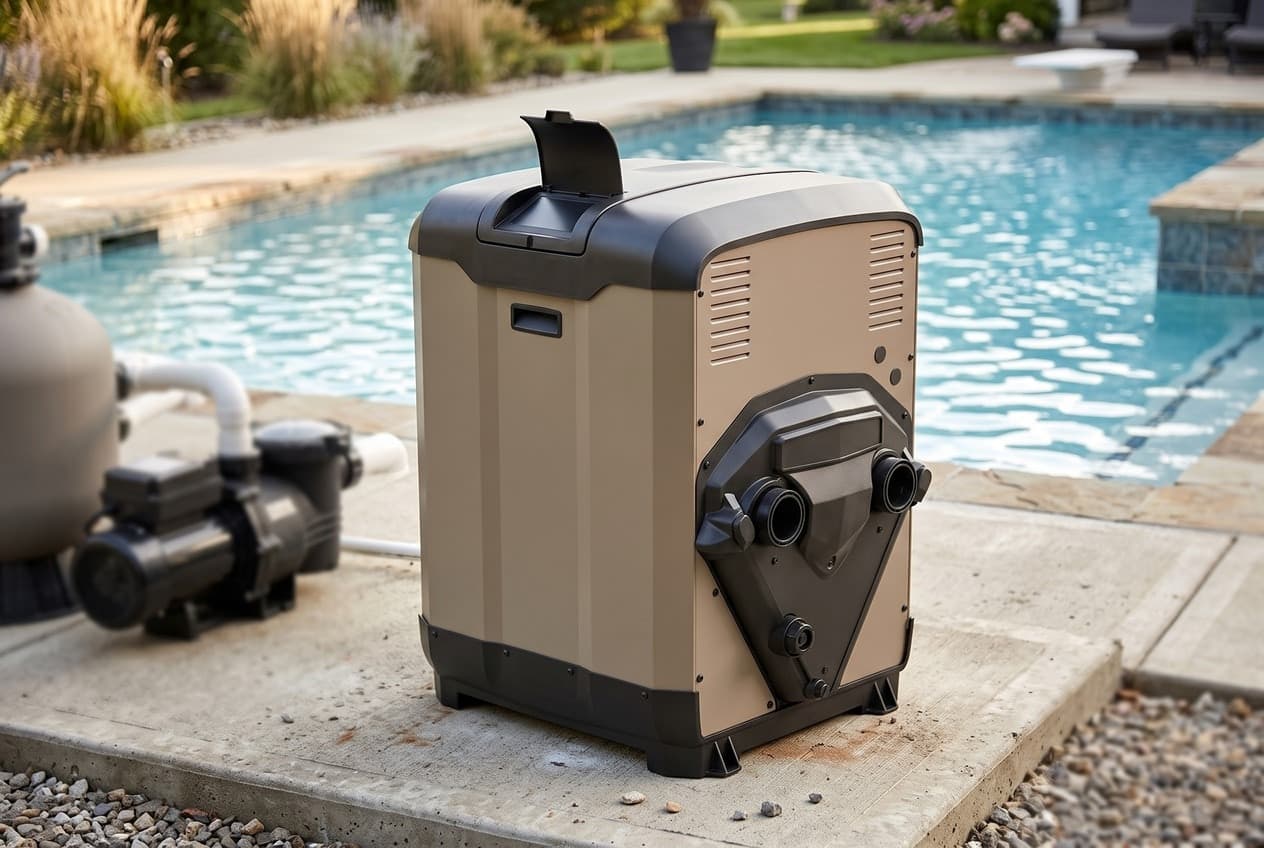
The Universal HC Series is Hayward's compact gas heater for in-ground pools and spas, in two sizes: the HDFS275 at 275,000 BTU/hr and the HDFS400 at 399,900. Both are 84% efficient, the figure DOE certifies and the FTC label prints. Each runs on natural gas or propane from the same model: it ships set for natural gas, and the propane part is in the box. It has a cupro-nickel heat exchanger, fits on a 21 by 21 inch footprint with no clearance at the back, and has Hayward's OmniX controls built in.
What "dual fuel" means here
Not two fuels at once. Hayward's "dual fuel" means one heater that can be set up for either natural gas or propane, where most gas heaters come as separate natural gas and propane models.
Every HC Series heater leaves the factory set for natural gas. Converting to propane takes two parts, both in the consumer kit packed in the top of the carton: a propane fuel/air mixer and a field conversion label. The mixer twists out of the combustion blower's inlet, about 45 degrees to unlock, and the new one twists in; the label goes next to the rating plate. Then the manifold pressure has to be checked.
The manual says the conversion must be done by a qualified service agency, and warns never to run the heater on propane before the mixer is changed, because of the risk of fire or explosion.
HDFS275 or HDFS400
- HDFS275: 275,000 BTU/hr, a minimum flow of 25 GPM, 131 pounds.
- HDFS400: 399,900 BTU/hr, a minimum flow of 30 GPM, 136 pounds.
Both are the same size outside, 28 by 21 inches and 31 inches high, and both are 84% efficient. The site's heater sizing calculator works out the size a pool needs from its surface area, and the heat-up time and running cost on gas or propane.
How it differs from the Universal H-Series
The HC Series shares an FTC EnergyGuide label, and its 84% rating, with Hayward's 250,000 and 400,000 BTU Universal H-Series heaters. What's different is the build:
- Its size. Hayward's footprint chart puts it at 28 by 21 inches, against 36 by 36 for its previous H400FDN. The site's H-Series page gives today's HS400FD as 34 inches wide.
- One model for both fuels, where the H-Series comes as separate natural gas (N) and propane (P) models.
- Its burner: pre-mix combustion with a silicon nitride hot surface igniter.
- Service from the top. Hayward says the top-access design means no side panels come off, and a single fastener opens the reversible top to the gas shutoff and the voltage selection.
Where it can go
From the manual:
- At least 5 feet from the inside wall of the pool or spa, unless a solid barrier separates them.
- Clearances: none needed behind it, 18 inches in front, 12 on the water side and 6 on the other side. Outdoors, nothing above it; indoors, 36 inches. The manual suggests a small gap behind anyway, so the top panels come off freely, and 12 inches if there's vinyl siding behind it or on the exhaust side.
- Not under an overhang less than 72 inches above it, and the area under one must be open on three sides.
- Not within 24 inches of outdoor HVAC equipment.
- Away from sprinklers, roof runoff and, near the ocean, blown sand and salt spray. The manual says damage from each isn't covered.
- On a level pad, at the same level as the filter pad or slightly above. Where codes call for anchoring, it takes four stainless ¼ in. concrete screws, at least 1½ in. long, through fender washers at the feet.
It drains its own condensate through a 6-foot tube from a port on the exhaust side. If water drips from the overflow indicator at the base, the tube is clogged.
Outdoors it needs no vent piping. Indoors it needs venting and air openings sized by the manual's tables, and the indoor vent kit can bring the combustion air in directly.
Water flow
- Up to 125 GPM passes through the heater's built-in bypass. If the system moves more than that, the manual calls for a manual bypass valve, set with a flow meter, with the handle then removed.
- The minimum is 25 GPM on the HDFS275 and 30 on the HDFS400, measured with every other demand running, including an in-floor cleaning system. The manual says damage from flow outside that range voids the warranty.
- The water connections can go on either side. They ship on the right. The manual's procedure for the left turns the top access panel, which carries the display, 180 degrees; one screw holds it. The gas, exhaust and electrics are always on the side opposite the water.
On a variable-speed pump, the water pressure switch needs at least 1 psi to close. If a low speed can't reach that, and the switch can't be adjusted further, run the pump at high speed to heat. The switch is set at the factory for a heater at deck level. Above or below the water, the manual gives the adjustment.
If the heater sits less than 3 feet above the water, fit eyeball fittings on the returns to build back pressure. More than 3 feet above, plumb a loop so the heater doesn't drain. An automatic chlorinator must go downstream of the heater, with a check valve between them. Never put tablets in the skimmer.
Gas and electrical
- Gas: a ¾ in. connection at the heater, with 4.0 to 14.0 inches of water column at the inlet on either fuel. The manual's tables size the supply pipe by distance, fuel and regulation.
- Propane: never let the tank fall below 30% full. The manual says that can damage the heater, and that Hayward isn't responsible for sooting from low tank levels.
- Electrical: 120 or 240 volts, 5.5 A maximum, shipped wired for 240. A jumper on the control board switches it to 120. Hayward recommends a 15 A breaker, and a disconnect within sight of the heater.
- Bonding: No. 8 AWG solid copper from the lug on the side. Hayward also recommends a sacrificial anode to protect the heat exchanger from galvanic corrosion.
Controls
The Universal Display on top runs it on its own, with pool and spa setpoints from 65°F to 104°F. Both start at 65°F.
- OmniX app: claims and runs the heater over Bluetooth. The OmniX Gateway, W3GATEWAYX1, sold separately, extends that to anywhere.
- 2-wire remote: another control turns it on and off. The heater's own thermostat then only limits the return water to 104°F.
- 3-wire remote: another control picks pool or spa, and the heater uses its own presets.
- Hayward Omni controls: a 3-conductor serial connection of up to 200 feet to an OmniLogic, OmniPL, OmniHub or S3 Omni, which then controls every function.
Water chemistry, by Hayward's numbers
The manual's table, for a cupro-nickel exchanger:
- pH 7.4 to 7.6
- Total alkalinity 80 to 120 ppm
- Calcium hardness 200 to 400 ppm
- Chlorine 1 to 3 ppm, or bromine 2 to 4 ppm
- Salt 2,700 to 5,000 ppm
Test at least weekly. Hayward says heat exchanger damage from unbalanced water or sanitizer isn't covered, and to bypass the heater until the water is balanced. It's for pools filled from municipal water only; mineral water or seawater voids the warranty.
What the codes mean
The manual's display codes an owner can act on, condensed:
- IF: it failed to light after three tries, or lost its flame ten times. It locks out for 60 minutes and then tries again. Clear it sooner by pressing MODE through STANDBY and back to POOL or SPA.
- L3: no flow. The pump is off, or the water pressure switch hasn't closed. It fires about two minutes after flow returns, or sooner if you clear it through STANDBY.
- LF: low water flow. Three in an hour and it locks out for good until reset.
- rF: reverse flow, or the bypass open. It locks out until reset.
- HS: return water above 105°F.
- rr: the inlet water rose more than 6°F in a minute. Three in an hour locks it out.
- PF: the supply voltage or polarity is wrong, or the ground is missing.
- SS: the voltage selector jumper doesn't match the supply.
- SF and oF: a water temperature sensor has failed or disagrees with its pair.
The A codes point to the air pressure switch, the b and E codes to the ignition control, CE to the display's connection, and IO to the igniter. Those, and the gas valve and limit codes, are service calls. The manual says its troubleshooting is for qualified technicians, not for do-it-yourself owners.
The board carries two fuses: F1, a 3 A fast-acting automotive blade fuse, type 257, and FC1, an 8 A slow-blow 5 x 20 mm fuse.
Soot means something else is wrong
The heat exchanger should be cleaned of soot, but the manual lists what soot usually points to: too little air, poor venting, high or low gas pressure, a blocked burner or blower inlet, low voltage, the wrong gas pipe size, too much water flow, or a propane tank below 30%.
Winter and spring
It isn't for freeze protection. The manual says not to use it to hold water just above freezing, and freeze damage isn't covered. If it runs in freezing weather, the pump must run continuously.
Where freezing weather comes, drain it at the end of the season. Set it to STANDBY, switch off the power and both gas valves, stop the pump, then pull the drain plug and let it empty. A heater below the water level needs the pool partly drained, or valves closing it off, first.
In spring, clear any leaves out of it, check the plumbing and that the drain is closed, purge the air from the lines with the pump, then turn on the gas and set the temperature.
Warranty and where to buy
The HDFS275 and HDFS400 are sold through pool dealers, with three years parts and one year labor, per the product pages and Hayward's 2026 terms. Heating elements and O-rings are wear items.
Hayward publishes no numbered parts list for it. The manual names the service parts and kits, from the ignition board to the header O-ring kit, without numbers, and Hayward's parts lookup returns nothing for either model. Order through a dealer with the full model number from the rating plate.
Where Hayward's documents disagree, or are unclear
- The HDFS400's input. The manual and DOE give 399,900 BTU/hr. The brochure and product page title round it to 400,000.
- Weight. The manual gives 136 and 131 pounds. The brochure gives 135 and 131.
- Width. The brochure and product pages give 28 inches wide by 21 deep. The manual's specification table lists the width of both as 21 inches, and its drawing shows 27½.
- Refrigerant. The HDFS275's product page says "Refrigerant: Yes". The HDFS400's says no, and nothing in the manual or brochure suggests a gas heater carries refrigerant.
- Open Line versions. The manual lists W3HDFS275 and W3HDFS400. Hayward's site has no page for either.
- Warranty. The brochure promises "3+ year parts and labor" from a Totally Hayward partner, and the product pages say the same of a Hayward Rewards partner. Their specifications, and Hayward's 2026 terms, give three years parts and one year labor.
Which model do you have?
The model number is on the heater label. Everything else in the range is shared — these are the parts that change with it.
| Model | SKU | Input | Minimum flow | Weight | Natural gas mixer | Propane mixer | Indoor vent kit | High-altitude kit | Note |
|---|---|---|---|---|---|---|---|---|---|
| HDFS275 | HDFS275 | 275,000 BTU/hr | 25 GPM | 131 lb | HDXFMXN275 | HDXFMXP275 | HDXFINVNT275 | — | 275,000 BTU/hr. Ready for outdoor installation at every approved altitude up to 10,100 ft without a kit. The manual also lists W3HDFS275, an Open Line version; Hayward's site has no page for it. |
| HDFS400 | HDFS400 | 399,900 BTU/hr | 30 GPM | 136 lb | HDXFMXN400 | HDXFMXP400 | HDXFINVNT400 | HDXFHIALT400 | 399,900 BTU/hr by the manual and DOE; the brochure rounds it to 400,000. Ready for outdoor installation up to 10,100 ft, or indoors up to 7,800 ft; indoors above that, it needs the HDXFHIALT400 high-altitude kit. The manual also lists W3HDFS400, with no page on Hayward's site. |
Hayward Universal HC Series parts, and what goes wrong
Read off the manufacturer’s parts list and checked before it ships. Open a row for what a bad one actually does — or start from the symptom and work down, which is the cheaper order.
What is it doing?
Every HC Series heater leaves the factory set for natural gas. The propane mixer and a field conversion label are in the consumer kit in the top of the carton, and they're the only two parts the conversion needs. The manual says a qualified service agency must do it. Never run the heater on propane before the mixer is changed: the manual warns of fire or explosion. The mixer's face is molded with its fuel, and its capacity has to match the rating plate. The HDFS275 takes HDXFMXP275, and the natural gas mixers are HDXFMXN400 and HDXFMXN275. Don't enlarge the mixer's orifice holes.
Live pricing arrives when the retailer programs are approved.
Outdoors, the heater needs no vent piping. Indoors it needs venting and combustion air, and this kit lets the combustion air come straight to the heater through field-supplied 3 in. PVC pipe. The manual still asks for ventilation openings in the room. The HDFS275's kit is HDXFINVNT275. Positive-pressure indoor venting uses Heatfab Saf-T Vent EZ Seal pipe and terminals, which the manual names by part number.
Live pricing arrives when the retailer programs are approved.
The HDFS400 is ready for outdoor installation up to 10,100 ft and indoor installation up to 7,800 ft. Indoors above that, it needs this kit. The HDFS275 needs no high-altitude kit at any approved altitude, up to 10,100 ft. Vent lengths shorten at altitude, and the manual tabulates them.
Live pricing arrives when the retailer programs are approved.
The OmniX app claims and controls the heater over Bluetooth, within your phone's range. The Gateway, sold separately, lets the app reach it from anywhere.
Live pricing arrives when the retailer programs are approved.
Hayward Universal HC Series manuals and documentation
Hosted by the manufacturer. These open on Hayward’s own servers, so they stay current.
- Universal HC Series owner's manual, English and French (51301064301 Rev C); English on pages 1 to 48manual
- Universal HC Series owner's manual, Spanish (1022818 Rev A)manual
- Universal HC Series brochure (LITUHC26, 2026)spec
- FTC EnergyGuide label, shared with the Universal H-Series (51301591001 Rev A)spec
- Universal HC Series footprint comparison chartspec
- HDFS400 product pagespec
- HDFS275 product pagespec
- DOE Compliance Certification Database, pool heaters — search HDF for the certified ratingsspec
- Hayward 2026 Expert Line warranty termsspec
Hayward Universal HC Series warranty
3 years parts, 1 year labor
Three years parts and one year labor, per both product pages and Hayward's 2026 Expert Line terms for in-ground equipment. Heating elements and O-rings are wear items, covered for manufacturing defects only. The manual excludes freezing, and heat exchanger damage from flow outside the rated range, unbalanced water or sanitizer dosing. It also excludes damage from sprinklers and from sand or salt spray, and use with mineral water or seawater. Hayward's warranty applies only to products bought from Hayward or an authorized seller.
Manufacturer’s termsHayward Universal HC Series complete parts list
Every part number the manufacturer lists for this equipment, from its own documents. Marked rows are the ones covered above with a symptom and a diagnosis.
| Part | Description | Note |
|---|---|---|
| HDXFMXN400 | Fuel/air mixer, natural gas, HDFS400 | Installed at the factory |
| HDXFMXP400 | Fuel/air mixer, propane, HDFS400 what goes wrong | In the consumer kit |
| HDXFMXN275 | Fuel/air mixer, natural gas, HDFS275 | Installed at the factory |
| HDXFMXP275 | Fuel/air mixer, propane, HDFS275 | In the consumer kit |
| HDXFHIALT400 | High-altitude kit, HDFS400 what goes wrong | Indoor installations above 7,800 ft |
| HDXFINVNT400 | Indoor vent kit, direct combustion air, HDFS400 what goes wrong | |
| HDXFINVNT275 | Indoor vent kit, direct combustion air, HDFS275 | |
| W3GATEWAYX1 | OmniX Gateway what goes wrong | Sold separately |