LaMotte · ColorQ 2x
LaMotte ColorQ 2x PRO 7
LaMotte's ColorQ 2x PRO 7 photometer: its seven tests and their ranges, what reads wrong and why, the reagent codes, and the one-year meter warranty.
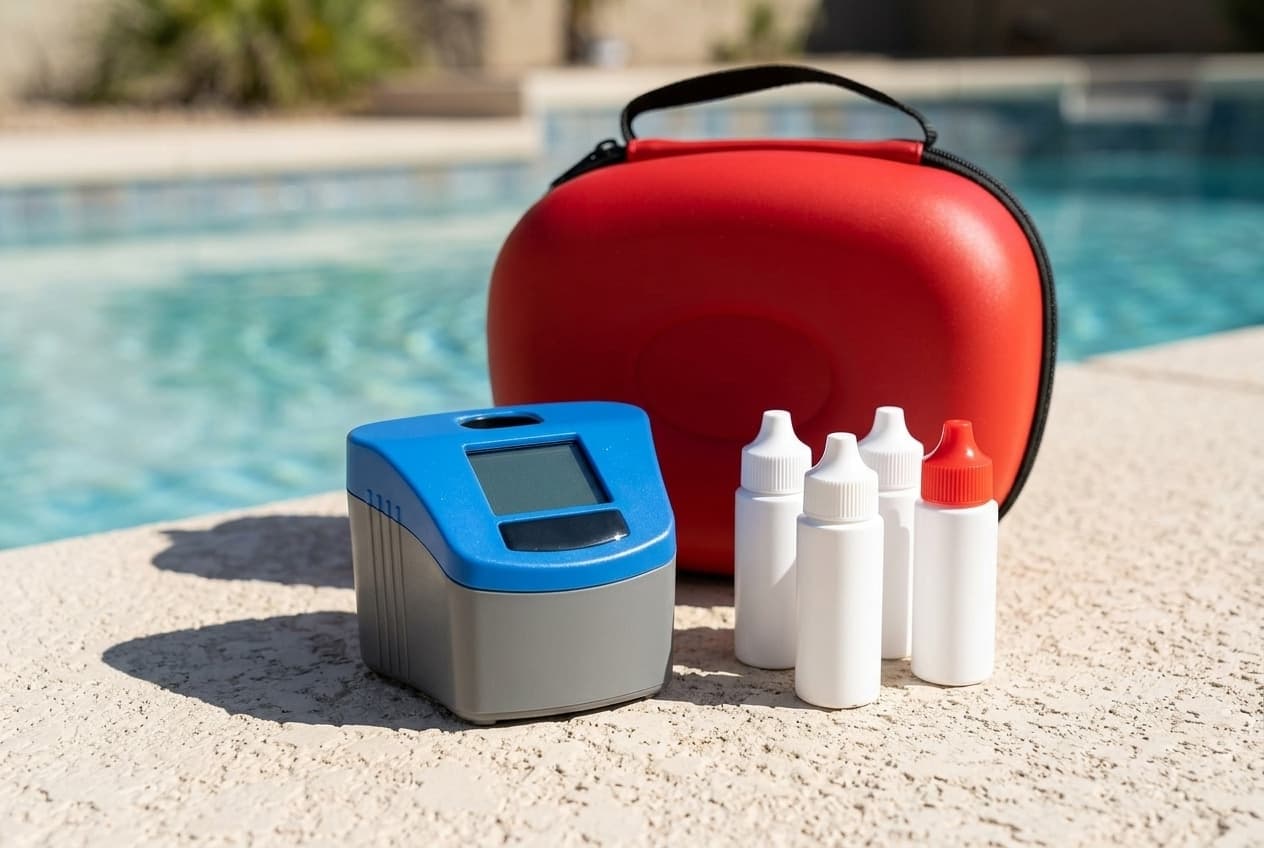
The ColorQ 2x PRO 7 is a handheld photometer: instead of matching a colored sample against printed blocks, you put the tube in the meter and it gives you a number on its display. LaMotte calls it waterproof, and it sends results to its WaterLink Solutions app over Bluetooth. LaMotte lists no price on its product page; Poolweb had it at $262.70 on 12 September 2026, against $149.23 for the Taylor K-2006C drop kit.
Code 2086 is the liquid-and-tablet kit. LaMotte also sells a ColorQ 2x TesTabs PRO 7, code 2087, which is a different kit.
What it tests
- Free chlorine and total chlorine: DPD liquid reagents, 0 to 10 ppm. Combined chlorine is total minus free; the meter shows the two readings, not the difference.
- Bromine: read from the same chlorine sample, 0 to 22 ppm.
- pH: liquid reagent, 6.5 to 8.5.
- Total alkalinity: tablet, 0 to 300 ppm.
- Calcium hardness: tablet, 0 to 600 ppm.
- Cyanuric acid: tablet, 0 to 150 ppm.
The kit has reagents for 144 tests each of chlorine and pH, and 100 tablets each for alkalinity, hardness and cyanuric acid.
A result outside a test's range shows a – or + beside the number. LaMotte's fix is to dilute one part sample with one part distilled water, retest, and multiply by 2. So a pool shocked above 10 ppm needs that dilution for a chlorine reading, where Taylor's FAS-DPD kit reads to 20 ppm directly.
How a test runs
From LaMotte's instruction manual:
- Blank the meter. Fill the sample bottle, fill a 2 cm tube to the 5 mL line, cap it with the blue cap, put it in the meter, turn it on, and press the button when Blank appears.
- Free chlorine. Add 5 drops of DPD 1A and 5 drops of DPD 1B to the same tube, cap it blue, invert three times, and read FCL.
- Total chlorine. Add 5 drops of DPD 3 to that reacted tube, cap it with the pink cap, invert three times, and read TCL. Press on past it to Br for a bromine reading.
- pH. A clean tube to the 5 mL line, 5 drops of pH reagent, red cap, invert three times, read.
- Alkalinity. A clean tube, one tablet, crushed with the tablet crusher, green cap, invert ten times, read.
- Calcium hardness. A clean tube, one tablet, crushed, purple cap, invert three times, read.
- Cyanuric acid. The 1 cm tube filled to its line, one tablet crushed thoroughly, gray cap, invert three times, wait two minutes, and read without mixing again.
A quick double press skips a test. The caps are color-coded and LaMotte says not to swap them. If the meter switches itself off mid-test, which it does after five idle minutes, rinse and fill a tube, blank it again, and carry on.
Readings that look wrong
LaMotte's user guide lists what interferes with each test:
- High chlorine or bromine can bleach the DPD reaction to nearly colorless. At high chlorine levels, chloramines can also break through into the free chlorine test.
- Sanitizer above 10 ppm can turn the pH reaction purple and bleach the alkalinity reaction.
- High combined chlorine: wait two minutes for the color to develop fully, as Standard Methods recommends.
- Very high monochloramine: add Steadifac reagent, 6383WT-H, to stop it breaking through into the free chlorine test.
- Potassium monopersulfate interferes with combined chlorine; MPS-OUT, 6910-E, prevents it.
- Calcium hardness above 450 ppm can turn the chlorine sample cloudy. Put the DPD drops in the empty tube first, then add the sample.
- Low pH or low alkalinity can significantly lower the hardness result, and copper above 1.0 ppm can make it read low.
- Algaecide above the recommended level can cause low alkalinity results.
- Cyanuric acid depends on temperature. It reads best with the sample between 70°F and 80°F, high in cold water and low in warm.
- Bubbles that form after adding reagents interfere with the result. Tap the bottom of the tube once or twice to shift them.
Checking the meter itself
The meter blanks on your own sample water before each set of tests. To check that the optics are still reading true, LaMotte sells the Performance Check Kit, 4301: a color standard you read as free chlorine. Record the first reading while the meter is new, then recheck at intervals, LaMotte's example being every 10 hours of use. A ColorQ 2x reading has to fall within 0.30 of that first figure. The standard has a six-month shelf life, and LaMotte says to discard what you use rather than pour it back.
Care
- Keep the chamber clean and dry. Blow it out with compressed air, and swab it gently with a cotton swab dampened with streak-free window cleaner. No alcohol, which leaves a film on the optics.
- Clean the outside with a damp, lint-free cloth, and store the meter away from chemical vapors.
- Rinse the tablet crusher after each use, brush and rinse the tubes and caps after testing, and let the tubes dry before they go back in the case.
- Batteries: two AA alkaline batteries, behind a cover held by three small Phillips screws on the bottom.
LaMotte's NSF certification is based on a 12-month reagent shelf life, and its user guide says to store and use reagents at 68°F to 75°F for the most accurate results. Refills are sold by code: the three DPD reagents come in 30 mL bottles as in the kit, or 60 mL.
What the certification covers
LaMotte's product page gives the NSF/ANSI/CAN 50 levels for the ColorQ 2x, where L1 is the highest. For the liquid reagents this kit uses:
- Free chlorine: L2, certified from 0 to 8 ppm.
- Combined chlorine: L1, from 0 to 1 ppm.
- pH: L2, from 6.5 to 8.2.
- Cyanuric acid (tablet): L3, from 5 to 150 ppm.
LaMotte says alkalinity, hardness and bromine were not evaluated by NSF.
Where LaMotte's documents disagree, or are unclear
- Certified ranges are narrower than the meter's. The meter reads chlorine to 10 ppm, pH from 6.5 to 8.5 and cyanuric acid from 0; the NSF certification covers chlorine to 8 ppm, pH to 8.2 and cyanuric acid from 5.
- High chlorine and the alkalinity test. The user guide says in one place that high chlorine may turn the alkalinity reaction yellow, and in another that sanitizer above 10 ppm bleaches it.
- 2086-CN. The instruction manual covers "2086/2086-CN" and gives every reagent a second code ending in -CN, but neither document says how the -CN kit differs.
- Ideal ranges. LaMotte's guide gives pools 1 to 3 ppm chlorine and 30 to 100 ppm cyanuric acid. A single chlorine range leaves out the point that the right chlorine level rises with cyanuric acid.
Which model do you have?
The model number is on the test kit label. Everything else in the range is shared — these are the parts that change with it.
| Model | SKU | Note |
|---|---|---|
| ColorQ 2x PRO 7 | 2086 | The liquid-and-tablet kit: liquid reagents for chlorine and pH, tablets for alkalinity, hardness and cyanuric acid. LaMotte's product page gives no price; Poolweb had it at $262.70 on 12 September 2026. The ColorQ 2x TesTabs PRO 7, code 2087, is a separate kit. |
LaMotte ColorQ 2x PRO 7 refills and supplies, and what goes wrong
Read off the manufacturer’s own documents and checked before it ships. Open a row for what the problem looks like and what the maker says to do — or start from the symptom and work down.
What is it doing?
The tube for every test except cyanuric acid. LaMotte says to replace any stained or scratched tube, to dry the outside before it goes in the chamber, and to brush and rinse tubes and caps after testing, because reagent left in a tube can affect the next test or stain it. For the most accurate chlorine results, soak new tubes and the pink and blue caps overnight in lightly chlorinated water, 2 to 10 ppm, and rinse them before first use.
Live pricing arrives when the retailer programs are approved.
LaMotte puts cloudiness down to calcium hardness above 450 ppm. Add the 5 drops of DPD 1A and 5 drops of DPD 1B to an empty tube first, then fill it to the line with sample water. DPD 1A is also sold in 60 mL as P-6740-H.
Live pricing arrives when the retailer programs are approved.
LaMotte's user guide says potassium monopersulfate interferes with combined chlorine results, and that adding MPS-OUT to the sample prevents it.
Live pricing arrives when the retailer programs are approved.
LaMotte says sanitizer above 10 ppm can turn the pH reaction purple, and bleach the alkalinity reaction too. The user guide gives the cause but no workaround for pH.
Live pricing arrives when the retailer programs are approved.
Three causes in LaMotte's user guide: low pH and low alkalinity can both lower the hardness result significantly, and copper above 1.0 ppm can make it read low. Balance pH and alkalinity before trusting a low hardness number.
Live pricing arrives when the retailer programs are approved.
LaMotte says algaecide above the recommended level can cause low alkalinity results. Crush the tablet with the tablet crusher and invert the tube ten times, not three, before reading.
Live pricing arrives when the retailer programs are approved.
The cyanuric acid reaction depends on temperature. LaMotte gets the best results with the sample between 70°F and 80°F; colder water reads high and warmer reads low. Use the 1 cm tube, 0206, crush the tablet thoroughly, invert three times, and let the tube stand for two minutes before reading without mixing again.
Live pricing arrives when the retailer programs are approved.
A color standard read as free chlorine. Blank the meter on distilled water, read the standard, and record the first reading while the meter is new. Recheck at intervals, LaMotte's example being every 10 hours of use: a ColorQ 2x reading must fall within 0.30 of the first one. If a fresh standard and a new tube still read outside that, LaMotte says to contact its technical service. The standard lasts six months.
Live pricing arrives when the retailer programs are approved.
LaMotte ColorQ 2x PRO 7 manuals and documentation
Hosted by the manufacturer. These open on LaMotte’s own servers, so they stay current.
LaMotte ColorQ 2x PRO 7 warranty
1 year, parts and workmanship
LaMotte's user guide gives a one-year warranty on ColorQ 2x parts and workmanship, and asks you to keep proof of purchase for warranty verification. It does not mention the reagents.
Manufacturer’s termsLaMotte ColorQ 2x PRO 7 refills and supplies
Every reagent, refill and accessory number the manufacturer lists for this kit, from its own documents. Marked rows are the ones covered above with a symptom and a diagnosis.
| Item | Description | Note |
|---|---|---|
| P-6740-G | DPD 1A free chlorine liquid reagent, 30 mL what goes wrong | |
| P-6740-H | DPD 1A free chlorine liquid reagent, 60 mL | |
| P-6741-G | DPD 1B free chlorine liquid reagent, 30 mL | |
| P-6741-H | DPD 1B free chlorine liquid reagent, 60 mL | |
| P-6743-G | DPD 3 total chlorine liquid reagent, 30 mL | |
| P-6743-H | DPD 3 total chlorine liquid reagent, 60 mL | |
| 7037-G | pH liquid reagent what goes wrong | |
| 3896A-J | Alkalinity tablets, ALK 2X IG what goes wrong | |
| 3887A-J | Calcium hardness tablets, CA HARD 2X IG what goes wrong | |
| 6996A-J | Cyanuric acid tablets what goes wrong | |
| 0205 | ColorQ 2x tube, 2 cm path what goes wrong | For every test except cyanuric acid |
| 0206 | ColorQ 2x tube, 1 cm path | For cyanuric acid |
| 0689 | Sample bottle | |
| 6910-E | MPS-OUT liquid reagent what goes wrong | An add-on, for pools treated with monopersulfate |
| 6383WT-H | Steadifac reagent | An add-on, for very high monochloramine |
| 4301 | ColorQ and ColorQ 2x Performance Check Kit what goes wrong | An accessory: 60 mL of standard and two tubes each for the ColorQ and ColorQ 2x |
| 4302-H | ColorQ Performance Check Standard, 60 mL | Six-month shelf life |
Buy the test kit
One retailer for now. More get added here as their programs are approved, and this becomes a comparison rather than a link.