Hayward · HeatPro
Hayward HeatPro VS HP51202T
Hayward's variable-speed 120,000 BTU heat pump that also cools: its output in cool air, the flow range four documents disagree on, its codes and its parts.
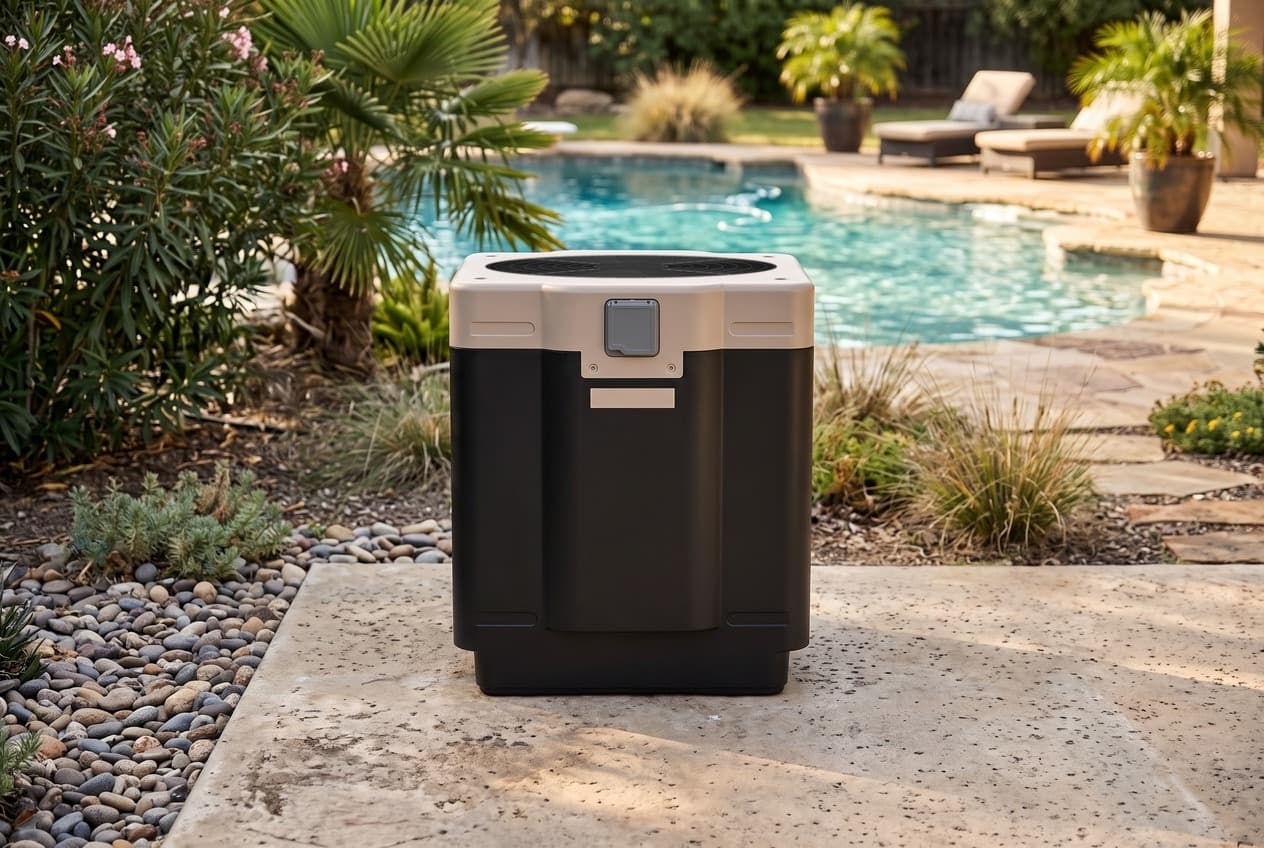
The HP51202T is Hayward's HeatPro VS, a 120,000 BTU heat pump that heats and cools, with a variable-speed compressor and fan. It sits on a square platform, 36.2 by 33.8 inches and 44.2 inches high. Its fan blows straight up through a round guard in the top, and a touchscreen sits in the top of the front panel. It weighs 286 lb. Hayward sells it only through pool dealers.
It's the variable-speed option alongside the single-speed HeatPro MCHX models and the round HP31005T. Asked the difference on the product page, Hayward Support said the HP51202T is variable speed and the MCHX HP31405T single speed. Both work with Hayward's current controls, and the HP51202T also shows some diagnostics on the display of an OmniLogic-type controller.
The manual also covers a 95,000 BTU sibling, the HP50952T. Hayward's troubleshooting guide says it was sold from 2022 to 2024, and it isn't on Hayward's current US listing. The HP51202T has been sold since 2022.
What 120,000 BTU becomes in cooler air
Hayward's AHRI certificate for the HP51202T, reproduced in the troubleshooting guide, rates it at three conditions, all with 80°F water:
- 80°F air, 80% humidity: 120,000 BTU/hr at a COP of 5.8
- 80°F air, 63% humidity: 112,000 BTU/hr at a COP of 5.5
- 50°F air, 63% humidity: 65,000 BTU/hr at a COP of 4.0
So in 50-degree air it delivers a little over half its warm-weather rating. For comparison, the MCHX 140K is rated at 82,000 BTU/hr at 50°F and the HP31005T at 61,000.
Those are full-output ratings. Variable speed matters below full output: Hayward's brochure describes automatic output modulation, with the compressor and fan slowing down rather than running flat out. It puts the COP above 15 at partial speed. That's Hayward's own figure, from its marketing, not an AHRI rating.
In cooling mode the brochure rates it at 48,000 BTU/hr with 95°F air and 90°F water. The rating plate gives the water range as 48.2 to 104°F heating and 48.2 to 86°F cooling.
Silent Mode
The touchscreen has a Silent Mode, with a timer, that cuts the unit's output to cut its noise. The manual says quiet running is achieved "by reducing unit capacity/output". So Silent Mode heats more slowly, and the timer lets you keep it to the hours when noise matters.
Flow: four answers
Hayward's documents give four different flow ranges for this heat pump:
- The manual: 37 GPM minimum, 56 maximum, 50.5 recommended.
- The rating plate: 50.5 GPM recommended, with a 2.18 psi pressure drop through the unit.
- The product page and brochure: 28 GPM minimum, 75 maximum.
- The troubleshooting guide: 30 GPM minimum in its E01 and E03 charts, and 30 to 75 GPM in its reference table.
The manual's range sits inside all the others, so a flow between 37 and 56 GPM satisfies every document. Aim for the plate's 50.5. The manual makes an external bypass a warranty condition wherever flow would exceed its maximum. Set it with a flow meter on the heat pump's outlet, then take the valve handle off so nobody moves it.
The rest of the plumbing:
- For an in-ground pool the manual asks for 2 in. Schedule 40 pipe, three isolation valves, one check valve and two tees.
- The water connections are low on the rear of the unit, with the outlet and inlet side by side. Each takes a butt nipple and gasket with a union nut: 2 in. socket by 2½ in. spigot.
- An automatic chlorinator goes downstream, lower than the heat pump, with a check valve between them.
- A gas or solar heater goes in parallel, isolated and run one at a time. The manual makes that a warranty condition too.
- More than 3 ft above the water, it needs a loop in the piping to keep it from draining.
The electrical side
It runs on 208 to 230 V single phase. The rating plate gives a minimum circuit ampacity of 45 A and a 60 A maximum fuse or breaker, and here the manual, the product page and the brochure all agree. None of them gives a recommended breaker size. The manual says to size the wire from the 45 A figure.
- A disconnect switch in line of sight is required. Power lands on the contactor inside the control box, with no junction box needed.
- Below 208 V it can be damaged, and the manual says that voids the warranty.
- Where code requires a GFCI, the manual names the Siemens QF250A as tested without nuisance trips. Nuisance trips aren't covered.
- Bond it with No. 8 AWG solid copper, or No. 6 in Canada.
Controls
The touchscreen shows the water temperature, the mode and any fault. Press the round button for half a second to switch it on or off, and hold it for five seconds to lock or unlock the screen. Swipe left or right from the main screen:
- Page one: mode (Heating, Auto or Cooling), target temperature, Silent Mode and its timer.
- Page two: the clock, an on/off timer, the fault list and the parameters. The parameters take password 22. There you set the lowest cooling set point, the highest heating set point and °F or °C.
Remote on/off. A factory jumper on terminals 3 and 4 can be replaced with a remote switch, with the unit left in auto mode. If a controller handles the temperature, set the heat pump to Heat at 104°F or Cool at 55°F. The pump must be running, and the wire can run up to 200 ft. The manual lists the remote on/off being in use as a cause of E03, the same code as low flow.
Hayward Omni. Omni firmware R4.3.0 or later controls it as a Smart Heater, over a three-conductor 22 AWG cable (20 AWG past 30 ft). Asked on the product page, Hayward Support said there are no plans for a standalone Wi-Fi module.
Where it can go
It's an outdoor-only appliance: not in a garage, shed or other enclosed space, which voids the warranty, and not under a deck.
- 24 inches around the sides and 24 to 36 inches at the control side, per the manual; Hayward's product page lists 12 in. at the sides and rear. 72 inches above to any overhang, and the top has to stay open because that's where the air leaves.
- At least 60 inches from the inside wall of the pool, or 120 inches in Canada, and 24 inches from outdoor HVAC equipment.
- Away from sprinklers and roof runoff. Sprinkler damage, and sand or salt spray, aren't covered.
- A level pad. Where it's anchored, the manual calls for 3½ in. of concrete. The eight anchor clamps come with it; you supply eight ¼ × 1½ in. stainless concrete screws and 1½ in. fender washers.
- It drains 3 to 5 gallons of condensate an hour while heating, through the supplied condensate drain. The manual's quick test for a leak is chlorine: condensate has none.
- Several units side by side need 4 to 6 ft between them.
Water chemistry
The manual's limits:
- Salt 2,700 to 5,000 ppm. Above that it lists salt as corrosive to the heat exchanger.
- pH 7.4 to 7.6, total alkalinity 80 to 120 ppm, calcium hardness 200 to 400 ppm.
- Chlorine 1 to 3 ppm, or bromine 2 to 4.
- No tablets in the skimmer.
- Municipal water only. Mineral water and seawater above 5,000 ppm void the warranty.
Until the water is balanced, keep the bypass open, and close it again before running the heater.
What the codes mean
The heat pump resets itself once a fault clears. The ones an owner can do something about:
- E03: no flow, or the remote on/off contact is open.
- E01: high refrigerant pressure, usually low flow, an open bypass or water that's already hot.
- E02: low refrigerant pressure. Clear the coil, and consider the air temperature.
- E05: the water is close to freezing.
- E06 and E07: low flow, and E07 is a freeze-up while cooling.
- E19 and E29: the air is too cold for heating.
- P codes and PP: a failed sensor, apart from P082, which is a compressor overload.
- E08: the display has lost contact with the main board.
- F codes: the inverter. The manual's advice for most of them is to restart the unit and call for service. For F10, which means the supply voltage is too low, check your power supply first.
After switching on, give the compressor its three-minute start delay. Once it's heating, Hayward's service reference puts the air leaving the fan 15 to 20°F colder than the outdoor air.
Winter and spring
Hayward is explicit that the heat pump isn't freeze protection and isn't warranted against freezing. In freezing weather the pump has to run continuously. Where it freezes, drain it when it's out of service: set it to off, switch off the breaker and the pump, and open the lower inlet union.
In spring, clear leaves and debris, reconnect the unions, run the pump until the air is out of the lines, switch the breaker on, and set it to heating.
Warranty
Hayward's product page gives five years parts and two years labor. That's what the 2026 Expert Line terms give every heat pump on an in-ground pool, with the titanium tube covered for ten years. The extended column raises labor to three years. Hayward lists it for in-ground pools only.
Asked on the product page, Hayward Support said it isn't built in Hayward's US factory, and confirmed it's made in China.
Parts
The manual has a service parts table for both models: common parts, then a column each for parts unique to the HP50952T and the HP51202T. Twelve are unique, including the compressor, both heat exchangers, the reversing valve, the chassis and the variable frequency driver. The list below gives the HP51202T's.
Hayward's parts lookup on the product page is organized differently, in five views, and it disagrees with the manual on about ten numbers:
- The flow switch: HPX83000069 in the manual, HPX51700086101 in the lookup.
- All three pressure switches and both thermistors: the lookup gives HPX517 numbers. It shows the manual's numbers superseded for all but the 5K thermistor, whose old number it prints as HPX20003242 rather than the manual's HPX20003202.
- The main board: HPX72200562F in the manual. The lookup gives HPX51100087001 for the PC1004 and adds a PC1002 board, HPX72200101.
- The electrical plate: the lookup gives the number the manual assigns to the HP50952T.
Both numbers are in the list, so either can be quoted. Order by the full model number on the rating plate, and let the dealer confirm which is current, particularly for the inverter: the guide says units from 2022 and 2023 have separate fan and compressor boards, and 2024 and later a single unified one.
Where Hayward's documents disagree
- Flow. 37 to 56 GPM in the manual; 28 to 75 on the product page and in the brochure; 30 minimum in the troubleshooting guide.
- Cold weather. The product page and brochure give a 40°F minimum air temperature. The manual's code table tells owners with an E02 low ambient cutoff to wait for the air to reach 20°F. The guide lists air below 50°F as a cause of E02.
- Low ambient operation. The product page's specifications say "No". Its description advertises a "low ambient temperature feature" and "efficient operation in even the coldest ambient temperatures".
- Boost mode. The product page says "No". The guide says units from November 2026 have a Boost mode that ramps the compressor up to reach the set point faster, a date still ahead when this page was written.
- Clearance. 24 in. at the sides in the manual; 12 in. side and rear on the product page.
- Locked rotor amps. 90 A in the manual's specification table; 50 A on the rating plate.
- Metering device. The manual's explanation of how a heat pump works names a TXV; its wiring diagram, its parts table and the guide show an electronic expansion valve.
- The guide's borrowed pages. Its E06 and E19/E29 pages are labeled HP31005T. The E06 page converts a 13°C difference to 55.4°F, when a 13°C difference is 23.4°F.
- Part numbers. About ten, listed under Parts. Hayward's lookup also prints the contactor without its X, and files the electrical box liner under the electrical box's key.
- Warranty. The brochure promises "3+ year parts and labor" from a Totally Hayward partner, and the product page the same from a Hayward Rewards partner. The product page's specifications and Hayward's 2026 terms give five years parts and two years labor.
Which model do you have?
The model number is on the heater label. Everything else in the range is shared — these are the parts that change with it.
| Model | SKU | Note |
|---|---|---|
| HP51202T | HP51202T | The only current model. The manual also covers a 95,000 BTU HP50952T, which Hayward's troubleshooting guide says was sold from 2022 to 2024. It isn't on Hayward's current US listing. |
Hayward HeatPro VS HP51202T parts, and what goes wrong
Read off the manufacturer’s parts list and checked before it ships. Open a row for what a bad one actually does — or start from the symptom and work down, which is the cheaper order.
What is it doing?
E03 means the flow switch circuit is open. The manual adds a cause the other HeatPros don't list: the remote on/off connection being in use. Otherwise it's flow. Check that the pump is running, clean the filter, make sure the valves are open and the bypass is closed, and look for air leaks or a pump too small for the job. A two-speed pump may have to run on high. The guide expects 0.1 to 0.8 ohms across the switch when it's closed and an open line when it's tripped. The manual's parts table gives HPX83000069. Hayward's parts lookup gives this number, and shows HPX20000360005 superseded by it.
Live pricing arrives when the retailer programs are approved.
E02 is the low refrigerant pressure switch. The manual lists three causes: something blocking air to the coil, the low ambient cutoff, and a unit low on refrigerant. For the cutoff it says to wait for the outside air to reach 20°F. The guide adds a stopped fan and a stuck expansion valve, and treats air below 50°F as a cause in itself. Clearing the coil is yours; anything in the refrigerant circuit needs an EPA 608 Type II or Universal technician. The manual's number is HPX20000360054, which Hayward's lookup shows superseded by this one.
Live pricing arrives when the retailer programs are approved.
E01 is the high refrigerant pressure switch. In heating it's usually low flow: the pump off, a dirty filter, a closed valve, an open bypass, or a fountain taking the water. The manual also lists water hotter than the unit's limits. There's a secondary high pressure switch too, HPX51700085001. Hayward's lookup shows the manual's numbers for both, HPX20000360052 and HPX20000360187, superseded by these.
Live pricing arrives when the retailer programs are approved.
A P code is a temperature sensor reading open, shorted or unplugged: P01 the water inlet, P02 the outlet, P04 the air, P05 the coil and P07 the suction line. The 50K discharge sensor behind P081 is HPX51700086001. The guide's first step is to check the sensor is plugged in firmly; after that a technician compares its resistance with Hayward's chart. The manual lists thermistors HPX20003202 and HPX20003223; Hayward's lookup gives these numbers instead.
Live pricing arrives when the retailer programs are approved.
E08 is lost communication between the main board and the display. Hayward's guide checks the model setting first: service parameter U03 must be 0 for the HP51202T. Then it checks the four-wire harness from the board to the display for continuity, and for 11 to 14 V DC at the board. The cable between them is keyed, so it only plugs in one way. For a unit that won't turn on at all, the manual lists a failed display module among the causes.
Live pricing arrives when the retailer programs are approved.
The inverter drives the compressor and fan, and E081 or F02 means the main board has lost contact with it. The other F codes are the inverter reporting a fault of its own: start failure, fan fault, overcurrent, low voltage or overheating. The manual's answer to most of them is to restart the unit and call for service. Hayward's guide says units built in 2022 and 2023 have separate fan and compressor inverter boards, and 2024 and later one unified board. So confirm which your unit has before ordering.
Live pricing arrives when the retailer programs are approved.
The guide's E02 chart comes to the expansion valve after the switch, the coil and the fan. A technician puts it in manual mode from the service menu, changes its steps and feels for the stepper motor moving. It needs 11 to 14 V DC from the board.
Live pricing arrives when the retailer programs are approved.
Hayward HeatPro VS HP51202T manuals and documentation
Hosted by the manufacturer. These open on Hayward’s own servers, so they stay current.
- HeatPro VS installation and operation manual, HP50952T and HP51202T (51300002101 Rev H); English on pages 1 to 26, French aftermanual
- HP51202T and HP50952T troubleshooting guide — the rating plate, the AHRI certificate, every code, and the model historymanual
- HeatPro VS brochure (LITHPVSBRO22) — cooling capacity and flow rangespec
- HeatPro VS brochure, Canadian, English and French (LITHPVSBRO23C)spec
- HP51202T product page, with the parts lookup and Hayward Support answersdiagram
- Hayward 2026 Expert Line warranty termsspec
Hayward HeatPro VS HP51202T warranty
5 years parts, 2 years labor
Five years parts and two years labor on Hayward's product page, which matches the 2026 Expert Line terms for every heat pump on an in-ground pool: five years parts with the titanium tube covered for ten, and two years field labor, raised to three in the extended column. Hayward sells it through dealers only. The manual excludes freezing, heat exchanger damage from low flow, unbalanced water or sanitizer, damage from sprinklers or from sand and salt spray, installation in an enclosed space, voltage below 208 V and GFCI nuisance trips. Hayward's warranty applies only to products bought from Hayward or an authorized seller.
Manufacturer’s termsHayward HeatPro VS HP51202T complete parts list
Every part on the manufacturer’s exploded diagram, in their numbering. Marked rows are the ones covered above with a symptom and a diagnosis.
63 parts
| No. | Part | Description | Note |
|---|---|---|---|
| 1 | HPX20000330402 | Axial flow fan motor | Common to both models |
| 2 | HPX20000220320 | Cover plate | Common to both models |
| 3 | HPX83700122 | Trademark | As the manual names it |
| 4 | HPX80900744 | Top | Common to both models |
| 5 | HPX80900320 | Rain guard | Common to both models |
| 6 | HPX82300038 | Touchscreen display, CP203 what goes wrong | The manual and lookup call it CP203 |
| 7 | HPX80705635 | Beam | Common to both models |
| 8 | HPX32004210137 | Fan guard | Common to both models |
| 9 | HPX20000360187 | Pressure switch | The manual's number. Hayward's lookup calls it the secondary high pressure switch, superseded by HPX51700085001 |
| 9 | HPX51700085001 | Secondary high pressure switch | Hayward's lookup number |
| 10 | HPX20000360052 | Pressure switch | The manual's number. Superseded by HPX51700085201 in Hayward's lookup |
| 10 | HPX51700085201 | High pressure switch what goes wrong | Hayward's lookup number |
| 11 | HPX20000360054 | Pressure switch | The manual's number. Superseded by HPX51700085401 in Hayward's lookup |
| 11 | HPX51700085401 | Low pressure switch what goes wrong | Hayward's lookup number |
| 12 | HPX20000140401 | Electronic expansion valve what goes wrong | Common to both models |
| 13 | HPX20000140027 | Filter | Common to both models |
| 14 | HPX20041444 | Filter | Common to both models |
| 15 | HPX20003202 | Thermistor | The manual's number. Hayward's lookup gives HPX51700085901, 5K |
| 15 | HPX51700085901 | Thermistor, 5K what goes wrong | Hayward's lookup number; it lists HPX20003242 as superseded by it |
| 16 | HPX20003223 | Thermistor | The manual's number. Superseded by HPX51700086001 in Hayward's lookup |
| 16 | HPX51700086001 | Thermistor, 50K | Hayward's lookup number |
| 17 | HPX81000137 | Four-way (reversing) valve | HP51202T. The HP50952T's is HPX20011491 |
| 18 | HPX83700118 | Trademark | As the manual names it |
| 19 | HPX80900745 | Front panel | Common to both models |
| 20 | HPX20000220247 | Junction box body | Common to both models |
| 21 | HPX80716224 | Electrical plate | HP51202T, per the manual. Hayward's lookup lists HPX80705636, which the manual gives for the HP50952T |
| 22 | HPX80715847 | Titanium pipe support | HP51202T |
| 23 | HPX80601793 | Titanium tube heat exchanger | HP51202T |
| 24 | HPX32004210134 | Press stents | Common to both models |
| 25 | HPX80100221 | Compressor | HP51202T |
| 26 | HPX81800023 | Adapter | Common to both models |
| 27 | HPX81800029 | Pipe | Common to both models |
| 28 | SPX3200UNKIT | Union kit | Union nut, connector and gasket, two of each |
| 29 | HPX80705641 | Fixed bracket | Hayward's lookup calls it a tie-down |
| 30 | HPX81800025 | Nut | Common to both models |
| 31 | SPX3200UNADP | Butt nipple with gasket | The manual's number. Hayward's lookup lists water union adapter kit HPX50100061801 here |
| 31 | HPX50100061801 | Water union adapter kit | Hayward's lookup number |
| 32 | HPX20000140579 | Liquid storage tank | HP51202T |
| 33 | HPX20000140150 | Needle valve | Common to both models |
| 34 | HPX20000140512 | Needle valve | Common to both models |
| 35 | HPX30403000000002 | Tee | Common to both models |
| 36 | HPX20001460 | Tee | Common to both models |
| 37 | HPX20001435 | Tee | Common to both models |
| 38 | HPX20011359 | 90° elbow | Common to both models |
| 39 | HPX83000069 | Water flow switch | The manual's number. Hayward's lookup gives HPX51700086101 |
| 39 | HPX51700086101 | Water flow switch what goes wrong | Hayward's lookup number; it lists HPX20000360005 as superseded by it |
| 40 | HPX80901442 | Chassis | HP51202T |
| 41 | HPX20031379 | Joint | Common to both models |
| 42 | HPX80601540 | Finned heat exchanger (air coil) | HP51202T |
| 43 | HPX32015210035 | Top support plate | Common to both models |
| 44 | HPX20000270057 | Axial flow fan | Common to both models |
| 45 | HPX80700160 | Fan net, with plastic cover | Common to both models |
| 46 | HPX80716223 | Electrical box | HP51202T, per the manual. Hayward's lookup puts the electrical box liner under this key |
| 47 | HPX20003909 | Two socket | Common to both models |
| 48 | HPX20000360297 | Relay | Common to both models |
| 49 | HPX20000360006 | Single-phase AC contactor | Hayward's lookup prints it without the X, as HP20000360006 |
| 50 | HPX2000090237 | Three terminal block | HP51202T, as the manual prints it: a digit shorter than the HP50952T's HPX20000390223 |
| 51 | HPX20000390046 | Terminal | Common to both models |
| 52 | HPX72200562F | Main control board, PC1004 | The manual's number. Hayward's lookup gives HPX51100087001 |
| 52 | HPX51100087001 | Main control board, PC1004 | Hayward's lookup number |
| 52 | HPX72200101 | Main control board, PC1002 | Hayward's lookup lists it under the same key |
| 53 | HPX80717057 | Electrical box liner | HP51202T |
| 54 | HPX20000310165 | Variable frequency driver module what goes wrong | HP51202T. The HP50952T's is HPX82300018 |