Hayward · HeatPro
Hayward HeatPro HP31005T
Hayward's round 100,000 BTU heat pump that also cools: what it delivers in 50°F air, its E codes, the breaker figures that disagree, and its parts.
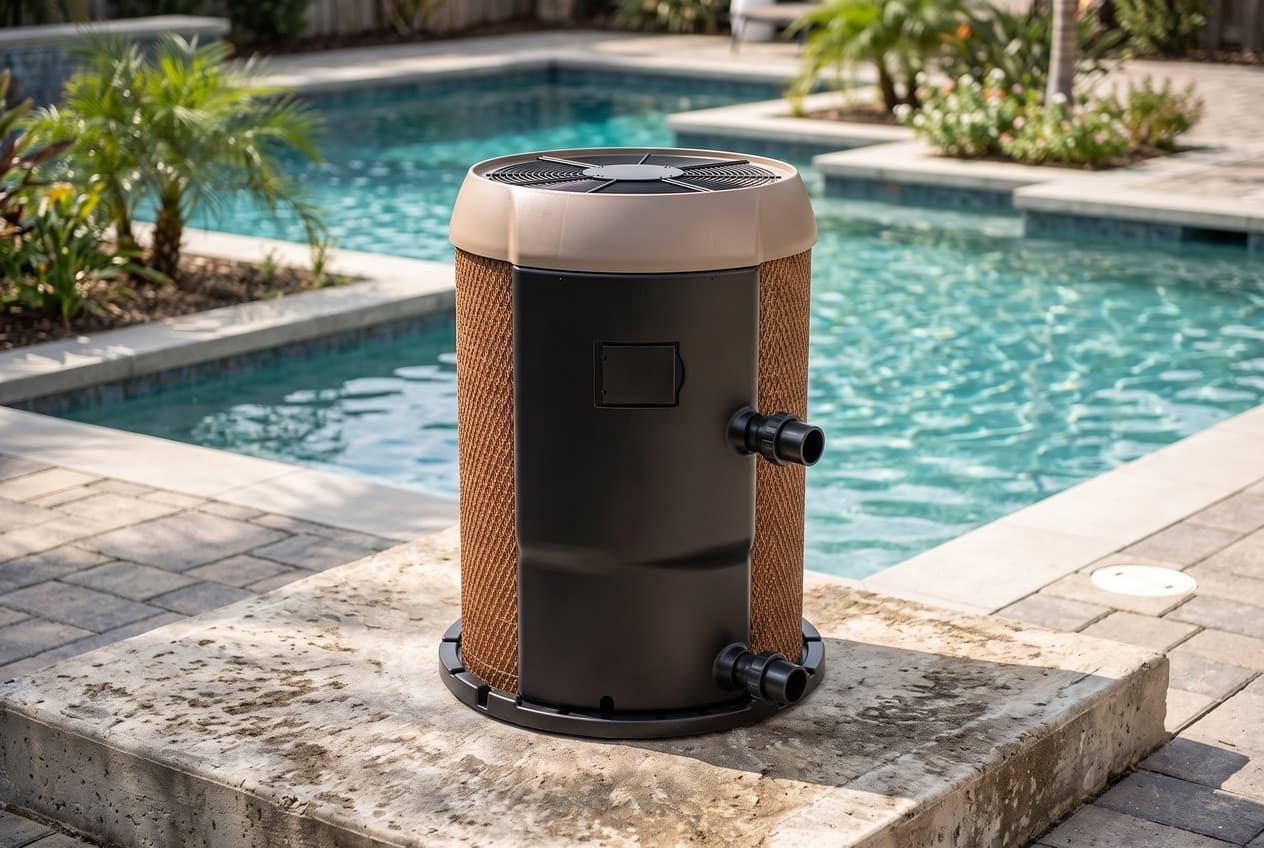
The HP31005T is Hayward's HeatPro 100K, a round heat pump that heats and cools. It's one model, rated at 100,000 BTU/hr, and it's sold through pool dealers: Hayward's site has no Open Line W3 version.
It is built differently from the square HeatPro MCHX models. The compressor is a single-speed scroll running R-410A, the fan is a variable-speed DC motor on its own inverter board, and refrigerant is metered by an electronic expansion valve. The part that touches the pool water is a titanium heat exchanger. It reports faults with its own set of codes, so an MCHX troubleshooting chart doesn't apply to it.
What 100,000 BTU becomes in cooler air
A heat pump's output depends on how much heat is in the air. Hayward's AHRI certificate for the HP31005T, which the troubleshooting guide reproduces, rates it at three conditions, all with 80°F water:
- 80°F air, 80% humidity: 100,000 BTU/hr at a COP of 6.4
- 80°F air, 63% humidity: 94,000 BTU/hr at a COP of 6.2
- 50°F air, 63% humidity: 61,000 BTU/hr at a COP of 4.2
So in 50-degree air it delivers 61% of its warm-weather rating. COP is heat delivered divided by electricity used: at 6.4, each unit of electricity moves 6.4 units of heat into the water. The manual puts its draw at 4.68 kW at the top rating.
Hayward's sell sheet compares it with its own 140K. It says the 100K takes about an hour longer to heat a 15 × 30 ft pool in winter, and about 30 minutes longer in spring or fall, though not what those times are added to.
Heating and cooling
The display has three modes: h for heat, C for cool and A for auto, which heats below the set point and cools above it. The rating plate gives the water range as 48.2 to 104°F heating and 48.2 to 86°F cooling.
Hayward publishes no cooling capacity for it. Asked on the product page whether it could cool a Florida pool from 95 to 85°F, Hayward's support team said it would work well for a small pool of 10,000 to 12,000 gallons. For larger pools it pointed to the HP31205T or HP31405T, heat-and-chill MCHX models with much more cooling capacity.
Two codes only happen while cooling. E06 is too large a difference between the water going in and coming out. E07 is the outlet water falling below 39.2°F, which the guide treats as a freeze risk. Both clear themselves, but three of either within 30 minutes lock the unit out until the breaker is switched off and on. Check that the bypass is closed and the filter isn't clogged.
Where it stops
Hayward's product page gives a 40°F minimum air temperature, and the unit has active defrost. Cold air still stops it in two ways. The guide lists outdoor air below 50°F as a cause of E02, the low pressure code. TP is the low ambient protection. When cold air is the cause, nothing is broken, and the manual's advice is to wait for warmer weather.
In standby it also protects itself from freezing. E19 appears when the air is at or below 32°F, and it runs the pool pump if the heat pump controls one. E29 is the second stage, where it runs in heat mode until the inlet water reaches 59°F or the air rises above freezing. The manual still says not to use the heat pump for freeze protection (see winterizing below).
Flow and plumbing
- 30 GPM minimum and 75 GPM maximum. The spec table and the rating plate recommend 42.7 GPM; the text of the manual says it is designed for 47. The plate also gives a water pressure drop of 1.6 psi.
- Without an external bypass where flow reaches 75 GPM or more, the manual says the warranty is void. Set it with a flow meter on the heat pump's outlet, then take the handle off so nobody moves it.
- For an in-ground pool it asks for 2 in. Schedule 40 pipe, three 2 in. isolation valves, one check valve and two 2 × 2 × 2 tees.
- Two unions come in the box, 2 in. socket by 2½ in. spigot, which Hayward says match the previous generation. The inlet is the lower one, 4.2 in. above the base, and the outlet is 18.9 in. above it.
- An automatic chlorinator goes downstream, lower than the heat pump, with a check valve between them so concentrated sanitizer can't drain back into the exchanger.
- A gas or solar heater goes in parallel, isolated and run one at a time. The manual makes that a warranty condition too.
- Installed less than 3 ft above the water, it needs eyeball fittings on the returns for back pressure. More than 3 ft above, it needs a loop to keep the heat pump from draining.
The electrical side
It runs on 208 to 230 V single phase, with a minimum circuit ampacity of 42 A. The rating plate on the unit gives that figure and a 70 A maximum fuse, and the manual says to size the wire from the 42 A. The recommended breaker depends on which Hayward document you read; the list at the end has all four answers.
- A disconnect switch in line of sight of the unit is required. There's no junction box; power lands on the contactor inside the control box.
- Below 208 V it can be damaged, and the manual says that voids the warranty.
- The manual doesn't recommend a GFCI, and nuisance trips aren't covered. Where code requires one, Hayward's guide names a Siemens second-generation GFCI breaker, QFxxxA, as tested without nuisance trips.
- Bond it with No. 8 AWG solid copper, or No. 6 in Canada, from the lug on its side.
Controls
The keys are ON/OFF, UP and DOWN.
- Change mode: hold UP and DOWN together for half a second, choose h, C or A, and wait five seconds for it to save. Holding the same two keys for ten seconds opens the password screen instead.
- °F or °C: hold ON/OFF and DOWN for five seconds.
- Outlet temperature: hold UP for two seconds.
- Lock the keys: hold ON/OFF for five seconds, and again to unlock.
- Mute: hold DOWN for five seconds.
Remote control. A remote on/off switch replaces a factory jumper, and the manual suggests leaving the unit in auto mode. If the controller also handles the temperature, set the heat pump to Heat at 104°F for heating or Cool at 65°F for cooling. The pump must be running, and the wire can run up to 200 ft.
Bypass mode hands control to a remote thermostat. Hold UP and DOWN for ten seconds, enter password 022, select parameter b and set it to 1. The display then shows bo. Hayward's support team says a controller that uses two low-voltage relays needs this mode. Which terminals to use is one of the disagreements below.
Hayward Omni. An Omni controller running firmware R4.3.0 or later controls it as a Smart Heater, over a three-conductor 22 AWG cable (20 AWG past 30 ft). The display shows rC while Omni is in control.
Where it can go
It's an outdoor-only appliance. The manual says not to put it in a garage, shed or other enclosed space, which voids the warranty, or under a deck.
- 24 inches around the sides is best practice. Where the lot doesn't allow that, Hayward says testing showed it can go as close as 6 inches from the coil to a wall or fence. The service front needs 24 to 36 inches, and anything overhead 72 inches above the top.
- At least 60 inches from the inside wall of the pool, or 120 inches in Canada.
- Not within 24 inches of outdoor HVAC equipment, and not where sprinklers or roof runoff can reach it. Sprinkler damage isn't covered.
- A level pad, at least 3½ in. of concrete where it's anchored, with three ¼ × 1¾ in. stainless concrete screws 120° apart.
- It drains 3 to 5 gallons of condensate an hour while heating. The drain hole is at the rear of the base pan and takes a hose.
- Don't tip it or carry it on its side.
The manual limits it to permanently installed pools and rules out storable ones, the kind built to be taken apart and put away. Hayward's product page lists it for above-ground and in-ground pools, and the warranty has a separate column for above-ground.
Water chemistry
The manual's limits:
- Salt 2,700 to 5,000 ppm. Above that, it lists salt as corrosive to the heat exchanger.
- pH 7.4 to 7.6, total alkalinity 80 to 120 ppm, calcium hardness 200 to 400 ppm.
- Chlorine 1 to 3 ppm, or bromine 2 to 4.
- No tablets in the skimmer, and no chemicals poured into it.
- Municipal water only. Mineral water, seawater above 5,000 ppm and other non-potable water void the warranty.
Until the water is balanced, keep the bypass open so it doesn't go through the heat pump, and close it again before running the heater.
What the codes mean
The heat pump resets itself once a fault clears. The ones an owner can do something about:
- E03: no flow. See the flow switch in the parts below.
- E01: high refrigerant pressure, usually low flow or an open bypass.
- E02: low refrigerant pressure. Clean the coil, check the fan, and consider the air temperature.
- E05: the water or air is too cold.
- E08: the display has lost contact with the main board.
- E081: the main board has lost contact with the fan's inverter board.
- P codes and PP: a failed sensor, apart from P082, which is a compressor overload.
- F31, F32 and F51: the fan motor has stopped or locked.
- bo and rC aren't faults: bypass mode, and Omni in control.
The manual also prints a second table, F01 to F28, for a frequency conversion board. The troubleshooting guide doesn't cover those codes, so treat any of them as a service call.
Is it working?
After switching on, give the compressor its three-minute start delay. Once it's running, Hayward's service reference puts the air leaving the top 15 to 20°F colder than the outdoor air while heating. The guide is also clear that anything inside the refrigerant circuit needs an EPA 608 certified technician.
The manual's other checks:
- Runs all the time: the set point may be too high for the weather, or the coil may be dirty. Rinse it with tap water from a hose without a nozzle; pressurized water can damage it and void the warranty.
- Cycles on and off quickly: check flow first, then look for heavy frost on the coil. If it keeps cycling, switch it off to protect the compressor and call for service.
- Water under the unit: usually condensation. Switch the heat pump off for a few hours with the pump still running. If the water stops, it was condensation.
Winter and spring
Hayward is explicit that the heat pump isn't freeze protection and isn't warranted against freezing. In freezing weather the pump has to run continuously. Where it freezes, drain it when it's out of service: set it to off, switch off the breaker and the pump, and open the lower inlet union to let the water out.
In spring, clear leaves and debris, reconnect the unions, run the pump until the air is out of the lines, switch the breaker on, and set it to h.
Warranty
Hayward's 2026 Expert Line terms give every heat pump:
- In-ground: five years parts and two years field labor, with the titanium tube covered for ten years. The extended column raises labor to three years.
- Above-ground: two years parts and one year labor, with the titanium tube covered for five. The extended column raises parts to three years.
A replacement part bought later, such as a compressor, fan motor, sensor or circuit board, carries one year parts only.
Parts
Hayward's parts lookup on the product page splits the unit into four views: heat exchanger, fan and cover; chassis and compressor; front panel and fittings; and electrical box. Two union kits are listed as not shown.
- Two main control boards share one key, the PC1004 and the PC1002. The manual and the troubleshooting guide describe the PC1004.
- Two compressor capacitors are listed, 98 µF and 60 µF, alongside a start relay.
- Two high pressure switches, a primary and a secondary, matching the manual's wiring diagram.
- Some parts the guide describes aren't in the lookup: the electronic expansion valve, the filter drier, and the 6.8K suction line sensor.
Order by the full model number on the rating plate, and let the dealer confirm which board number is current.
Where Hayward's documents disagree
- Breaker. The manual recommends 45 A with a 70 A maximum, and the rating plate gives a 70 A maximum fuse. The sell sheet gives 50 A minimum and 60 A maximum. Hayward's support team says it needs a 50 A, 240 V circuit.
- Size. The manual's specification table gives 36.2 × 33.8 × 44.2 in., which is the size Hayward lists for the square HeatPro VS, HP51202T. The manual's own drawing shows 31½ in. across and 40 in. high, and the sell sheet 31¼ across and 40 high.
- Weight. 247 lb on the rating plate, the manual and the product page; 245 on the sell sheet. Shipping weight is 305 lb in the manual, 296 on the product page and 285 on the sell sheet.
- Flow. The spec table and rating plate recommend 42.7 GPM; the manual's text says it's designed for 47.
- Clearance. The manual asks for 24 in. around the sides and allows 6 in. to the coil where space is tight. The product page lists 6 in. side and rear, and the sell sheet says it needs "just 6 in." of wall clearance.
- Low ambient operation. The product page lists "Low Ambient Operation: No" in its specifications and advertises low ambient operation in its description.
- Flow switch or pressure switch. The manual describes adjusting a water pressure switch for a heat pump up to 6 ft below or 15 ft above the pool, and refers to a start-up section that it doesn't have. Its wiring diagram, its code table and the guide all show a flow switch.
- Metering device. The manual's explanation of how a heat pump works names a TXV; its wiring diagram and the guide show an electronic expansion valve.
- Remote terminals. The guide wires a remote thermostat to terminals 1 and 2 for heat and 3 and 4 for cool. The manual's wiring diagram labels 1 and 2 heat/cool and 3 and 4 remote on/off.
- E06. The manual lists it as low flow. The guide says it triggers in cooling mode when the inlet and outlet water differ by more than 13°C, and converts that to 55.4°F. A 13°C difference is 23.4°F; 55.4°F is 13°C as a temperature.
- Display. The guide calls it the LED206; the parts lookup sells the LED302.
- Warranty. The product page says "3+ Year Parts and Labor Warranties" from a Hayward Rewards partner. Its specifications, and Hayward's 2026 terms, give five years parts and two years labor.
- Documents on the product page. Two of its three manuals are for other heat pumps: the HP50HA2 and HP70HA2, and an earlier HeatPro series (51300102101). Its "HeatPro Infographic" link opens a drawing of the HP50HA2 and HP70HA2.
Which model do you have?
The model number is on the heater label. Everything else in the range is shared — these are the parts that change with it.
| Model | SKU | Note |
|---|---|---|
| HP31005T | HP31005T | The only model. Hayward's site has no Open Line W3 version of it, so it's sold through pool dealers. |
Hayward HeatPro HP31005T parts, and what goes wrong
Read off the manufacturer’s parts list and checked before it ships. Open a row for what a bad one actually does — or start from the symptom and work down, which is the cheaper order.
What is it doing?
E03 means the flow switch hasn't closed, and Hayward's troubleshooting guide puts the switch last on its list. First check that the pump is running and moving at least 30 GPM. Check for a dirty filter, a filter left in backwash, an open bypass, an air leak on the suction side and a pump too small for the job. Hayward's support team adds one more: make sure it isn't plumbed backward, with the inlet at the bottom and the outlet at the top. A two-speed pump may have to run on high. Only then test the switch: the guide expects 0.1 to 0.8 ohms when it's closed and an open line when it's tripped.
Live pricing arrives when the retailer programs are approved.
E02 is the low refrigerant pressure switch. The guide's causes are a dirty air coil, a fan that isn't running, a refrigerant leak, a failed switch, and outdoor air below 50°F. The first two and the last are yours to check. A leak or a switch on the refrigerant circuit is work for a technician with EPA 608 Type II or Universal certification, which Hayward requires for any refrigerant work.
Live pricing arrives when the retailer programs are approved.
E01 is the high refrigerant pressure switch, and in heating mode it's usually a flow problem: the pump off, too little flow, or the external bypass left open. Clean the filter and skimmer and restart the heat pump before suspecting the switch. There are two high pressure switches, this one and the secondary switch HPX20000360187, and Hayward's lookup shows HPX20000360052 superseded by this number.
Live pricing arrives when the retailer programs are approved.
A P code is a temperature sensor reading open or shorted. P01 is the water inlet, P02 the water outlet, P04 the air and P05 the coil sensor, and all four are 5K. The 50K discharge line sensor (P081) is HPX51700086001. The guide's first step is to check the sensor is plugged in firmly; after that a technician unplugs it and compares its resistance with Hayward's chart.
Live pricing arrives when the retailer programs are approved.
The fan runs from its own inverter board, and E081 means the main board has lost contact with it. The guide checks the fan type setting first, then the harness voltages and the board's fuse. A failed inverter board can also stop the fan, and F31, F32 and F51 are the codes for a fan motor that has locked or stopped.
Live pricing arrives when the retailer programs are approved.
E08 is lost communication between the main board and the display. Hayward's guide suspects the four-wire harness from the board to the back of the display before either part. It tests each wire for continuity and looks for 11 to 14 V DC at the board. The guide calls the display LED206; Hayward's parts lookup sells the LED302 under this number.
Live pricing arrives when the retailer programs are approved.
PP is the refrigerant pressure sensor. Before replacing it, the guide checks a service setting, H38, which should be 1, and then looks for 5 V DC from the board to the sensor. If the board puts out nothing, it's the board that needs replacing.
Live pricing arrives when the retailer programs are approved.
Hayward HeatPro HP31005T manuals and documentation
Hosted by the manufacturer. These open on Hayward’s own servers, so they stay current.
- HeatPro heat pump installation and operation manual, HP31005T (51300056501 Rev G)manual
- HP31005T troubleshooting guide (51301743001 Rev A) — the rating plate, the AHRI certificate, every code and the service reference pressuresmanual
- HeatPro 100K sell sheet (LITHP100K22)spec
- HP31005T product page, with the parts lookupdiagram
- Hayward 2026 Expert Line warranty termsspec
Hayward HeatPro HP31005T warranty
5 years parts, 2 years labor
Hayward's 2026 Expert Line terms give every heat pump five years parts and two years field labor on an in-ground pool, with the titanium tube covered for ten years; the extended column raises labor to three. On an above-ground pool the standard terms are two years parts and one year labor, with the titanium tube covered for five. The manual excludes freezing and heat exchanger damage from low flow, unbalanced water or sanitizer. It also excludes damage from sprinklers or from sand and salt spray, installation in an enclosed space, voltage below 208 V, and GFCI nuisance trips. Hayward's warranty applies only to products bought from Hayward or an authorized seller.
Manufacturer’s termsHayward HeatPro HP31005T complete parts list
Every part on the manufacturer’s exploded diagram, in their numbering. Marked rows are the ones covered above with a symptom and a diagnosis.
33 parts
| No. | Part | Description | Note |
|---|---|---|---|
| 1 | HPX20000360187 | Secondary high pressure switch | Chassis and compressor view |
| 2 | HPX20000360054 | Low pressure switch what goes wrong | Chassis and compressor view |
| 9 | HPX80901109 | Front panel | Front panel and fittings view |
| 10 | HPX80711456 | Electrical box cover | Front panel and fittings view |
| 11 | HPX83700118 | Logo badge | Front panel and fittings view; Hayward's lookup calls it The Trademark |
| 12 | HPX72200348 | Display, LED302 what goes wrong | Front panel and fittings view. Hayward's troubleshooting guide names the display LED206 |
| 15 | HPX20011497 | Check valve | Front panel and fittings view |
| 22 | HPX20011491 | Four-way (reversing) valve | Front panel and fittings view. Energized only in cooling |
| 23 | HPX20000330381 | Fan motor | Heat exchanger, fan and cover view |
| 25 | HPX20000220320 | Motor cover plate | Heat exchanger, fan and cover view |
| 27 | HPX80901118 | Cover | Heat exchanger, fan and cover view |
| 28 | HPX80300033 | Fan | Heat exchanger, fan and cover view |
| 30 | HPX80601153 | Fin heat exchanger (air coil) | Heat exchanger, fan and cover view |
| 31 | HPX51700086101 | Water flow switch what goes wrong | Chassis and compressor view |
| 32 | HPX80601154 | Titanium heat exchanger | Shown in two views |
| 34 | HPX35051405 | Gas liquid separator | Chassis and compressor view |
| 35 | HPX20000110040 | Compressor | Shown in two views |
| 36 | HPX51700085201 | High pressure switch what goes wrong | Chassis and compressor view |
| 36 | HPX20000360052 | Pressure switch | Superseded by HPX51700085201 |
| 38 | HPX20000360035 | Start relay | Electrical box view |
| 39 | HPX20003909 | Terminal board, 2 bit | Electrical box view |
| 40 | HPX51100087001 | Main control board, PC1004 | Electrical box view. The board the manual and troubleshooting guide describe |
| 40 | HPX51100106201 | Main control board, PC1002 | Electrical box view. Listed under the same key as the PC1004 |
| 41 | HPX20000390222 | Terminal board, 3 bit | Electrical box view |
| 42 | HPX72200052 | DC speed control module what goes wrong | Electrical box view. The fan's inverter board |
| 43 | HPX82900067 | AC contactor | Electrical box view. Supply power lands on its terminals |
| 44 | HPX20003524 | Compressor capacitor, 98 µF | Electrical box view |
| 45 | HPX20003510 | Compressor capacitor, 60 µF | Electrical box view |
| 46 | HPX20000360306 | Pressure sensor what goes wrong | Electrical box view |
| 47 | HPX51700085901 | Temperature sensor, 5K what goes wrong | Electrical box view. Water inlet, water outlet, air and coil |
| 48 | HPX51700086001 | Temperature sensor, 50K | Electrical box view. Discharge line |
| — | SPX3200UNKIT | Union kit, set of 2 | Not shown. Union nut, connector and gasket, two of each |
| — | HPX50100061801 | Water union adapter kit, set of 2 | Not shown |