Polaris · VRX
Polaris VRX iQ+
Polaris's corded iAquaLink robot — where the 70-foot cable goes in, the cycle times behind each mode, and the wear parts its two-year warranty leaves out.
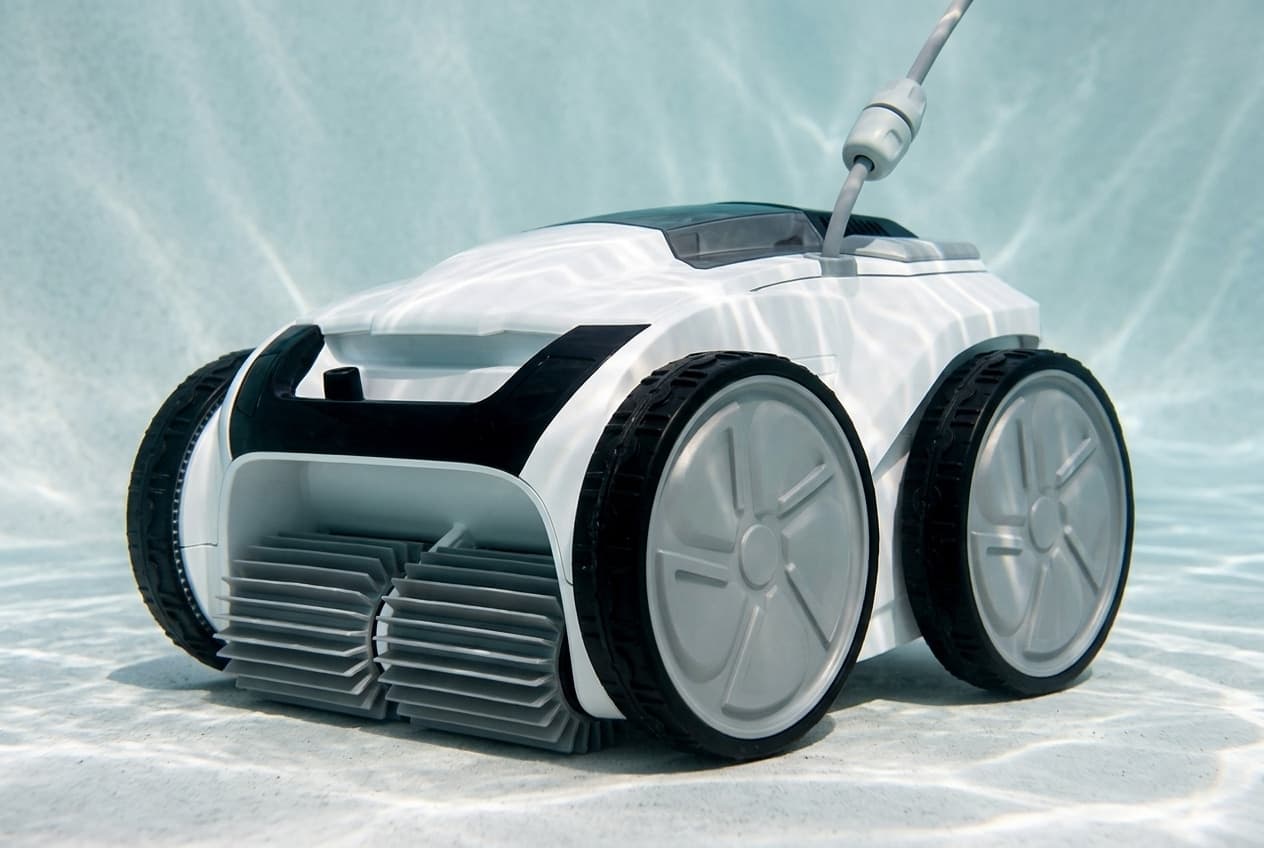
The VRX iQ+ is Polaris's corded robot for in-ground pools, run from the iAquaLink app and a control box on the deck. It pulls a 70-foot floating cable with a tangle-reducing swivel, and Polaris's own product artwork puts it at pools up to 60 feet. Its specification table gives no pool size at all.
VRX iQ+ or ALPHA iQ+
Polaris sells what looks like the same robot twice. The ALPHA iQ+, FALPHAIQP, shares the VRX iQ+'s owner's manual, and Polaris's two brochures are nearly identical, down to the specification table. The two product pages list the same 5-liter illuminated canister, 70-foot cable, front brushes with 4WD, caddy and in-app scheduling, and differ only in how they name the cleaning modes.
The difference is where you can buy it. The ALPHA iQ+ is on the Trade Series Exclusive list in Fluidra's 2026 catalog, and that policy bars dealers from selling it on the internet. The VRX iQ+ is not on the list, and it is the one sold online.
The warranty does not change. Polaris's warranty statement gives robotic cleaners two years and says nothing about where they were bought.
Where the cable goes in
Most tangling starts at setup, and the manual is specific about the fix.
- Enter near the middle of the pool's length. Spread the cable across the deck to that point, not from a corner.
- Put in only enough cable to reach the farthest point of the pool. Leave the rest on the deck. Polaris's troubleshooting lists too much cable in the water as the first cause of excessive tangling.
- Keep the control box at least 5 feet from the pool's edge, plugged straight into a GFCI outlet, with no extension cord. It is water-resistant, not waterproof, so never leave it out in bad weather.
- Put it near the router if you can. The box is what connects to Wi-Fi, and one of Polaris's answers to a flashing Wi-Fi light is moving the box closer to the router.
If the cable does tangle, take the cleaner out, unplug it, and untangle it starting at the cleaner head. Then lay the cable in the sun to take the memory out of it.
Putting it in the water
At the entry point, submerge the cleaner and hold it vertical until the trapped air is out, then let it sink to the floor. It must never be switched on out of the water: the manual says doing so may void the warranty and badly damage the motors.
If a cycle starts while the cleaner is not submerged, a safety feature stops it. On pools with a beach entry, it drives the cleaner back into the water when the impeller comes out.
The modes, and how long each runs
Four modes are on the control box, with the run times Polaris sets:
- Waterline: 45 minutes, waterline only.
- Quick Clean: 1 hour 15 minutes, floor only.
- SMART Cycle: floor, walls and waterline, for a time the cleaner calculates. This is the factory default.
- Deep Clean: 2 hours 45 minutes, floor, walls and waterline at high intensity.
The first SMART Cycle runs 2 hours 30 minutes while it works out the best time for your pool, then saves that time for later cycles. Polaris says it weighs the pool's shape, size and surface. To make it recalculate, hold the Start/Stop button for five seconds.
The app adds Custom mode, where you choose the surface and the intensity. Polaris's brochure counts seven cleaning modes in all.
Two things surprise people. For about the first ten minutes of every cycle the robot is confirming the pool's dimensions and will not climb to the waterline. And you can change any cycle in 15-minute steps, but never below 30 minutes or above 3 hours 30 minutes.
Schedules are set in the app, one cycle per day. Polaris still says to take the canister out and clean it after every cycle.
Getting it out, every time
The manual is blunt: take the cleaner out at the end of every cycle, and do not leave it in the pool permanently. Take it out, too, whenever you super chlorinate or add acid.
The Lift System does the hard part. From the control box or the app, turn the cleaner to face the wall you want, and it drives up that wall and waits at the waterline. As you pull it out by the handle, it pushes the water out so it comes out lighter. Never lift it by the floating cable or the swivel.
Cleaning the canister
After every cycle:
- Let the cleaner drain, and set it on its four wheels.
- Press the cover lock and lift the cover until it stays upright.
- Lift out the filter canister assembly, press the quick release button and open it.
- Separate the canister from the filter support, empty it, and hose off the canister, the support and the cleaner.
Every so often, scrub the canister with soapy water and a soft brush. Store the cleaner on its caddy, out of direct sun, and never clean it with solvents.
The parts that wear
The manual gives owners two jobs, and both parts are ones Polaris's warranty does not cover.
- Brushes. They are PVC with a wear indicator. Replace them as soon as any one indicator is reached, even if the wear is uneven, or every two years, whichever comes first. When fitting a new one, cut the tabs ¾ inch from the heel so they sit no higher than the blade.
- Tires. Worn treads are a named cause of a cleaner that will not climb walls. Fit each new tire with the word INSIDE facing the body.
Everything past that, the manual sends to a service provider, though Fluidra's catalog lists every part by number.
When it is not cleaning properly
- Will not climb walls. A full or dirty canister, worn tire treads, or water chemistry. Clean the canister first.
- Not cleaning well. The canister, worn brushes, or a badly tangled cable.
- Floating, or not staying down. Air trapped inside, or a full canister. Take it out and submerge it again, vertically.
- Not moving. Check the outlet has power and a cycle is actually running. Otherwise, unplug it for 20 seconds and reconnect.
The control box and the app show numbered errors:
- 1, 2 and 3 — pump motor, right and left traction motors. Check the cable connection for corrosion or bent pins, then turn each wheel a quarter turn at a time until it spins smoothly, and repeat in the other direction.
- 4 — pump motor consumption. Look for small debris or hair in the impeller, and clean the canister.
- 5 and 6 — drive motor consumption, right and left. Clean the canister, then submerge the cleaner again and shake out the air.
- 7 and 8 — floating, or out of the water. Switch off and submerge it properly.
- 9 is not an error. The cycle has finished.
- 10 — communication. Switch the power off and on, and check the cable connection for corrosion or bent pins.
- 11 — sensor unit. A service station replaces it.
For errors 1 to 6 and 10, the manual's last step is a diagnostic review at your retailer.
Where Polaris's documents fall short
- Pool size. The "up to 60 feet" appears in Polaris's product artwork, not in the specification table, the brochure or the manual.
- Cable length. The manual covers five models and gives the cable as 60 or 70 feet depending on model. The VRX iQ+ page and brochure both say 70.
- Cleaning modes. The brochure counts seven. The specification table names five, and the manual shows four on the control box plus Custom in the app.
- The parts list. The manual says it's on the Polaris website, and Polaris's parts page for this cleaner wouldn't load for this check. The list below is from Fluidra's catalog instead, dated 2020, so confirm any number against your serial number with a dealer.
What the two years cover
Two years, and the same wherever you bought it. But on a robot the parts that wear are most of what goes wrong, and brushes, rollers, tires and filter canisters are not warranted at all. Register the cleaner, keep the receipt, and the Polaris brand page has the rest of the terms.
The parts list is in Fluidra's catalog
Fluidra, Polaris's parent company, prints the VRX iQ+ parts table in its 2020 product catalog addendum, under part number FVRXIQP: an exploded view with 38 keys, including three canister options at key 9 and the transmission, bearings and gears at 14. The copy linked here is hosted by Leslie's.
That settles a question this page used to leave open. Fluidra's 2026 catalog prints a parts list for the ALPHA iQ+ that names a navy housing, where the VRX iQ+ is white. The VRX iQ+'s own table lists its main body housing, white (R0866000) and complete cover, white and black (R0866100), so the two robots don't share that part, whatever they share inside.
The table is six years old. Parts get superseded, so give a dealer the serial number from the robot head when you order.
Which model do you have?
The model number is on the cleaner label. Everything else in the range is shared — these are the parts that change with it.
| Model | SKU | Note |
|---|---|---|
| VRX iQ+ | FVRXIQP | The unit is designated TYPE EC27 and shares one owner's manual with the ALPHA iQ+, ALPHA iQ, VRX iQ and PHENOM iQ+. The serial number is on the robot head. In the box: the cleaner with its floating cable, the control box, and the transport caddy. |
Polaris VRX iQ+ parts, and what goes wrong
Read off the manufacturer’s parts list and checked before it ships. Open a row for what a bad one actually does — or start from the symptom and work down, which is the cheaper order.
What is it doing?
The brushes are PVC with a wear indicator. The manual says to replace them as soon as any one indicator is reached, even if the wear is uneven, or every two years, whichever comes first. When fitting a new brush, cut the tabs 3/4 inch from the heel so they sit no higher than the blade. Polaris's warranty doesn't cover brushes.
Live pricing arrives when the retailer programs are approved.
Worn treads are one of the manual's named causes of a cleaner that won't climb, after a full or dirty canister, which it says to check first. Fit each new tire with the word INSIDE facing the body. Tires are sold singly and the cleaner takes four. The warranty doesn't cover them.
Live pricing arrives when the retailer programs are approved.
A full or dirty canister is the first cause the manual gives for both. Polaris says to take it out and clean it after every cycle, and scrub it now and then with soapy water and a soft brush. For a floating cleaner, take it out and submerge it again vertically to clear trapped air. The fine canister, R0517800, and ultra fine sand and silt canister, R0535800, are the optional alternatives.
Live pricing arrives when the retailer programs are approved.
The manual says to look for small debris or hair in the impeller, which Fluidra's parts table calls the propeller, and to clean the canister.
Live pricing arrives when the retailer programs are approved.
For errors 1 to 3 and 10, the manual says to check the cable connection for corrosion or bent pins. A badly tangled cable is also one of its causes of poor cleaning. If the errors persist, its last step is a diagnostic review at your retailer.
Live pricing arrives when the retailer programs are approved.
The manual says a service station replaces the sensor unit. Fluidra lists it as this assembly.
Live pricing arrives when the retailer programs are approved.
Polaris VRX iQ+ manuals and documentation
Hosted by the manufacturer. These open on Polaris’s own servers, so they stay current.
- Fluidra 2020 product catalog addendum, VRX iQ+ parts tablediagram
- VRX iQ+ product page — FVRXIQP specification tablespec
- Owner's manual, PHENOM, ALPHA and VRX robots (H0800400 Rev. A)manual
- Quick start guide (H0800500 Rev. A)guide
- VRX iQ+ brochure (4834_SL)spec
- ALPHA iQ+ product page — the pool-store twinspec
- Polaris limited warranty (H0355004 Rev. N)spec
Polaris VRX iQ+ warranty
2 years parts
Polaris's current warranty statement gives its robotic pool cleaners two years from retail purchase, against one year for most of the range, and it makes no distinction by where the cleaner was bought. What it takes away matters more on a robot than on anything else Polaris sells: brushes, rollers, tires, filter canisters and filter trays are named as wear items and are not warranted at all, and purchased replacement parts get ninety days. Coverage is for the first retail purchaser in the fifty states and Canada, is not transferable, and excludes labor and shipping. A claim goes through the original dealer with proof of purchase and the serial number from the robot head. The manual adds that switching the cleaner on out of the water may void the warranty, and that beyond routine cleaning and maintenance it must be serviced by a qualified professional. Pattern wear and abrasion on vinyl liners is excluded outright.
Manufacturer’s termsPolaris VRX iQ+ complete parts list
Every part on the manufacturer’s exploded diagram, in their numbering. Marked rows are the ones covered above with a symptom and a diagnosis.
41 parts
| No. | Part | Description | Note |
|---|---|---|---|
| 1 | R0866000 | Main body housing, white | |
| 2 | R0865400 | Motor block, type 2 | |
| 3 | R0567800 | Motor block shaft pin | 5-pack; 1 in the cleaner |
| 4 | R0518800 | Drive gear | 2-pack; 2 in the cleaner |
| 5 | R0517000 | Propeller what goes wrong | |
| 6 | R0517500 | Flow outlet | |
| 7 | R0517600 | Motor screen | |
| 8 | R0865100 | Filter canister inlet housing | |
| 9 | R0535900 | General purpose canister what goes wrong | Comes standard |
| 9 | R0517800 | Fine filter canister | Optional; not in the box |
| 9 | R0535800 | Ultra fine sand/silt canister | Optional; not in the box |
| 10 | R0865200 | Float | |
| 11 | R0866300 | Handle with window, black | |
| 12 | R0516700 | Screw 12 mm | 5-pack; 24 in the cleaner |
| 13 | R0518500 | Wheel bushing | One set for one wheel; 4 in the cleaner |
| 14 | R0517200 | Transmission kit | 4 in the cleaner |
| 14A | R0639100 | Outer bearing | 2-pack; 6 in the cleaner |
| 14B | R0639000 | 17-point gear | 2-pack; 4 in the cleaner |
| 15 | R0540300 | Wheel covers | 2 in the cleaner |
| 16 | R0517400 | Roller kit | 2-pack; 2 in the cleaner |
| 17 | R0518701 | Roller support, white | |
| 18 | R0528900 | Brush what goes wrong | 2-pack; 2 in the cleaner |
| 19 | R0864900 | Roller | 2-pack; 2 in the cleaner |
| 20 | R0529300 | Tire, black what goes wrong | Sold singly; 4 in the cleaner |
| 21 | R0866200 | Wheel, silver | Sold singly; 4 in the cleaner |
| 22 | R0564800 | Caddy base | |
| 23 | R0565200 | Caddy tube | |
| 24 | R0564900 | Caddy accessories | |
| 25 | R0565100 | Caddy wheel kit | 2-pack |
| 26 | R0565000 | Caddy handle | |
| 27 | R0567900 | Floating cable clamp | 5-pack; 1 in the cleaner |
| 28 | R0565600 | Floating cable plug | |
| 30 | R0726700 | Swivel floating cable kit, 21 m what goes wrong | The table has no key 29 |
| 31 | R0866500 | Control box, type 1 | |
| 32 | R0800500 | Control box connector cap | |
| 33 | R0866100 | Complete cover, white and black | |
| 34 | R0863200 | Rear float assembly | |
| 35 | R0866400 | Polaris latch | |
| 36 | R0608500 | Screw M4 x 16 mm | 5-pack; 2 in the cleaner |
| 37 | R0609100 | Complete caddy kit | |
| 38 | R0863300 | Sensor block assembly what goes wrong |
Buy the cleaner
One retailer for now. More get added here as their programs are approved, and this becomes a comparison rather than a link.