Hayward · SharkVac
Hayward SharkVac and SharkVac XL
Hayward's in-ground robot with a filter that lifts out of the top: SharkVac or XL, what looks like a fault but isn't, the manual's fixes and all 52 parts.
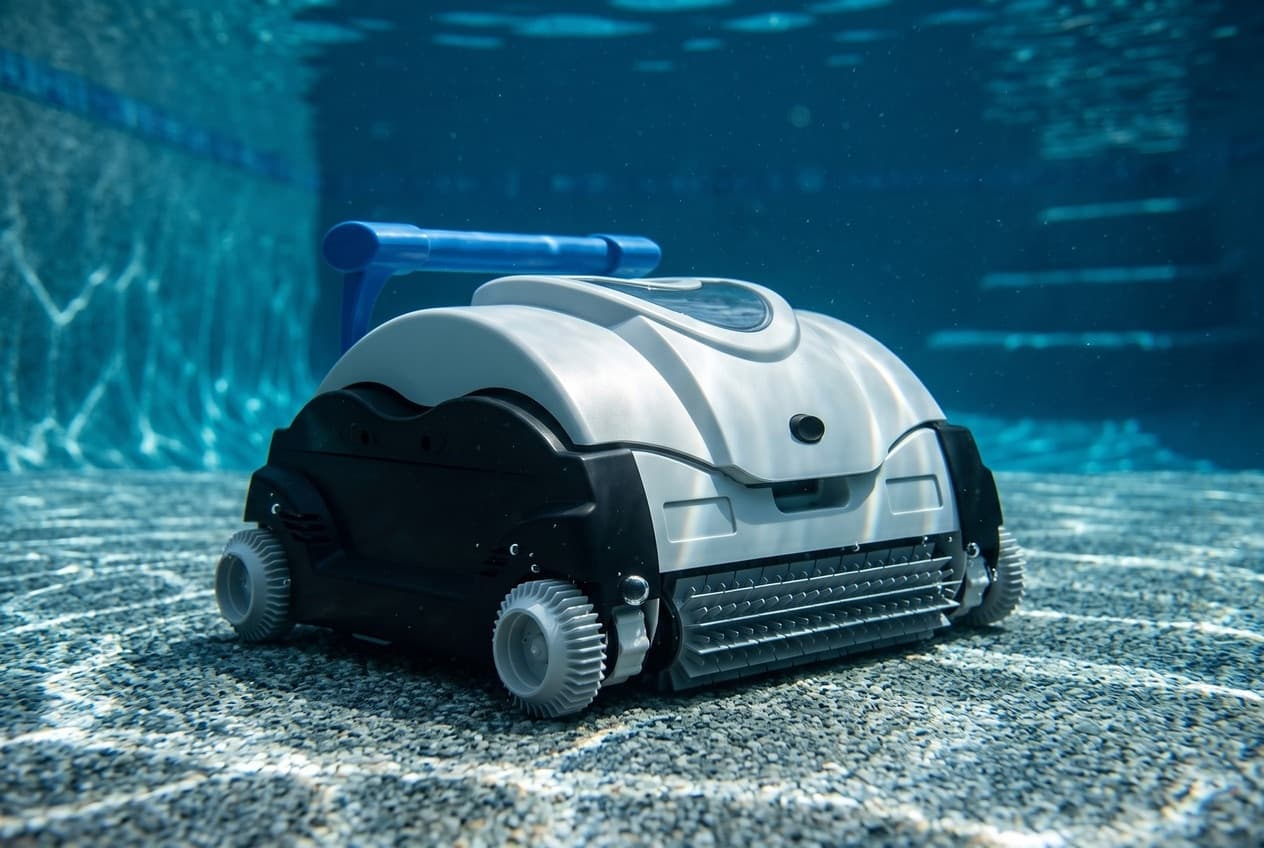
The SharkVac and SharkVac XL are Hayward's corded robots for in-ground pools up to 20 by 40 feet. Their filter is a bucket that lifts out of the top, so you never turn the cleaner over to empty it. The SharkVac cleans the floor and coves in 2 hours. The XL adds the walls and waterline and runs for 3. Both carry three years parts and three years in-store labor when bought through a dealer.
SharkVac or SharkVac XL
The difference is how much of the pool it cleans:
- SharkVac, RC9740CUB: the floor and coves, in one 2-hour cycle. The manual says it may go to a wall without climbing all the way up, and that's normal. It isn't built to scrub walls.
- SharkVac XL, RC9740WCCUB: the floor, walls, coves and waterline, in 3 hours. It adds an out-of-water sensor, which protects the motor by keeping the cleaner from running out of the water, and a beach-entry sensor, which reverses it when it starts climbing out of the water. Its dome carries a float, RCX97477.
Each has its own motor assembly, dome, handle and side panels. The filter, drive track, roller brush, impeller, cord and power supply are the same parts.
RC9742CUBY and RC9742WCCUBY are the same two cleaners with Hayward's caddy cart, RC97385D, in the box. The cart is sold separately for the others. Hayward's site also lists Open Line versions for the US, W3RC9742CUBY and W3RC9740WCCUB, with shorter coverage.
Hayward Support says there's no app for the XL.
The pools it's for
In-ground pools only. Asked twice whether it would work in an above-ground pool, Hayward Support said no, and that it could damage the liner. The sell sheet rates both for pools up to 20 by 40 feet, in gunite, vinyl, fiberglass, pebble or tile. On tile, it says the cleaner may need the foam roller.
Hayward Support told one owner that where the floor meets the wall at a sharp 90 degrees, with no curve, most cleaners will struggle to climb. That matters for the XL.
The manual puts the best water temperature between 50°F and 95°F.
Setting it up
From the owner's manual:
- Plug the power supply into a protected outlet, never through an extension cord. The sell sheet rates the supply at 115 volts, 60 Hz. The manual Hayward links is its European edition, and it asks for 230 volts and a 30 mA residual-current device.
- Place the power supply at least 3.5 meters, about 11.5 feet, from the pool's edge.
- Plug the floating cord into the power supply. Use only Hayward's original supply.
- Put the cleaner in the pool. It sinks slowly as the air inside it escapes.
- Switch the power supply on. The cleaner runs a self-test for several minutes before it starts cleaning. The manual also says it spends the first 10 minutes of every run working out the pool's size and shape, and its programmed cycle doesn't begin until after that.
Never switch it on out of the water. The manual says that can damage the pump and drive motor seals and void the warranty. Nobody should be in the pool while it runs.
Run a full cycle the first time. The manual says that gives you a clean pool and a sense of what the cleaner can do, and that later runs may need less than a full cycle. It switches itself off at the end. For a second cycle, switch the power supply off for 10 seconds, then back on.
What looks like a fault but isn't
The manual lists behavior that's part of the program:
- Stopping in the middle of the pool and reversing.
- Going to a wall without climbing all the way up it, on the SharkVac.
- Riding up a wall for a short time, to change position and cover the floor.
- Lifting its handle end off the floor to clear an obstacle, like a raised main drain or a stair step.
- Sitting on a high main drain for a while. The manual says the program frees it in the end. Hayward Support says there's no guarantee it won't get stuck on a drain.
The manual's advice is to judge it by how clean the pool is after a complete cycle, not by watching where it goes. If it covers only a small area, clean the filter and check it isn't catching on drains, floor cleaning heads or toys. Then try starting it somewhere else in the pool.
Taking it out
Switch the power supply off first. Pull the cord from the shallow end until the cleaner reaches the surface, then lift it out by the handle, never by the cord. Pull the cord in hand over hand. The manual says not to wind it around your arm, and not to drag the cleaner up against the pool wall.
If you can see a lot of debris through the dome windows, take the cleaner out quickly. Otherwise some of it can escape back into the pool.
Take it out after every use. The manual says that's safer for swimmers and better for the cleaner, and that leaving it in the pool permanently may mean more service.
Cleaning the filter
After every use. Unplug the power supply. Press the lid button on the front and lift the dome. Lift the filter bucket straight out with both hands, turn it over to dump the debris, and rinse it with a garden hose. The cartridges can stay in for that.
For a deeper clean:
- Unsnap both filter door latches and pull out the two cartridges.
- Hose each cartridge with a spray nozzle, holding it so the debris falls out. Wash the bucket too.
- Put the cartridges back with the center frame reinforcements facing in, and snap the doors shut.
- Set the bucket back in the right way round, using the manual's diagram for front and back.
- Close the dome and press the lid button to latch it.
A filter cleaning solution will shift dirt and sand. The manual says to clean the filter more often in water high in calcium, and not to run the cleaner until any chemical powder has fully dissolved. The cartridges are pleated, in a cellulose and polyester blend. For leaves and heavier debris, Hayward sells spring clean-up cartridges, RCX70103PAK2.
Hayward doesn't publish a micron rating or a flow rate. An owner asked Hayward Support for both, and the reply was that someone would be in touch.
Keeping the moving parts clean
Unplug the power supply first. Then:
- Look into the venturi for hair or debris clogging the impeller, and spray the impeller clean with a hose.
- Clear anything caught between the tracks and the wheels.
- Replace worn brushes.
There are three intake ports, at the bottom of the filter bucket near the brush roller. For sand and other fine debris, the manual says a "high velocity flapper" at an intake port gives stronger suction. Neither SharkVac parts list shows one.
When it isn't cleaning properly
The manual's answers, condensed:
- Leaves fine or heavy debris behind: clean the filter, which may be clogged.
- Starts, then stops: the impeller may be clogged or jammed, or the brush roller or drive track may be stuck on debris. Clean them.
- Debris falls back out as it comes out of the pool: the filter may be overloaded, so clean it more often. Make sure nothing large is blocking an intake, and take large debris out of the pool before a run. If a drain flap is stuck open with sand or leaves, clean it and snap it back into place.
- Cord twisted: it twists when the cleaner gets stuck on something like a toy, a rock or a drain. Lay it out full length in the sun, and the heat helps it untwist.
The motor unit and the power supply have no parts an owner can use, and the manual says opening either voids the warranty. The manual has no checks for a cleaner that won't start at all. Hayward Support sends owners with one, or with a cleaner that stops after a few feet, to a Hayward Authorized Service Center. When a robotic cleaner stops working goes through the diagnosis in order.
Off-season storage
Out of the water, somewhere dry and shaded, between 39°F and 115°F. Hayward doesn't make a cover for it, Hayward Support says; keep it out of direct sun to limit UV damage. The manual suggests keeping the box, for storage or for sending it in for repair.
What it shares with the TigerShark
The SharkVac's parts list has many numbers in common with the TigerShark's, Hayward's older tracked robot:
- the power supply, RCX97453, which the TigerShark's list names as the supply for the standard TigerShark
- the floating cord, RCX50061
- the filter cartridges, RCX70101PAK2, and the spring clean-up cartridges
- the roller brush, RCX26008
- the impeller, RCX11000, and the drive pin, RCX40117
- the pulley bearings, RCX26000PAK2
- the motor cord seal kit, RCX59004KIT
The rest differs. The TigerShark runs 4 hours, climbs the walls, and its filter comes out from underneath.
Warranty and where to buy
The Expert Line RC9740CUB, RC9742CUBY, RC9740WCCUB and RC9742WCCUBY are sold through pool dealers, with three years parts and three years in-store labor. Hayward's 2026 Expert Line terms give robotic cleaners in in-ground pools three years and exclude the filters. In-store labor means taking the cleaner to a Hayward dealer.
The Open Line W3RC9742CUBY and W3RC9740WCCUB get one year parts and no labor, like every Open Line product.
A motor or power supply bought on its own carries one year parts. Plastic cleaner parts bought on their own get six months. Hayward's warranty applies only to products bought from Hayward or an authorized seller, so keep the receipt.
Where Hayward's documents disagree, or are unclear
- The manual itself. Both US product pages link the same manual, and it's Hayward's European multilingual edition. It specifies 230 volts and a 30 mA residual-current device, and prints a two-year European warranty. The sell sheet gives 115 volts, 60 Hz, and the product pages give three years. The page above uses the US figures.
- The XL. The manual covers only the 2-hour SharkVac. Nothing in it describes the XL's 3-hour cycle, its sensors or its wall cleaning. What the page says about the XL comes from the sell sheet, the product pages and the parts list.
- Cord length. The sell sheet says 55 feet. The manual says 15.24 meters, which is 50 feet, and the SharkVac parts list calls cord RCX50061 50 feet. The TigerShark's parts list calls the same number 55 feet.
- An XL cord. Hayward Support gave one XL owner RCX97413 as the cord. Neither parts list shows that number.
- Filter door elements. The parts lists give RCX97417SPAK2 for the pair. Hayward Support has given owners RCX97417PAK2 and RCX97417, and RCX97417 is the filter door itself on the parts list.
- Foam roller. The sell sheet gives RCX26011WCE for the foam roller that tile may need. Neither SharkVac parts list shows a foam roller, and the TigerShark's diagram lists its foam roller as RCX26012.
- Size. Hayward's dimension sheets print 29.9 x 17.7 x 24.6 inches over a picture of the cleaner. Those are the shipping dimensions on the product pages, and close to the manual's carton, 620 by 440 by 752 millimeters. Hayward publishes no size for the cleaner itself, so none is given here.
- Power supply parts. The manual says the power supply has no parts an owner can use, and Hayward Support says the control box isn't serviceable. The SharkVac parts list still sells its switch, switch cover, breaker and output connector.
Which model do you have?
The model number is on the cleaner label. Everything else in the range is shared — these are the parts that change with it.
| Model | SKU | Cleans | Cleaning cycle | Motor assembly | Dome assembly | Handle | Side panel | Float | Note |
|---|---|---|---|---|---|---|---|---|---|
| SharkVac | RC9740CUB | Floor and coves | 2 hours | RCX97400 | RCX97418-237 | RCX97425-234 | RCX97403-236 | — | Cleans the floor and coves in one 2-hour cycle, then switches itself off. Expert Line, sold through pool dealers. RC9742CUBY is the same cleaner with the caddy cart, and W3RC9742CUBY is that one's Open Line version. Hayward's site files a W3RC9740CUB under its Canadian catalog only. |
| SharkVac XL | RC9740WCCUB | Floor, walls, coves and waterline | 3 hours | RCX97490 | RCX97471SB-237 | RCX97480SB-234 | RCX97403XL-236 | RCX97477 | Adds the walls and the waterline, a 3-hour cycle, an out-of-water sensor, a beach-entry sensor and a float in the dome. Expert Line. RC9742WCCUBY adds the caddy cart, and W3RC9740WCCUB is the Open Line version. The owner's manual on both product pages covers only the 2-hour SharkVac. |
Hayward SharkVac and SharkVac XL parts, and what goes wrong
Read off the manufacturer’s parts list and checked before it ships. Open a row for what a bad one actually does — or start from the symptom and work down, which is the cheaper order.
What is it doing?
The manual's first fix for a cleaner that misses debris, and it says to clean them after every use. Press the lid button and lift the dome, lift the filter bucket out with both hands, turn it over to dump the debris and hose it. The cartridges don't need to come out for that. For a deeper clean, unsnap the two filter doors, pull the cartridges and hose each one. They go back with the center frame reinforcements facing in. The filter bucket is RCX97414, and the elements in the two filter doors are RCX97417SPAK2. For leaves, Hayward sells spring clean-up cartridges, RCX70103PAK2. These are the same cartridges the TigerShark uses.
Live pricing arrives when the retailer programs are approved.
The manual gives two causes: an overloaded filter, which means cleaning it more often, and drain flaps stuck open with sand or leaves. Clean around the flaps and snap them back into place. Hayward Support told one owner whose debris fell back into the pool that a drain flap may be damaged. The small flap is RCX97405.
Live pricing arrives when the retailer programs are approved.
The manual's first cause for a cleaner that runs for a moment and then stops is an impeller clogged or jammed with debris. Unplug the power supply, look into the venturi for hair and debris, and spray the impeller clean with a hose. A cleaner that drives around and collects nothing may have a pump that isn't working, Hayward Support told one owner, and that's a service center job.
Live pricing arrives when the retailer programs are approved.
The manual's other cause for a cleaner that starts and stops is a brush roller or drive track stuck on debris. Clear anything caught between the tracks and the wheels. Hayward Support says a broken track can be replaced, and that the XL has one drive belt. The drive bearing assembly is RCX97502GR and the pulley bearings come as a pair, RCX26000PAK2. Hayward Support told an owner who found ball bearings in the pool that they could be from the pulley bearings or the drive pulley.
Live pricing arrives when the retailer programs are approved.
Replacing worn brushes is on the manual's list of tips, and the TigerShark takes the same roller. On tile, the sell sheet says the cleaner may need the foam roller instead, and gives RCX26011WCE. Neither SharkVac parts list shows a foam roller. Hayward publishes no replacement interval.
Live pricing arrives when the retailer programs are approved.
With use the cord coils like a telephone cord. The manual's fix is to stretch it out in the sun, and to check it now and then for damage. A damaged cord has to be replaced by Hayward, its service agent or someone similarly qualified. Hayward Support told an owner with broken connectors that the motor-end connector is sold separately, as RCX59004KIT and RCX59006. It gave another RCX97413 as a cord for the XL, a number on neither parts list.
Live pricing arrives when the retailer programs are approved.
The manual gives no checks for a cleaner that won't start, and Hayward Support sends owners with one to a Hayward Authorized Service Center. The manual says the supply has no parts an owner can use, and that opening it voids the warranty. Hayward still lists its switch (RCX31012), the switch's membrane cover (RCX31012A), a 3 A breaker (RCX31013A) and the output connector (RCX31018). This is the same number as the standard TigerShark's supply. Bought on its own, a robotic cleaner power supply carries one year parts.
Live pricing arrives when the retailer programs are approved.
The manual says the sealed motor unit has no parts an owner can use, and that opening it voids the warranty. Past the filter, impeller and track checks, it's a job for a Hayward service center. This is the SharkVac's; the XL's is RCX97490. Bought on its own, a robotic cleaner motor carries one year parts.
Live pricing arrives when the retailer programs are approved.
Hayward SharkVac and SharkVac XL manuals and documentation
Hosted by the manufacturer. These open on Hayward’s own servers, so they stay current.
- Owner's manual, SharkVac (ISRC9740 Rev E), Hayward's European multilingual edition; English on pages 17 to 32manual
- SharkVac product page — specifications, the parts diagram and Hayward Support answersdiagram
- SharkVac XL product page — specifications, the parts diagram and Hayward Support answersdiagram
- RC9742CUBY product page, SharkVac with caddy cartspec
- RC9742WCCUBY product page, SharkVac XL with caddy cartspec
- W3RC9742CUBY product page, Open Linespec
- W3RC9740WCCUB product page, Open Linespec
- SharkVac series sell sheet (LITSVSSS24, 2024)spec
- SharkVac accessories: caddy cart and spring clean-up filtersspec
- SharkVac dimension sheet, which gives the carton's sizespec
- Hayward 2026 Expert Line warranty termsspec
- Hayward 2026 Open Line warranty termsspec
Hayward SharkVac and SharkVac XL warranty
3 years parts, 3 years in-store labor
Three years parts and three years in-store labor on the Expert Line RC9740CUB, RC9742CUBY, RC9740WCCUB and RC9742WCCUBY, per their product pages and Hayward's 2026 Expert Line terms, which give robotic cleaners in in-ground pools three years and exclude the filters. In-store labor means taking the cleaner to a Hayward dealer, not a visit to your pool. The Open Line W3RC9742CUBY and W3RC9740WCCUB get one year parts and no labor. A robotic cleaner motor or power supply bought on its own gets one year parts; plastic cleaner parts bought on their own get six months. The two-year warranty printed in the manual is Hayward's European one.
Manufacturer’s termsHayward SharkVac and SharkVac XL complete parts list
Every part on the manufacturer’s exploded diagram, in their numbering. Marked rows are the ones covered above with a symptom and a diagnosis.
52 parts
| No. | Part | Description | Note |
|---|---|---|---|
| 1 | RCX97421 | Dome window, clear | View 1; SharkVac parts list only |
| 2 | RCX97470SB-237 | Dome, gray metallic | XL diagram, view 1; XL only |
| 3 | RCX341149 | Flat spring | View 1; both models |
| 4 | RCX97433 | Lid button | View 1; both models |
| 5 | RCX97423 | Dome bushing | View 1; both models |
| 5 | RCX97477 | Float assembly | XL diagram, view 1; XL only, part of its dome assembly |
| 47 | RCX97418-237 | Dome assembly, gray | View 1; SharkVac only; includes items 1 to 5 |
| 6 | RCX97471SB-237 | Dome assembly, gray | XL diagram, view 1; XL only; includes items 1 to 5 |
| 7 | RCX97417 | Filter door | View 1; both models |
| 7 | RCX97417SPAK2 | Filter door elements, set of 2 | View 1; both models |
| 8 | RCX97405 | Drain flap, small | View 1; both models |
| 9 | RCX97407 | Drain flap, large what goes wrong | View 1; both models |
| 48 | RCX97414 | Filter bucket assembly | View 1; both models; includes the filter doors and drain flaps |
| 50 | RCX70101PAK2 | Filter cartridges, set of 2 what goes wrong | View 1; both models |
| 50 | RCX70103PAK2 | Spring clean-up cartridges, set of 2 | View 1; for larger debris; the sell sheet offers them for both models |
| 36 | RCX40117 | Drive pin assembly | View 1; both models |
| 18 | RCX341142-236 | Base, black | View 2; SharkVac parts list only |
| 19 | RCX97425-234 | Handle assembly, blue | View 2; SharkVac only |
| 18 | RCX97480SB-234 | Handle assembly, blue | XL diagram, view 3; XL only |
| 20 | RCX97427 | Handle spring | View 2; both models |
| 22 | RCX97400 | Motor assembly what goes wrong | View 2; SharkVac only |
| 17 | RCX97490 | Motor assembly | XL diagram, view 4; XL only |
| 23 | RCX97455 | Vent tube | View 2; both models |
| 27 | RCX97461 | Screw, M5 x 35 mm | Views 2 to 4; both models; the XL list sells it in a set of 5 |
| 41 | RCX97459 | Screw, M7 x 10 mm, flat Torx, set of 5 | XL diagram, view 3; XL parts list only |
| 31 | RCX97429 | Hinge shaft, stainless steel | View 2; both models |
| 35 | RCX11000 | Impeller what goes wrong | View 2; both models |
| 32 | RCX97520ABK | Wheel tube, black | Views 2 and 3; both models |
| 49 | RCX97410 | Wheel tube assembly | View 3; both models |
| 33 | RCX26008 | Roller brush what goes wrong | View 2; both models |
| 16 | RCX97441 | Roller end | View 3; both models |
| 13 | RCX97435PAK2 | Roller shaft bushing kit, set of 2 | View 3; both models |
| 14 | RCX97506PAK2 | Roller bushing kit, set of 2 | View 3; both models |
| 17 | RCX97507PAK2 | Roller wheel shaft, set of 2 | View 4; both models |
| 12 | RCX97508GR | Wheel with tire | Views 3 and 4; both models |
| 46 | RCX97509PAK2 | Drive wheel kit, set of 2 | View 3; both models |
| 15 | RCX97505GR | Wheel drive belt | View 4; SharkVac parts list only |
| 36 | RCX97505PAK2 | Drive track wheel kit, set of 2 | XL diagram, view 5; XL parts list only |
| 34 | RCX97501GR | Drive track, soft tread what goes wrong | View 4; both models |
| 37 | RCX97502GR | Drive bearing assembly | Views 2 and 4; both models |
| 38 | RCX26000PAK2 | Pulley bearing kit, set of 2 | Views 2 and 4; both models |
| 24 | RCX97403-236 | Side panel, black | Views 3 and 4; SharkVac only |
| 19 | RCX97403XL-236 | Side panel, black | XL diagram, views 5 and 6; XL only |
| 45 | RCX12011 | Screw, M5 x 20, Torx T-20 | View 4; both models |
| 21 | RCX50061 | Floating cord assembly, 50 ft what goes wrong | View 5; both models; the TigerShark's parts list calls the same number 55 ft |
| 28 | RCX97453 | Power supply what goes wrong | View 5; both models |
| 44 | RCX59004KIT | Motor cord seal kit | View 5; both models |
| — | RCX59006 | Connector socket, Molex | Both models; listed with view 5 but not shown on the SharkVac's |
| — | RCX31012 | Power supply switch, 16 A | SharkVac parts list only; listed with view 5 but not shown on it |
| — | RCX31012A | Power supply switch membrane cover | SharkVac parts list only; listed with view 5 but not shown on it |
| — | RCX31013A | Power supply circuit breaker, 3 A | SharkVac parts list only; listed with view 5 but not shown on it |
| — | RCX31018 | Power supply output connector | SharkVac parts list only; listed with view 5 but not shown on it |