Hayward · TigerShark
Hayward TigerShark and TigerShark QC
Hayward's tracked robot for in-ground pools: TigerShark or QC, the handle trick for a twisting cable, the filter, the fixes in the manual, and all 45 parts.
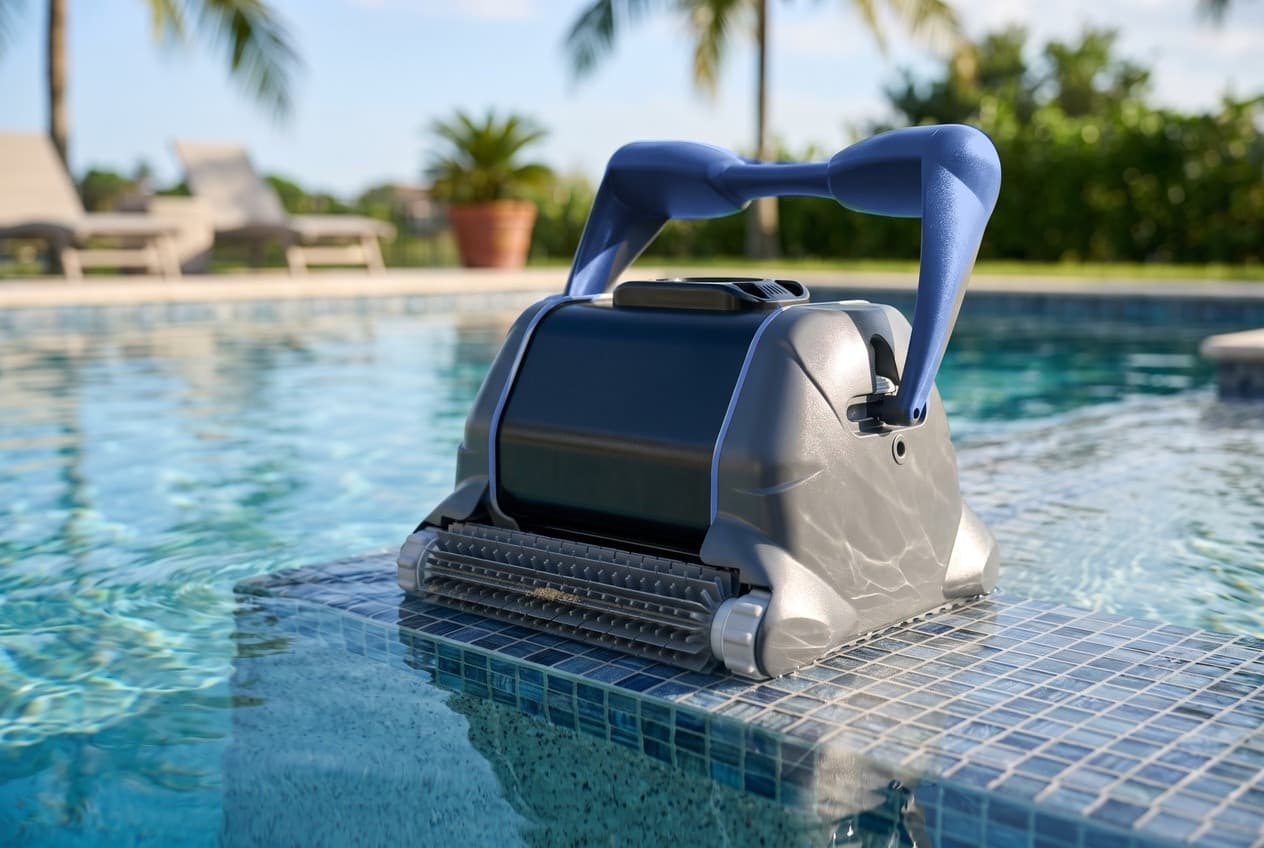
The TigerShark and TigerShark QC are Hayward's corded robots on tracks, for in-ground pools up to 20 by 40 feet. They share a body, a filter and a parts diagram. The QC adds a 90-minute Quick Clean to the 4-hour cycle both of them run. Both scrub and vacuum the floor, walls, coves and waterline, filter through a pleated cartridge you take out from underneath, and carry three years parts and three years in-store labor when bought through a dealer.
TigerShark or TigerShark QC
The difference is the cycle, and what it takes to change it:
- TigerShark, RC9950CUB: one 4-hour cycle, then it switches itself off. Switch it off sooner if the pool's clean.
- TigerShark QC, RC9990CUB: every time it's switched on, it starts a 90-minute Quick Clean, and the Quick Clean light on the power supply comes on. For the 4-hour program, press Full Cycle while the Quick Clean is running. The manual says that's the only time you can choose it. Once a Quick Clean has ended, switch off and back on to start again.
Each has its own power supply and motor unit: RCX97453 and RCX40000DC for the TigerShark, RCX97453QC and RCX43000 for the QC. Hayward Support says the supply is different for each version. The body, filter, tracks, brushes, handle and 55-foot cord are the same parts.
Hayward's site also lists an Open Line version of each, W3RC9950CUB and W3RC9990CUB, with shorter coverage.
The pools it's for
In-ground pools. Hayward's product pages say so, and the sell sheet rates both for pools up to 20 by 40 feet, in gunite, vinyl, fiberglass, pebble or tile.
On tile, the sell sheet says it may need the foam roller in place of the PVC brushes. The manual says the PVC brushes also stiffen in water below 59°F and lose grip on the walls. Foam is the fix there too.
The manual puts the best water temperature between 50°F and 95°F, and says the cleaner will still run outside that range.
Setting it up
From the owner's manual:
- Plug the power supply into a 110 to 120 volt outlet with ground-fault protection. The manual asks for a 30 mA residual-current device, the European rating. On a US pool, that protection is a GFCI outlet.
- Place the power supply at least 3.5 meters, about 11.5 feet, from the pool's edge, where the cleaner can reach every wall.
- Plug the floating cord into the power supply. Use only the original supply.
- Lock the handle on a diagonal. It steers the cleaner, and the section below explains why the diagonal matters.
- Put it in the pool. It sinks slowly as the air inside it escapes.
- Switch the power supply on. The cleaner runs a self-test for a few minutes before it starts cleaning.
Never switch it on out of the water. The manual says that can damage the pump and void the warranty. It also cuts out by itself if it's lifted out while running. Nobody should be in the pool while it runs.
To run a second cycle, wait 30 seconds after switching off before you switch on again.
Taking it out
Switch the power supply off first. Pull the cable from the shallow end until the cleaner reaches the surface, then lift it out by the handle, never the cable. The manual says to wind the cable around your hands as you pull, not around your arm, and to let the water drain out of the cleaner every time.
Can it stay in the pool? Hayward Support told a TigerShark QC owner it's best not to leave the cleaner in the pool constantly. That's stricter than Hayward's advice for its R110 and R130, which its FAQ says can stay in between runs.
The handle, and a cord that twists
The TigerShark's cord twists as it works, like a phone cord, and there's no swivel version, according to Hayward Support. The fix is the handle.
Locked on one diagonal, the handle turns the cleaner one way. Reverse it after every use, and the cleaner turns the other way next time and unwinds what it wound. The manual says to do that every single time. For a cord that's already twisted, lock the handle the other way for a run, or pull the cord out straight in the sun.
A tangled cord shortens the cleaner's reach, and it looks exactly like a robot that skips half the pool. Robotic cleaner maintenance covers the cable habits that stop it.
Cleaning the filter
After every use. Unplug the power supply. Lay the cleaner on its side, undo the fastenings on the bottom cover and lift the cover off. Take out the filter cartridge. If yours is in three parts, take each one out.
Hose each part clean with a spray nozzle, holding it so the dirt falls away. Wash the inside of the bottom cover too, then put the cartridge back and refit the cover.
The manual says to clean it more often in hard water, and not to run the cleaner until any granular chemicals have fully dissolved, because the powder clogs the filter. Hayward's cartridge is pleated, and the manual rates it at 5 microns. For leaves and heavier debris, Hayward sells spring clean-up cartridges, RCX70103PAK2.
While it's open, check the venturi tube for hair and debris, and clear anything caught between the tracks and the wheels. The venturi comes out with a twist.
When it isn't cleaning properly
The manual's answers, condensed:
- Won't climb the walls: clean the filter, which may be clogged or weighed down with debris or algaecide. Check the brushes for wear. Check the supply voltage. In water below 59°F, fit foam brushes. Make sure the handle is on a diagonal.
- Has lost suction: clean the filter. Check that the openings in the bottom cover aren't blocked, and check the venturi tube. Hayward sells a high-velocity inlet, RCX17000, that clips onto the bottom cover for better pickup of small or heavy debris.
- Stops suddenly while cleaning: clear the venturi tube, and clean any dirt from the brush and track bearings.
- Not working at all: reset the power supply's breaker by switching it off and on. The manual adds that the cleaner socket should read 24 volts across terminals 1 and 2, and to check the floating cord.
- Rattles, draws air or climbs past the waterline: the manual's cause is a cleaner riding too high on the wall, and its fix is the reducer kit. Check with a clean filter, over several cycles.
The motor unit and the power supply have no parts an owner can use, and the manual says opening either voids the warranty. Past those checks, it's a Hayward service center job. When a robotic cleaner stops working goes through the diagnosis in order.
Off-season storage
Out of the water, lay it on its side, somewhere dry and shaded, between 41°F and 115°F. The manual suggests keeping the box, for storage or for sending it in for repair.
Warranty and where to buy
The Expert Line RC9950CUB and RC9990CUB are sold through pool dealers, with three years parts and three years in-store labor. Hayward's 2026 Expert Line terms give robotic cleaners in in-ground pools three years and exclude the filters. In-store labor means taking the cleaner to a Hayward dealer. Hayward Support gave the same three and three to an owner in their third year.
The Open Line W3RC9950CUB and W3RC9990CUB get one year parts and no labor, like every Open Line product.
A motor unit or power supply bought on its own carries one year parts. Plastic cleaner parts bought on their own get six months. Hayward's warranty applies only to products bought from Hayward or an authorized seller, so keep the receipt.
The TigerShark Plus, and older numbers
The TigerShark Plus added a handheld remote for steering it around the pool. It's no longer on Hayward's cleaner listing, but its power supply (RCX30000RC), motor unit (RCX40000RC), cord (RCX50070) and remote (RCX40215) are all still on the diagram. Hayward Support says the remote won't work with a QC.
An older RC9990GR is an earlier QC number, and Hayward Support says its handle and filters are the RC9990CUB's parts.
The TigerShark 2, RC9956GR, is a different cleaner. Hayward lists it for commercial pools, on rollers rather than tracks, with a 100-foot cord. Only its cord, RCX50110, appears on this diagram.
Where Hayward's documents disagree, or are unclear
- Warranty. The owner's manual says 1 year for the standard cleaner and 3 years for the QC. The product pages, Hayward Support and Hayward's 2026 terms give both Expert Line models three years parts and three years in-store labor. The page above uses the current terms.
- Cord length. The sell sheet and dimension sheet say 55 feet, and the manual's specifications say 16.76 meters, which matches. Its setup steps say the standard cable is 18 meters, about 59 feet.
- Weight. The sell sheet and dimension sheet say 21.5 pounds. The manual says 21.
- Power supply output. The sell sheet says 24 V DC. The manual writes 24 V with the symbol for AC. The diagram names the motor units for DC units.
- Foam roller. The sell sheet gives RCX26011 for the foam roller tile may need. The parts diagram lists the foam roller assembly as RCX26012.
- Where to buy. The 2019 sell sheet says only from pool pros. Hayward now lists Open Line versions of both.
- Filter area. The manual's specifications give the filter an area of 64 cm², about 10 square inches. That can't describe a pleated cartridge this size, so it isn't used here.
- The manual itself. It's the bilingual owner's manual from Hayward's Canadian arm, in metric, and it covers the Plus. It's hosted on Hayward's own site, but neither product page links a manual at all.
Which model do you have?
The model number is on the cleaner label. Everything else in the range is shared — these are the parts that change with it.
| Model | SKU | Cleaning cycles | Power supply | Motor unit | Floating cord | Remote | Note |
|---|---|---|---|---|---|---|---|
| TigerShark | RC9950CUB | 4 hours | RCX97453 | RCX40000DC | RCX50061 | — | The standard model: one 4-hour cycle, then it switches itself off. Expert Line, sold through pool dealers. W3RC9950CUB is the Open Line version. Hayward's diagram doesn't name this model's motor unit. RCX40000DC, listed for DC units, is the one left once the Plus's and QC's are accounted for. |
| TigerShark QC | RC9990CUB | 90-minute Quick Clean, or 4 hours | RCX97453QC | RCX43000 | RCX50061 | — | Adds a 90-minute Quick Clean, which it selects every time it's switched on. Press Full Cycle during a Quick Clean for the 4-hour program. Expert Line; W3RC9990CUB is the Open Line version. Hayward Support says an older RC9990GR takes the same handle and filters. |
| TigerShark Plus | — | 4 hours, with remote steering | RCX30000RC | RCX40000RC | RCX50070 | RCX40215 | The version with a handheld remote. It's no longer on Hayward's cleaner listing, but its power supply, motor, cord and remote are still on the diagram. Hayward Support says the QC can't take the remote. |
Hayward TigerShark and TigerShark QC parts, and what goes wrong
Read off the manufacturer’s parts list and checked before it ships. Open a row for what a bad one actually does — or start from the symptom and work down, which is the cheaper order.
What is it doing?
The first fix the manual gives for both. Clean the cartridge after every use: lay the cleaner on its side, undo the bottom cover's fastenings, lift the cover off and take the cartridge out. Hose it from the outside in, holding it so the dirt falls away, and wash the inside of the cover too. The manual says algaecide can clog it, and to clean it more often in hard water. The frame with its filters is RCX70100. For leaves and other large debris, Hayward sells spring clean-up cartridges, RCX70103PAK2.
Live pricing arrives when the retailer programs are approved.
The venturi tube is where the pump pushes water out, and hair or debris in it cuts suction or stops the cleaner mid-cycle. Unplug the power supply first. The manual says to remove the tube by turning it, clear it, and replace it if it's damaged. RCX11208 is Hayward's new-style assembly; RCX11208BK is the black one.
Live pricing arrives when the retailer programs are approved.
Worn brushes are the manual's second cause of a cleaner that won't climb. It also says the PVC brushes stiffen in water below 59°F, and that foam brushes are the alternative. Hayward's diagram lists the foam roller assembly as RCX26012; its sell sheet gives RCX26011 for the foam roller that tile may need. Hayward publishes no replacement interval.
Live pricing arrives when the retailer programs are approved.
A cleaner that stops mid-cycle can have stuck track or brush bearings, and the manual's fix is to clean them. Clear the debris that builds up between the tracks and the wheels as part of regular care. The pulley bearings come as a pair, RCX26000PAK2.
Live pricing arrives when the retailer programs are approved.
The supply has a breaker that cuts out on a surge. Reset it by switching the supply off and back on. The manual adds that the output across terminals 1 and 2 of the cleaner socket should be 24 V. Hayward Support says each version has its own supply: this one for the standard TigerShark, RCX97453QC for the QC and RCX30000RC for the Plus. It also says there's no fuse to replace. The manual says opening the supply voids the warranty. Bought on its own, a robotic cleaner power supply carries one year parts.
Live pricing arrives when the retailer programs are approved.
The cord twists with use. The TigerShark's fix is its handle: lock it on the opposite diagonal and the cleaner turns the other way and unwinds the cord. The manual says to reverse the handle after every use. Pulling the cord straight in the sun helps too. Hayward Support says there's no swivel cord for the TigerShark. If the cord is damaged, the manual says it must be replaced by Hayward, its service agent or someone similarly qualified.
Live pricing arrives when the retailer programs are approved.
The same handle fits the TigerShark, Plus and QC. Hayward Support has given this number to more than one owner whose handle broke, and says an older RC9990GR takes it too. The handle's slide parts come as RCX14000KIT. Lift the cleaner out by the handle, never by the cord.
Live pricing arrives when the retailer programs are approved.
The manual says the motor unit has no parts an owner can use, and that opening it voids the warranty. Past the filter, venturi, bearings and power supply checks, it's a job for a Hayward service center. This is the QC's unit; the Plus's is RCX40000RC, and RCX40000DC is listed for DC units. Bought on its own, a robotic cleaner motor carries one year parts.
Live pricing arrives when the retailer programs are approved.
Hayward TigerShark and TigerShark QC manuals and documentation
Hosted by the manufacturer. These open on Hayward’s own servers, so they stay current.
- Robotic cleaner owner's manual, TigerShark, QC and Plus (ISRC9900EF Rev A)manual
- TigerShark product page — specifications, the parts diagram and Hayward Support answersdiagram
- TigerShark QC product page — specifications, the parts diagram and Hayward Support answersdiagram
- W3RC9950CUB product page, Open Linespec
- W3RC9990CUB product page, Open Linespec
- TigerShark series sell sheet (LITTGR19, 2019)spec
- TigerShark dimension sheetspec
- TigerShark accessories: caddy cart and spring clean-up filtersspec
- Hayward 2026 Expert Line warranty termsspec
- Hayward 2026 Open Line warranty termsspec
Hayward TigerShark and TigerShark QC warranty
3 years parts, 3 years in-store labor
Three years parts and three years in-store labor on the Expert Line RC9950CUB and RC9990CUB, per both product pages and Hayward's 2026 Expert Line terms, which give robotic cleaners in in-ground pools three years and exclude the filters. In-store labor means taking the cleaner to a Hayward dealer, not a visit to your pool. The Open Line W3RC9950CUB and W3RC9990CUB get one year parts and no labor. A robotic cleaner motor or power supply bought on its own gets one year parts; plastic cleaner parts bought on their own get six months. Hayward's warranty applies only to products bought from Hayward or an authorized seller.
Manufacturer’s termsHayward TigerShark and TigerShark QC complete parts list
Every part on the manufacturer’s exploded diagram, in their numbering. Marked rows are the ones covered above with a symptom and a diagnosis.
45 parts
| No. | Part | Description | Note |
|---|---|---|---|
| 5 | RCX76008-234 | Handle assembly, blue what goes wrong | Main case and handle diagram; TigerShark, Plus and QC |
| 6 | RCX14000KIT | Handle arm slide kit | Main case and handle diagram |
| 7 | RCX11208 | Venturi assembly, new style what goes wrong | Main case and handle diagram |
| 7 | RCX11208BK | Venturi assembly, black | Main case and handle diagram |
| 8 | RCX13001C | Main case | Main case and handle diagram; TigerShark, Plus and QC |
| 11 | RCX11400 | Lid clip | Main case and handle diagram |
| 1 | RCX97453 | Power supply, 115 V, standard TigerShark what goes wrong | Motor and power supply diagram |
| 1 | RCX97453QC | Power supply, 115 V, Quick Clean | Motor and power supply diagram |
| 1 | RCX30000RC | Power supply, 115 V, TigerShark Plus | Motor and power supply diagram |
| 2 | RCX31018 | Power supply output connector | Motor and power supply diagram |
| 3 | RCX31013A | Power supply circuit breaker, 3 A | Motor and power supply diagram |
| 4 | RCX31012 | Power supply switch, 16 A | Motor and power supply diagram |
| 4 | RCX31012A | Power supply switch membrane cover | Motor and power supply diagram |
| 9 | RCX50061 | Floating cord assembly, 55 ft what goes wrong | Motor and power supply diagram; TigerShark and QC |
| 9 | RCX50070 | Floating cord assembly, 55 ft | Motor and power supply diagram; TigerShark Plus |
| 9 | RCX50110 | Floating cord assembly, 100 ft | Motor and power supply diagram; TigerShark 2, a different cleaner |
| 10 | RCX59006 | Connector socket, Molex | Motor and power supply diagram |
| 12 | RCX12001 | Screw, M4 x 12, T-20 | Motor and power supply diagram |
| 13 | RCX40117 | Drive pin assembly | Motor and power supply diagram |
| 14 | RCX11000 | Impeller | Motor and power supply diagram |
| 15 | RCX40000DC | Motor unit, 4-hour, for DC units | Motor and power supply diagram |
| 15 | RCX40000RC | Motor unit, 4-hour, TigerShark Plus DC | Motor and power supply diagram |
| 15 | RCX43000 | Motor unit, 4-hour, TigerShark QC what goes wrong | Motor and power supply diagram |
| 16 | RCX59007 | Strain relief cover plate | Motor and power supply diagram |
| 17 | RCX59004KIT | Motor cord seal kit | Motor and power supply diagram |
| — | RCX40215 | Handheld wireless remote, 433 MHz, 2008 to present | Listed with the motor and power supply diagram but not shown on it; TigerShark Plus |
| 18 | RCX26001 | Roller bearing guide | Filter and drive train diagram |
| 19 | RCX70100 | Filter cartridge assembly, frame with filters | Filter and drive train diagram |
| 20 | RCX70101PAK2 | Filter cartridges, set of 2 what goes wrong | Filter and drive train diagram |
| 20 | RCX70103PAK2 | Spring clean-up cartridges, set of 2 | Filter and drive train diagram; for larger debris |
| 21 | RCX17100 | Drain flaps, set of 2 | Filter and drive train diagram |
| 22 | RCX26002 | Drive pulley bearing assembly | Filter and drive train diagram; includes insert RC260031 |
| 23 | RCX23002 | Drive track, soft tread what goes wrong | Filter and drive train diagram |
| 24 | RCX26000PAK2 | Pulley bearing kit, set of 2 | Filter and drive train diagram |
| 25 | RCX12011 | Screw, M5 x 20, T-20 | Filter and drive train diagram |
| 26 | RCX97201 | Side covers, right and left | Filter and drive train diagram |
| 27 | RCX75003KIT | Locking plate kit | Filter and drive train diagram |
| 28 | RCX75000-236 | Bottom lid assembly, black | Filter and drive train diagram |
| 28 | RCX75005 | Inlet flap | Filter and drive train diagram |
| 28 | RCX78005 | Bottom lid filter gasket | Filter and drive train diagram |
| 29 | RCX26005S | Wheel tube bearing, slotted | Filter and drive train diagram |
| 30 | RCX26003 | Wheel tube assembly, without brush | Filter and drive train diagram |
| 31 | RCX26008 | Roller brush what goes wrong | Filter and drive train diagram |
| 31 | RCX26012 | Foam roller assembly | Filter and drive train diagram; the sell sheet gives RCX26011 |
| — | RCX17000 | High-velocity inlet | Listed with the filter and drive train diagram but not shown on it |